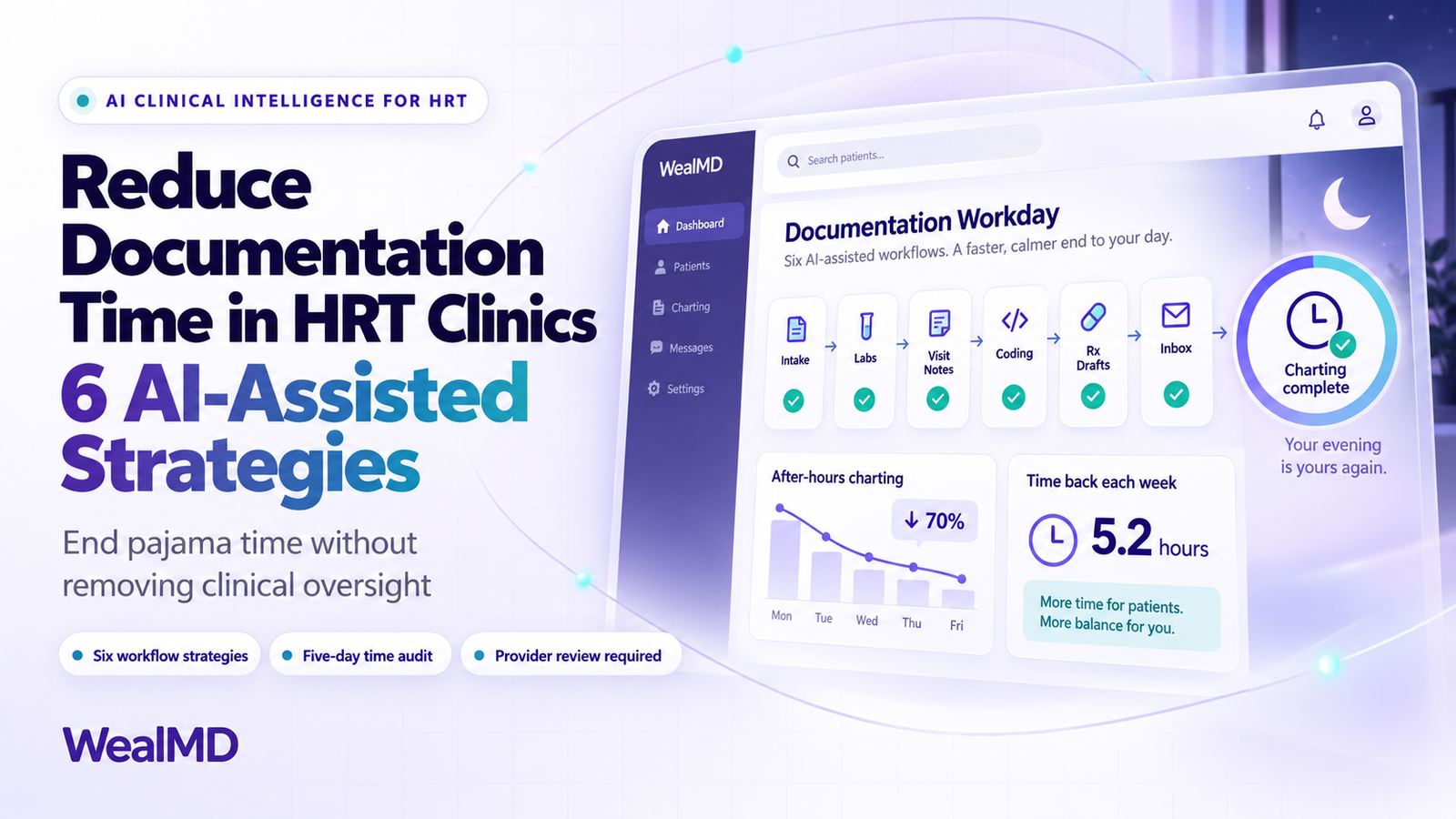
Reduce Documentation Time in HRT Clinics6 AI-Assisted Strategies to End Pajama Time
A practical, research-backed guide to cutting after-hours charting across intake, labs, visit notes, codes, prescriptions, and the inbox while keeping every clinical decision with the provider.
Most HRT clinicians trying to reduce documentation time are not losing the fight during the workday. They are losing it at 9:40 p.m., at the kitchen table, still charting for patients who left hours ago. Clinicians call this pajama time: after-hours EHR work, including notes, lab review, refills, and inbox tasks, that spills into evenings because the clinic day ran out first.
This guide shows where that time goes, why a faster visit note rarely fixes it alone, and six workflow strategies that can help.
- One event-log study found family physicians averaged about 1.4 hours of EHR work after clinic hours each weekday.
- A 2026 JAMA study associated AI scribe adoption with about 16 fewer documentation minutes per eight scheduled patient hours.
- The same JAMA study did not find a significant overall reduction in EHR time outside scheduled work hours.
The Real Cost of Pajama Time
The best-known measurement comes from a study of 142 family physicians using EHR event logs. The physicians spent 5.9 hours of an 11.4-hour workday in the EHR: 4.5 hours during clinic hours and 1.4 hours after. Clerical and administrative work, including documentation, order entry, and coding, took 44.2% of EHR time. Inbox management took another 23.7%. The visit note, in other words, was only one slice of the load.
The minute bars compare time during and after clinic. The percentage bars show the share of total EHR time spent on two task categories.
The problem has not disappeared. In American Medical Association survey data from more than 12,400 physician responses in 2023, 20.9% reported spending more than eight hours a week on the EHR outside normal working hours, the same share as in 2022. A 2026 survey of more than 9,000 family medicine residents also found that those averaging three or more after-hours EHR hours a night had about 1.6 times the odds of burnout.
These studies are not specific to hormone therapy, so the figures should be treated as context rather than an HRT-clinic benchmark. Their central lesson still travels well: after-hours work is spread across the chart, not concentrated in one note field.
Why HRT Visits Pile On More Documentation
Hormone therapy clinics add a recurring workload of their own. A single follow-up can touch structured intake, symptom scores, a current hormone panel, comparison with earlier results, a telehealth encounter, the visit note, a prescription workflow, diagnosis codes, follow-up orders, and a patient message.
The mix differs by clinic. TRT practices often lean on recurring labs and controlled-substance prescribing. Menopause and BHRT practices may carry more symptom history and, in some settings, procedure documentation. Cash-pay membership models create a steady cadence of repeat follow-ups, so the same bundle returns all day, every day.
History, symptoms, regimen, and changes arrive before the visit.
Current values are compared with prior panels and summarized.
The encounter becomes a structured draft for review.
Draft actions are checked, edited, and signed by authorized staff.
Messages, refills, orders, and next steps are closed.
Each stage is a place to save time. That is why the fix is a workflow, not a single tool.
Six Ways to Reduce Documentation Time in an HRT Clinic
Measure Your Own Pajama Time First
Before buying software, log one normal week. Every time you open a chart after hours, record the task and minutes spent. Many EMRs can provide audit or event-log data, but a simple tally is enough to reveal the biggest row. Your largest row becomes your first improvement project.
| Where the Minutes Go | Typical After-Hours Trigger | Your Minutes, Mon to Fri | First Fix |
|---|---|---|---|
| Finishing visit notes | Notes left open between visits | _____ | #4 |
| Lab review and summaries | Results land after the visit | _____ | #3 |
| Intake and history review | Forms are read cold at visit time | _____ | #2 |
| Codes and prescriptions | Tasks are batched at the end of the day | _____ | #5 |
| Inbox, refills, and messages | Portal traffic accumulates after close | _____ | #6 |
Move Data Collection Before the Visit
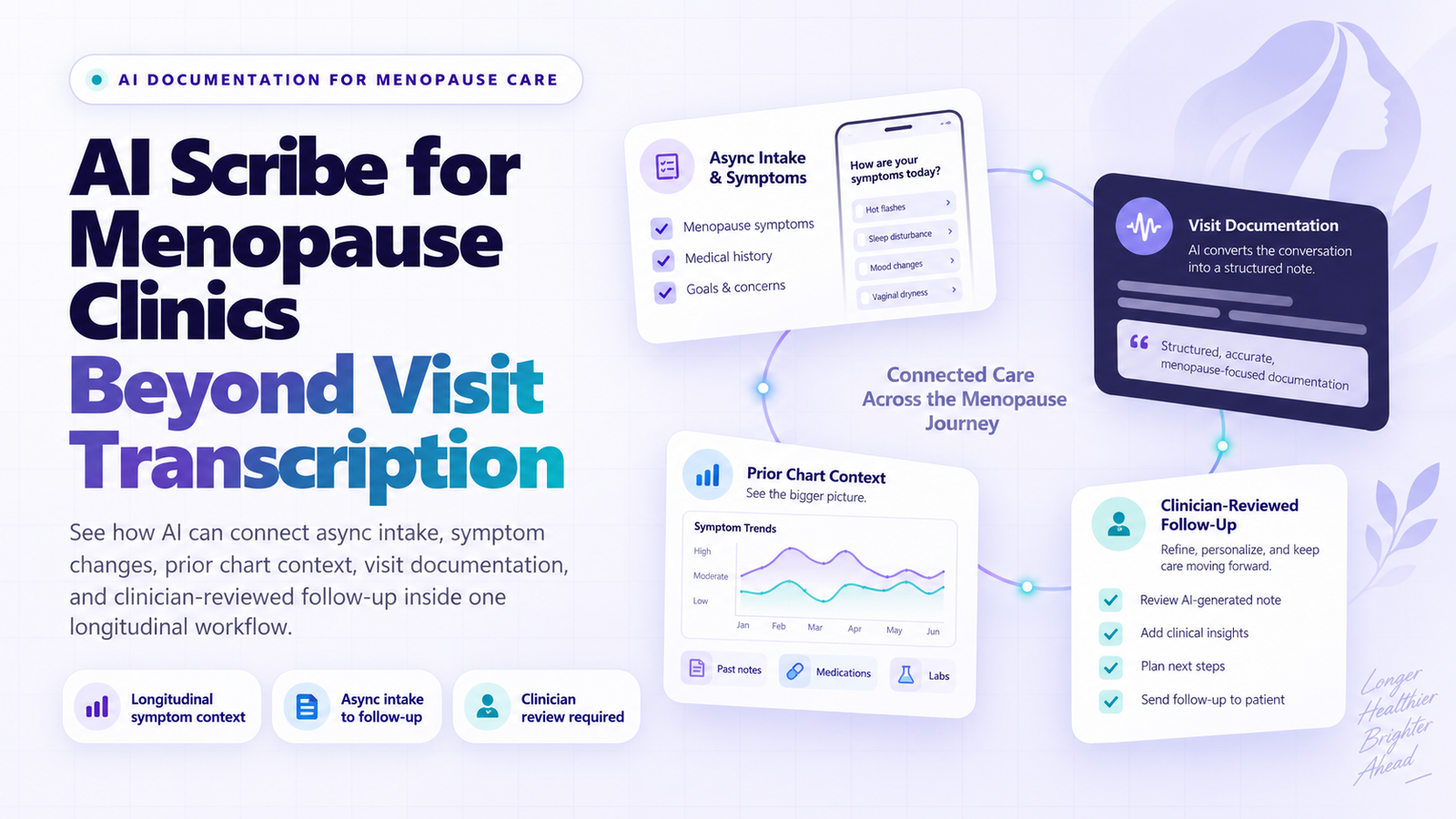
Structured async intake lets patients complete history and symptom scores before the appointment. The saving appears when the clinician opens a concise summary instead of reading raw forms, re-asking questions, and retyping the answers. For menopause care, that might include symptom scores and cycle history. For a TRT follow-up, it might include a symptom check-in and current regimen.
Use flags to surface changes or risk-relevant answers first, then let pre-populated fields give the note a useful starting structure.
Stop Re-Keying Lab Results
Copying hormone panel values into a note and comparing them with last quarter is clerical work. A lab-integrated workflow should pull structured results into the chart and place earlier values beside the new result. The clinician then reviews the trend and decides what it means instead of acting as a transcription layer.
When evaluating tools, ask whether results arrive as structured data or static PDFs and whether prior values are visible without opening several screens. See how AI-assisted lab interpretation for testosterone panels fits into a provider-reviewed workflow.
Draft the Note While the Visit Happens
This is where ambient AI scribes can help, but expectations need calibrating. A 2026 multisite JAMA study of 8,581 clinicians linked scribe adoption to 16 fewer minutes of documentation time and 13.4 fewer minutes of total EHR time per eight scheduled patient hours. EHR time outside work hours did not change significantly.
A randomized trial in NEJM AI was similarly restrained. Estimated note-writing time fell by 23 to 41 seconds with the two scribes tested, compared with 18 seconds in the control group. These tools can produce useful drafts, but they do not automatically close the rest of the chart.
Give a pilot a fair test across eligible visits, define recording and consent procedures for every state where you practice, and measure edits as well as draft speed. For a closer look, compare an AI EHR with a standalone AI scribe and review the AI SOAP note workflow for HRT visits.
Automate Chart Work After the Note
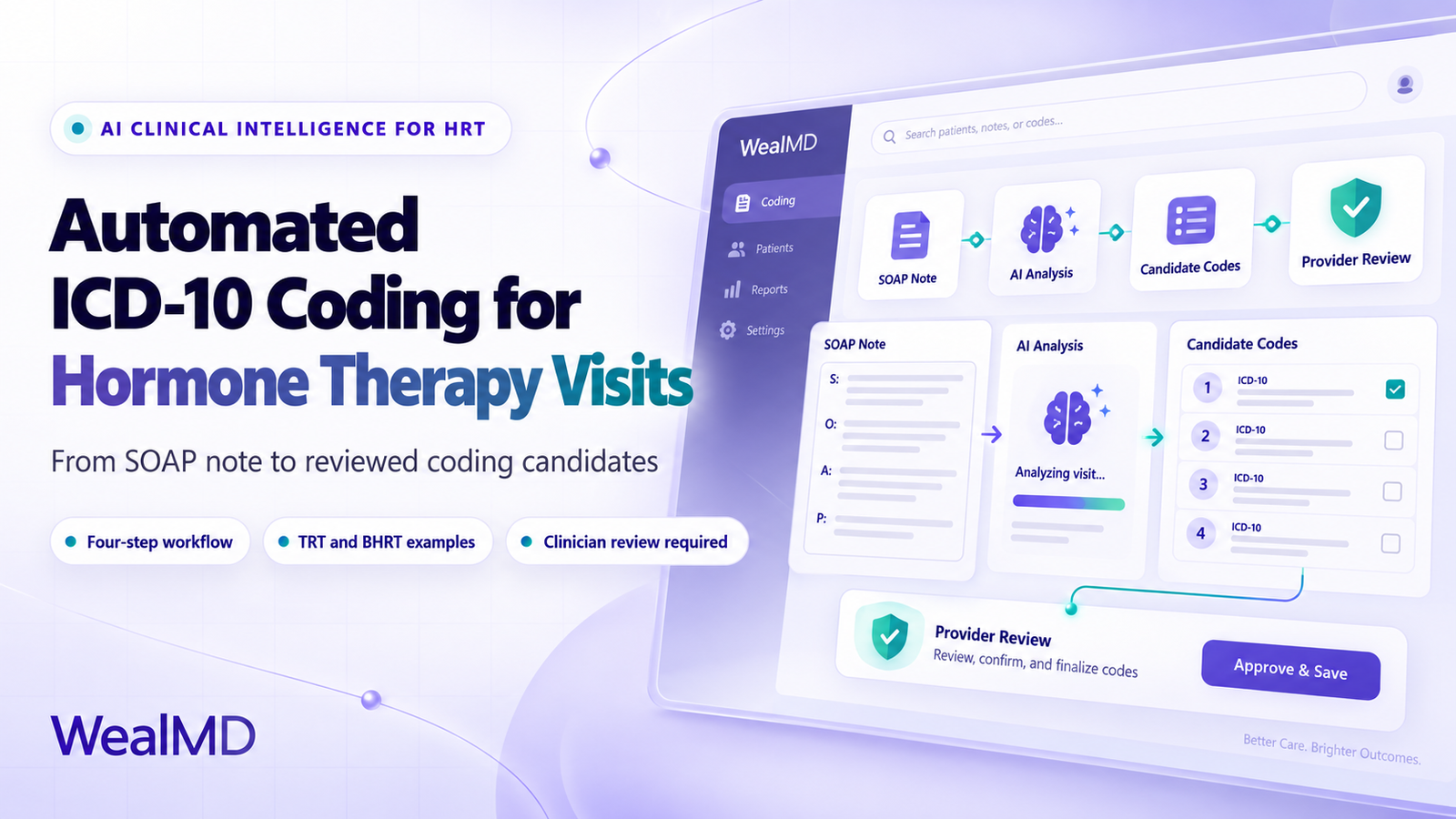
After the note come diagnosis codes, prescription entry, follow-up orders, and patient instructions. These tasks are easy to overlook because they happen after the conversation ends. Clinical intelligence tools can prepare drafts from reviewed encounter data for the clinician or authorized staff member to inspect, edit, and sign.
The boundary matters. Codes are suggestions, prescriptions remain drafts, and clinical interpretation remains the provider's job. The benefit is a prepared starting point rather than a blank screen. Read the broader framework in AI Clinical Intelligence for HRT.
Share the Load and Standardize
Not every documentation task needs a clinician. The AMA describes examples such as trained documentation specialists and team-inbox models where nurses or medical assistants handle appropriate first-pass messages. Inside the clinic, pair clear delegation rules with protocol-based templates so routine follow-ups start from the same structure.
Set a daily cutoff for closing notes, assign ownership for each inbox category, and review exceptions instead of allowing the backlog to compound quietly.
Keep the Clinician in the Loop
AI drafts. The clinician decides and signs. Generated notes can contain errors or omissions, lab summaries can lose context, and a prescription draft can be wrong even when it sounds plausible. Build verification into the workflow rather than relying on a disclaimer.
Start with the sections most likely to affect the next clinical action, then review the supporting note.
Confirm lab values and trends against the original structured result or report before signing.
Verify medication, strength, instructions, patient context, and required authorization before submission.
Before protected health information reaches any AI vendor, confirm the vendor will sign a business associate agreement and understand which subprocessors can access audio, transcripts, notes, or structured chart data.
Where WealMD Fits
WealMD is designed to keep async intake, chart data, lab context, AI-assisted documentation, coding support, prescription workflows, and follow-up actions close to the same patient record. That connected approach targets strategies 2 through 5. Strategy 1 still depends on measuring your baseline, and strategy 6 still depends on team design and accountability.
Whichever platform you evaluate, begin with your five-day audit. Choose the biggest row, request a live demonstration of that exact workflow, and measure the result after implementation. A polished note demo is not enough if your actual backlog lives in labs, refills, or the inbox.
Review WealMD's current AI Assistance features, then ask the vendor to show what happens before the visit, during the encounter, and after the note is signed.
Frequently Asked Questions
Can I reduce documentation time in an HRT clinic without AI?
Yes. Measuring your time, moving intake before the visit, standardizing templates, delegating appropriate first-pass inbox work, and setting a daily note cutoff can all help without AI. AI adds drafting for notes, codes, and prescriptions on top of that foundation.
What is pajama time?
Pajama time is after-hours EHR work that clinicians do at home, such as finishing notes, reviewing labs, and answering patient messages. In one primary care study, it averaged about 1.4 hours per weekday.
How much time do AI scribes save?
In a 2026 JAMA multisite study, adopters saved about 16 minutes of documentation time per eight hours of scheduled patient care. Results vary by specialty, adoption level, workflow, and how much editing each draft needs.
Will an AI scribe end after-hours charting?
Not on its own. The same JAMA study found no significant overall change in EHR time outside scheduled work hours. Pair scribing with better intake, lab, coding, prescribing, delegation, and inbox workflows.
Is AI-assisted charting safe for HRT clinics?
It can support a safer workflow when a clinician reviews and signs every clinical output, verifies values and prescription details against source data, and the clinic completes privacy, security, BAA, consent, and vendor due diligence before use.
Fix the Workflow Before You Add Software
To reduce documentation time in your HRT clinic, begin with the work that follows clinicians home. A scribe may make one slice faster. A connected workflow addresses the intake, labs, codes, prescriptions, follow-up, and inbox work surrounding that note.
Track every after-hours chart task and the minutes it consumes.
Match the largest time category to one of the six fixes above.
Set a closing-time rule, launch the fix, and measure the same row again.
Research and References
- Arndt BG, Beasley JW, Watkinson MD, et al. Tethered to the EHR: Primary Care Physician Workload Assessment Using EHR Event Log Data and Time-Motion Observations. Annals of Family Medicine. 2017;15(5):419-426.
- American Medical Association. Burnout on the way down, but pajama time stands still. August 13, 2024.
- Barr W, et al. Pajama time and burnout: the burden of after-hours electronic health record use on family medicine residents. Academic Medicine. 2026;101(3):312.
- Rotenstein LS, Holmgren AJ, Thombley R, et al. Changes in Clinician Time Expenditure and Visit Quantity With Adoption of Artificial Intelligence-Powered Scribes: A Multisite Study. JAMA. 2026.
- Lukac PJ, Turner W, Vangala S, et al. Ambient AI Scribes in Clinical Practice: A Randomized Trial. NEJM AI. 2025;2(12).
See a connected HRT chart workflow in action.
Explore how WealMD brings patient intake, records, lab context, documentation support, prescribing workflows, and practice operations into one hormone-clinic platform while keeping the final clinical decisions with your team.