AI SOAP Notes for HRT VisitsHow It Works
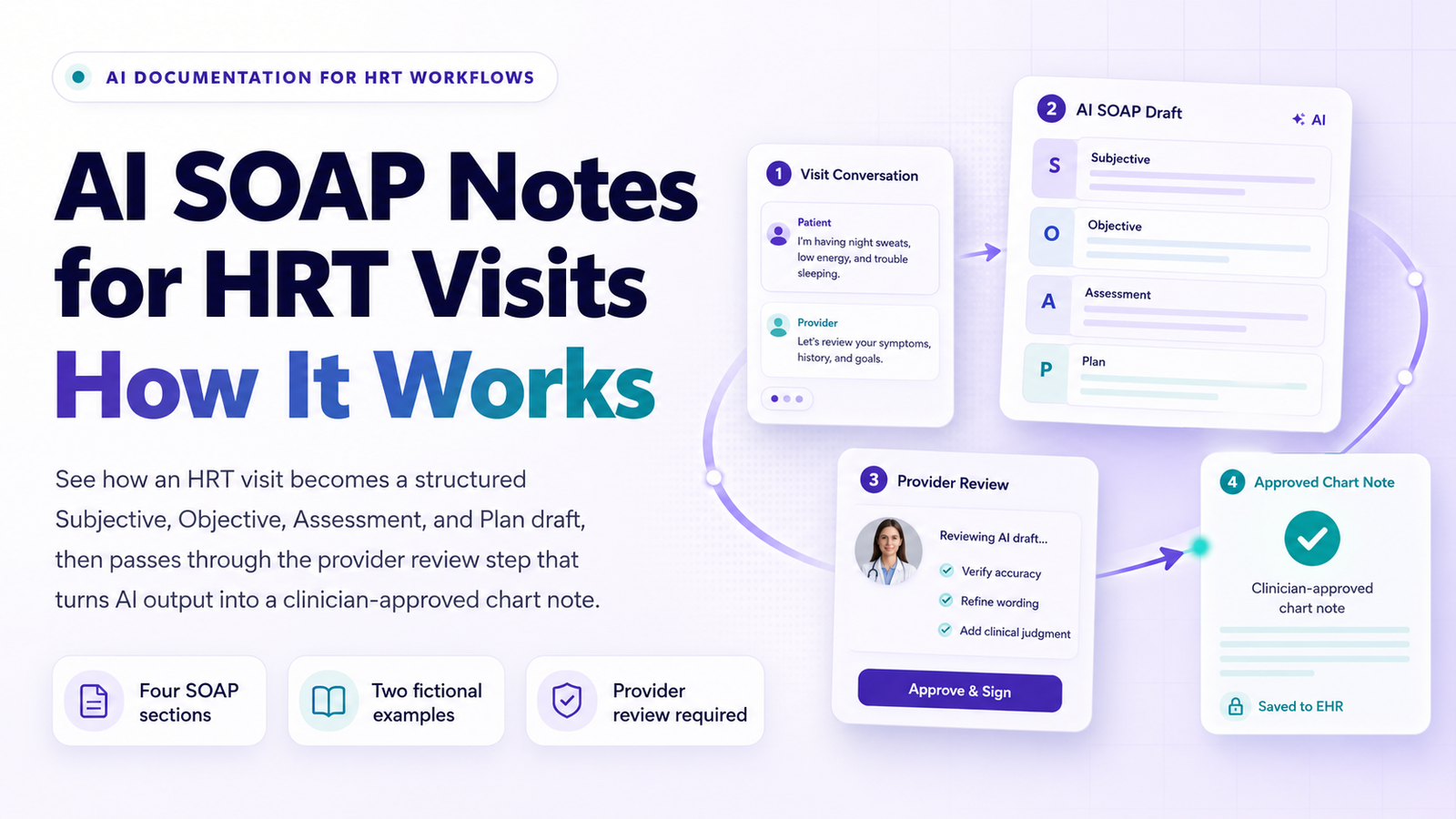
See how an HRT visit becomes a structured Subjective, Objective, Assessment, and Plan draft, then passes through the provider review step that turns AI output into a clinician-approved chart note.
Here is what an AI SOAP note for a testosterone follow-up visit can look like: generated from the conversation, structured into Subjective, Objective, Assessment, and Plan, and waiting for the clinician's review before it ever becomes part of the chart. That gap between "AI-generated" and "chart-ready" is where the real story of AI SOAP notes for HRT visits lives, and it is the gap many vendor demos skip.
Hormone replacement therapy clinics face a documentation load that is heavier than it looks from the outside. Providers review symptoms, lab trends, medication histories, and treatment goals for the same patients visit after visit, then write it all up in a structured note. As patient volume grows, documentation can become one of the slowest parts of the day.
This guide explains how AI SOAP notes for HRT visits work, shows two fictional and anonymized example notes from start to finish, compares documentation time before and after AI assistance, and covers where the technology still needs human judgment.
Medical review status: The two example SOAP notes below are fictional and anonymized. They have not yet completed the formal MD/NP review required by the source brief. Treat them as documentation examples, not clinical guidance, until reviewer sign-off is complete.
Understanding SOAP Notes in Hormone Therapy Clinics
SOAP stands for Subjective, Objective, Assessment, and Plan. The format has been standard across healthcare for decades because it creates a consistent and predictable structure for documenting an encounter.
In HRT practices, SOAP notes typically cover symptom discussions, treatment progress, lab findings, medication adherence, side effect monitoring, and next steps. Hormone therapy is longitudinal care, so many patients return every few months for years. Notes therefore need to reference prior visits, track trends over time, and stay consistent enough that another provider can understand where the patient stands.
That repetition is exactly what makes hormone therapy charting time-consuming, and exactly why it can be a strong fit for automation. The structure repeats, but the details change every time, which is a pattern AI models can help organize when paired with provider review.
Patient concerns, symptoms, reported outcomes, adherence, and experience since the last visit.
Lab values, vitals, medication records, and measurements already available in the chart.
A structured summary of the clinical picture based on the documented encounter.
Follow-up actions, monitoring, education, and next appointments for clinician review.
What Are AI SOAP Notes?
AI SOAP notes are clinical documentation tools that use artificial intelligence, typically speech-to-text combined with a large language model, to draft structured notes from a patient encounter rather than requiring a clinician to type every section by hand.
The provider still reviews, edits, and signs the final note. That review step is not optional in a credible AI SOAP note workflow. It is the mechanism that keeps AI-assisted documentation tied to clinician accountability.
For HRT clinics specifically, AI SOAP notes can appear across new patient consultations, TRT and BHRT follow-ups, telehealth visits, medication management conversations, and ongoing monitoring appointments. Those recurring visit types make up a large share of a hormone clinic's calendar.
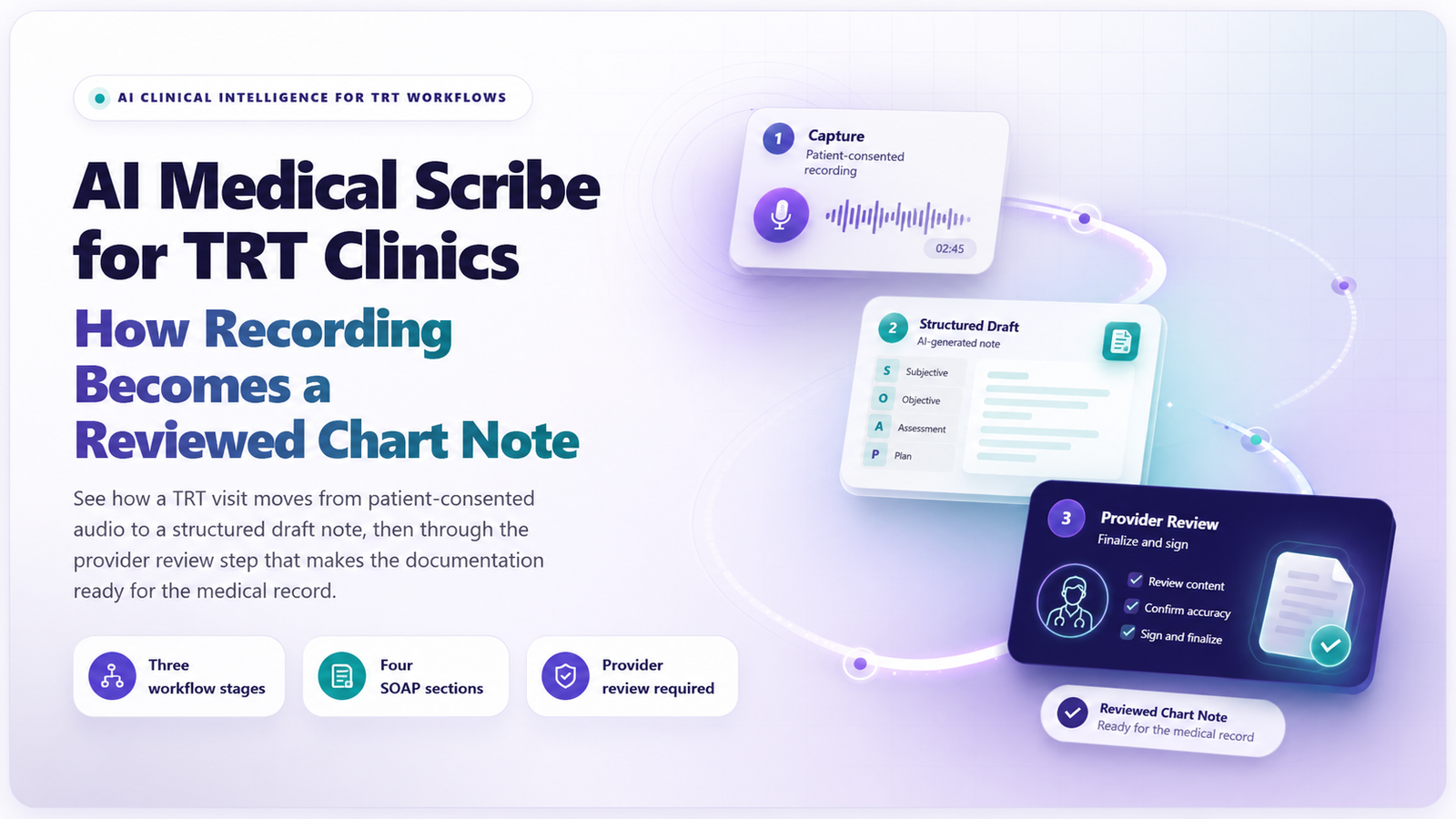
For a closer look at patient-consented recording and provider review, see AI Medical Scribe for TRT Clinics.
How AI SOAP Notes for HRT Visits Work
Capturing the patient encounter
The process starts during the visit. Some systems use ambient listening with patient consent, while others rely on dictation or structured prompts. The system identifies clinically relevant information and begins organizing it into the appropriate note sections.
Structuring information into SOAP format
Once the encounter is captured, the system organizes patient concerns, chart data, assessment language, and follow-up actions into the four SOAP sections. The result is a draft, not a finished note.
Integrating with clinical systems
The most useful documentation tools sit inside the EMR rather than beside it. Patient history, labs, and the generated note should be close enough that the clinician does not need to work across multiple disconnected logins.
Provider review and approval
AI-generated documentation should never bypass clinical review. The provider reads the draft, corrects anything wrong, and signs the final note before it becomes part of the patient record.
The provider keeps conducting the visit while the documentation workflow runs in the background. That is the basis of hands-free medical charting: less time looking at a screen and more time focused on the patient.
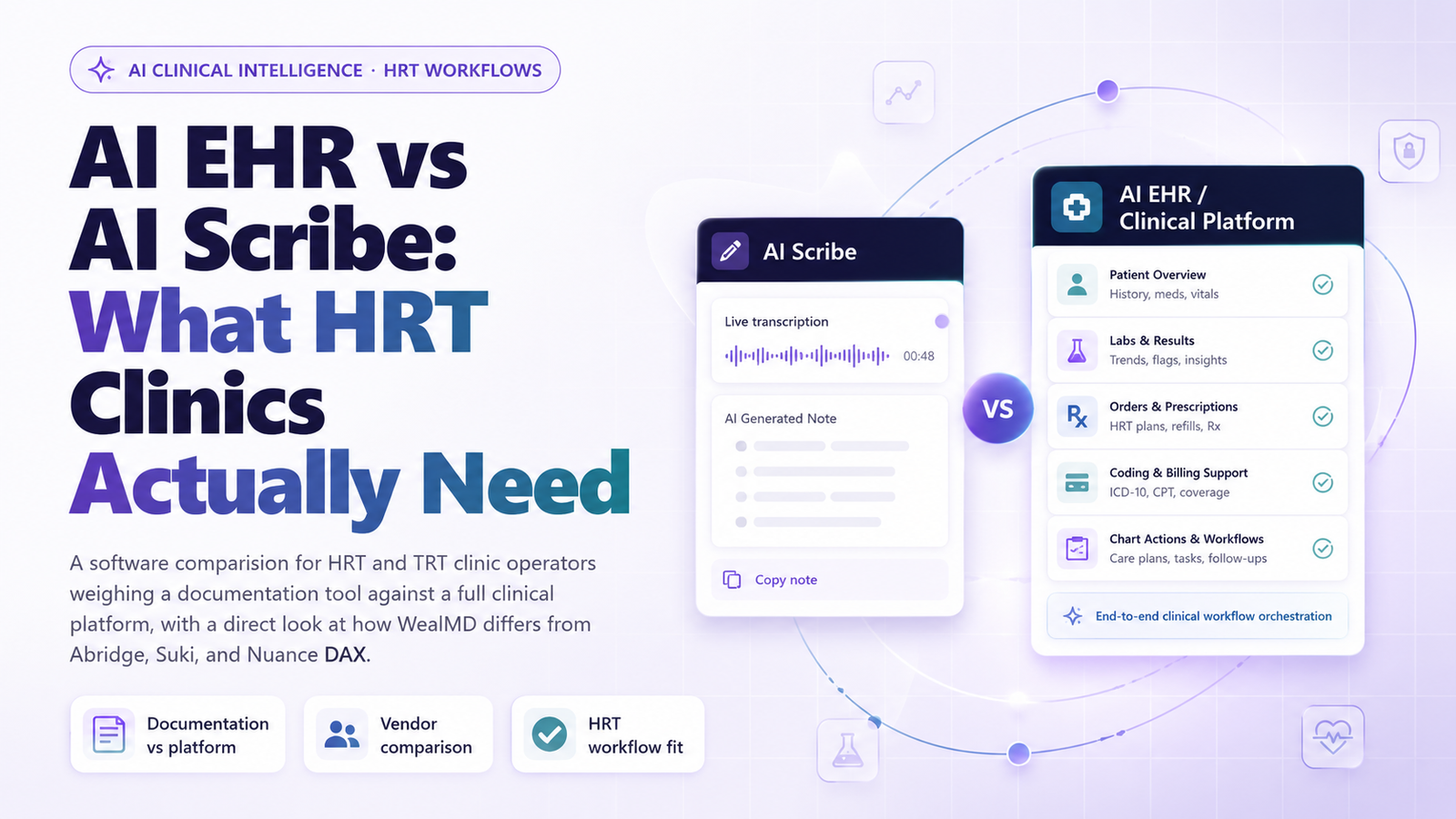
Documentation quality is only one part of software fit. Use How to Choose an EMR for Your HRT Clinic to evaluate the broader system around the note.
Documentation Time: Before and After AI SOAP Notes
The number clinics actually care about is not whether the AI sounds smart. It is minutes per note. The source brief provides the following directional ranges for common HRT documentation workflows.
| Visit Type | Manual Charting | AI Draft + Provider Review | Typical Time Saved |
|---|---|---|---|
| TRT follow-up visit note | 12 to 15 minutes | 3 to 5 minutes to review and edit | About 8 to 10 minutes per note |
| Perimenopause or BHRT initial consult note | 20 to 25 minutes | 6 to 8 minutes to review and edit | About 14 to 17 minutes per note |
| After-hours charting per week | 5 to 7 hours | 1 to 2 hours | About 4 to 5 hours per week |
These are directional ranges, not guarantees. Actual savings depend on visit complexity, how much the clinician needs to correct, and how well the tool is tuned to HRT-specific documentation. The source brief also points to 2024 ambient AI documentation research from Stony Brook University as supporting evidence for lower documentation burden and reduced note-writing time.
Fictional AI SOAP Note for a TRT Follow-Up Visit
This example is fictional and anonymized. It is included to show what an AI-drafted note can look like, including where a clinician still needs to step in. Formal MD/NP review remains pending.
Patient reports improved energy and libido since starting therapy. Denies acne, mood swings, or injection site reactions. Sleep quality improved. No chest pain, shortness of breath, or leg swelling.
Vitals stable. Most recent labs, drawn day 3 post-injection: total testosterone 780 ng/dL, estradiol 42 pg/mL, hematocrit 51%, PSA within normal limits for age. Weight stable since last visit.
Testosterone response therapeutic and within target range for current dose. Hematocrit trending upward over the last two visits, from 47% to 49% to 51%, but still below the threshold described in the source example for dose adjustment or therapeutic phlebotomy. Estradiol within acceptable range on current protocol.
Continue testosterone cypionate 100 mg/week IM. Recheck CBC and hematocrit in 8 weeks given upward trend. Continue testosterone and estradiol monitoring at the next scheduled follow-up in 12 weeks. Counseled patient on hydration and hematocrit-related symptoms to watch for, including headache, dizziness, and visual changes.
It correctly structured the note, pulled the stated lab values into Objective, and generated a clean Plan in the source example.
The source says the first draft treated the estradiol value using a generic reference range, reported only the current hematocrit rather than the three-visit trend, and used a less specific follow-up interval. The clinician corrected those points before signing.
Fictional AI SOAP Note for a Perimenopause Initial Consult
As with the TRT example, this note is fictional and anonymized. It is pending the same medical review before publication.
Patient reports hot flashes, 8 to 10 per day, night sweats disrupting sleep, irregular cycles for the past 18 months ranging from 21 to 45 days, and new-onset joint aches. No vaginal bleeding after intercourse. No personal history of breast cancer, blood clots, or liver disease. Family history notable for mother diagnosed with breast cancer at age 58.
Vitals stable, BMI within normal range. FSH elevated at 42 mIU/mL, consistent with perimenopause in the source example. TSH within normal limits. Mammogram up to date and normal per patient report.
Perimenopause with vasomotor symptoms significantly affecting sleep and quality of life. FSH elevation consistent with reported symptom timeline. Candidate for hormone therapy pending discussion of risks and benefits, including family history of breast cancer.
Discussed hormone therapy options including transdermal estradiol with cyclic progesterone given intact uterus. Discussed baseline risks, including the modest increase in breast cancer risk associated with combined hormone therapy, in the context of family history. Patient education materials provided. Follow-up in 6 to 8 weeks to assess symptom response and tolerability. Mammogram screening to continue on standard schedule.
The source describes comprehensive symptom capture, an accurate menstrual-history summary, and a structured Assessment centered on perimenopause.
The source says the draft did not carry the family history of breast cancer into the Plan, used a more generic starting approach, and needed a more specific patient-education section. The clinician revised those areas before signing.
Where AI SOAP Notes Can Fall Short
The two examples show the recurring pattern. AI SOAP notes can be strong at structure and consistency, while judgment calls that depend on broader context still need careful clinician review.
Hallucinated or misapplied values
A model can apply a generic reference range where a therapy-specific context is required.
Missed narrative nuance
A detail mentioned in Subjective may need to change the Plan, yet the model may fail to connect the two.
Over-confident assessments
Generated language can sound more certain than the clinical picture actually supports.
Coding errors
ICD-10 or E/M suggestions can fail to match the depth and specificity of the underlying documentation.
None of these failure modes are reasons to avoid AI SOAP note generators. They are reasons provider review is non-negotiable rather than a formality.
Why HRT Clinics Are Adopting AI Documentation
Hormone therapy clinics manage recurring and longitudinal patient relationships, so documentation load compounds over time. AI SOAP notes for HRT visits address several recurring operational challenges.
Reducing documentation burden
AI-assisted charting can reduce the amount of manual typing that happens during the day and after hours, while the provider still retains the final review step.
Improving documentation consistency
More consistent note structure can simplify internal QA, chart audits, and handoffs between providers in a multi-provider clinic.
Supporting faster follow-ups
A few minutes saved per note can become meaningful time across dozens of recurring follow-up visits every week.
Enhancing telehealth operations
Virtual visits require the same documentation standard as in-person care, so automated drafting can help maintain one consistent charting workflow across both formats.
AI SOAP Notes and Telehealth HRT Visits
Many hormone clinics now serve patients across wide geographic areas through virtual consultations. That increases access, but it also increases documentation volume. AI SOAP note generators can draft notes directly from virtual encounters and organize predictable follow-up structures into one standardized format.
The value is operational consistency. The clinic can maintain the same documentation standard across in-person and virtual care instead of creating separate charting habits for each setting.
WealMD's telehealth workflow keeps virtual visits inside the same practice platform as records and documentation.
The Connection Between AI SOAP Notes and Clinical Intelligence
Documentation is one part of a larger shift happening in HRT clinical software. Beyond ambient transcription, platforms increasingly combine documentation with clinical intelligence by surfacing documentation gaps, summarizing historical records, organizing lab trends, and supporting draft workflow actions.
Providers remain responsible for reviewing any AI recommendation and making the clinical call. That does not change as the tooling becomes more capable.
For the broader architecture, read AI Clinical Intelligence for HRT: Beyond Ambient Scribes.
Benefits for Clinic Owners and Operators
From an operations standpoint, AI documentation can reduce administrative overhead and improve provider throughput without requiring the clinic to add headcount solely for chart completion. Faster note completion may also reduce after-hours charting, which matters for provider experience and retention.
Consistent documentation can support quality initiatives and make scaling to additional providers or locations easier because chart structure depends less on one person's typing speed or documentation habits.
What AI SOAP Notes Cannot Do
AI can draft a note. It cannot replace clinical judgment, and it should never be treated as automatically accurate. Both fictional examples in this article required corrections from a clinician who understood the patient's context. That is the expected review pattern, not an edge case.
Before adopting any AI documentation tool, clinics should evaluate privacy protections, security controls, compliance posture, and data handling practices, then put governance and review policies in place rather than assuming the tool will get every detail right by default.
Review WealMD's published security controls when evaluating how patient data is handled.
What to Ask Vendors About AI SOAP Notes
Vendor demos are stage-managed by design. These questions tend to surface what a polished demo does not.
Do not rely only on a polished example chosen by the vendor.
Ask how it distinguishes HRT-specific context from generic adult reference ranges and general templates.
Find out whether uncertain content is surfaced differently or presented with the same tone as high-confidence content.
Ask whether source recordings are retained, where they are stored, and for how long.
Test whether an early detail that should affect a later section actually carries through the note.
Ask for actual timing on a normal 15-minute visit rather than an estimate.
Key Features to Look for in an AI SOAP Note Solution
Not all documentation platforms offer the same depth. Prioritize workflow fit over marketing claims.
EMR integration
The note should live beside the chart data the clinician already needs, not in a separate workflow that creates another copy-and-paste step.
Telehealth compatibility
The same drafting and review workflow should work for virtual encounters without lowering the documentation standard.
HRT-specific context
Evaluate how the tool handles recurring hormone-therapy visit patterns rather than relying on a generic primary-care demo.
Provider review controls
Drafts should be easy to inspect, correct, and approve before anything becomes final in the medical record.
Security safeguards
Confirm how audio, transcripts, notes, and protected health information move through the system and its subprocessors.
Ease of rollout
The value disappears if providers need weeks of workarounds to make the output match the clinic's normal charting style.
See WealMD's current AI Assistance features for note suggestions, summaries, alerts, form pre-fill, and workflow support.
The Future of AI Documentation in Hormone Therapy
Documentation technology is moving from simple dictation toward deeper workflow integration, better contextual understanding across visits, and stronger support for longitudinal care. For HRT clinics, that points toward more efficient operations and better documentation consistency over time.
None of that removes the need for human oversight. It simply raises the bar for what the AI should organize correctly before a clinician has to fix it.
Conclusion
AI SOAP notes for HRT visits are one of the most practical AI applications in hormone therapy today, not because the AI is flawless, but because a useful draft plus fast clinician review can beat typing every note from scratch.
From hands-free charting to automated documentation for telehealth HRT visits, these tools can remove real time from the charting process while keeping provider oversight exactly where it belongs: on the final signature.
If you are evaluating documentation tools as part of a broader EMR decision, use the HRT EMR Buyer's Guide 2026 and the How to Start an HRT Clinic guide to see where documentation fits into the larger platform and operating model.
Frequently Asked Questions
What are AI SOAP notes?
AI SOAP notes are documentation tools that use artificial intelligence to generate structured clinical notes from patient encounters, provider input, and available chart data, which a clinician then reviews and signs.
Are AI SOAP notes suitable for HRT clinics?
Yes. Hormone therapy practices manage recurring follow-up visits and detailed longitudinal documentation, which makes structured AI-assisted drafting relevant to the workflow when paired with provider review.
Can AI SOAP notes replace clinicians?
No. Providers must review, edit, and approve every note. Both fictional examples in this article required clinician corrections before they would be accurate enough to sign.
Do AI SOAP notes work with telehealth visits?
Yes. Many platforms support automated charting for virtual HRT visits and can generate documentation directly from telehealth encounters.
How much documentation time can AI SOAP notes save?
The source brief gives directional ranges of about 8 to 17 minutes saved per note depending on visit complexity, plus several hours per week in reduced after-hours charting. Actual savings vary by tool and by how much editing each note needs.
Are the example SOAP notes in this article real patient records?
No. Both examples are fictional and anonymized. They are designed to illustrate AI-generated documentation before and after clinician review, and they remain pending the formal medical review required by the source brief.
Sources
- Stony Brook University research on ambient AI clinical documentation and provider time burden, 2024, as cited in the source brief.
- Physician Documentation Quality Instrument, PDQI-9, used across medical informatics research on note quality.
- Endocrine Society clinical practice guidelines on testosterone therapy in men.
- The Menopause Society position statements on hormone therapy.
See AI-assisted documentation inside the HRT workflow.
Explore how WealMD connects note drafting with patient records, telehealth, forms, security controls, and the broader clinical workflow hormone therapy practices manage every day.