How to Choose an EMR for Your HRT Clinic: A 2026 Decision Framework
A practitioner-built framework for evaluating hormone replacement therapy software across the five criteria that actually decide whether an EMR holds up under real clinic volume: EPCS, lab integration, telehealth, AI documentation, and pricing transparency.
If you are running an HRT clinic on an EMR that was not built for HRT, you already know the friction: prescribing testosterone takes three extra clicks it should not, your intake forms do not talk to your chart, and every lab result means a PDF upload instead of a trend line. That friction compounds every week you keep the wrong system.
This guide gives you a structured way to evaluate hormone replacement therapy software — whether you call it TRT clinic software, BHRT EMR software, or a menopause clinic EMR — using a weighted matrix built around five criteria that actually predict whether a system will hold up under real hormone-clinic volume: controlled substance prescribing, lab integration, telehealth architecture, AI documentation, and pricing transparency.
There is no single "best EHR for hormone therapy." There is the one that scores best against how your clinic actually operates.
Why Generic EMRs Struggle With HRT Workflows
Most clinics start on a general EHR for testosterone clinic operations, or on an integrative medicine EMR not built for hormone-specific volume, then discover the gaps once patient load picks up. Four of them show up consistently.
Controlled substance prescribing is clunky
Testosterone is a controlled substance in most jurisdictions, which means secure electronic prescribing with identity verification and an audit trail. Generic EMRs often bolt this on as a separate module or third-party add-on, forcing providers to switch screens mid-visit.
Intake is treated as a form, not a workflow
HRT clinics rely on pre-visit questionnaires, symptom tracking, and prior lab history. Systems designed around in-person, same-day intake often reduce this to a static PDF instead of structured data that feeds the chart.
Lab integration is shallow
Hormone therapy runs on repeat testing — testosterone, estradiol, SHBG, thyroid panels — and providers need trend views, not isolated snapshots. Many general EMRs connect to Labcorp or Quest in name only, then still require manual uploads and re-keyed values.
Visit templates assume acute care
A template built for a 10-minute primary care visit does not hold dosing history, symptom trajectories, or pellet insertion tracking well. Providers end up building free-text workarounds that make longitudinal care harder to document.
None of this means generic EMRs are unusable for HRT. Plenty of clinics run on OptiMantra or Cerbo successfully. It means the switching cost from "unusable" to "usable" is customization time your team is paying for whether or not it shows up on the invoice.
The Weighted Decision Matrix
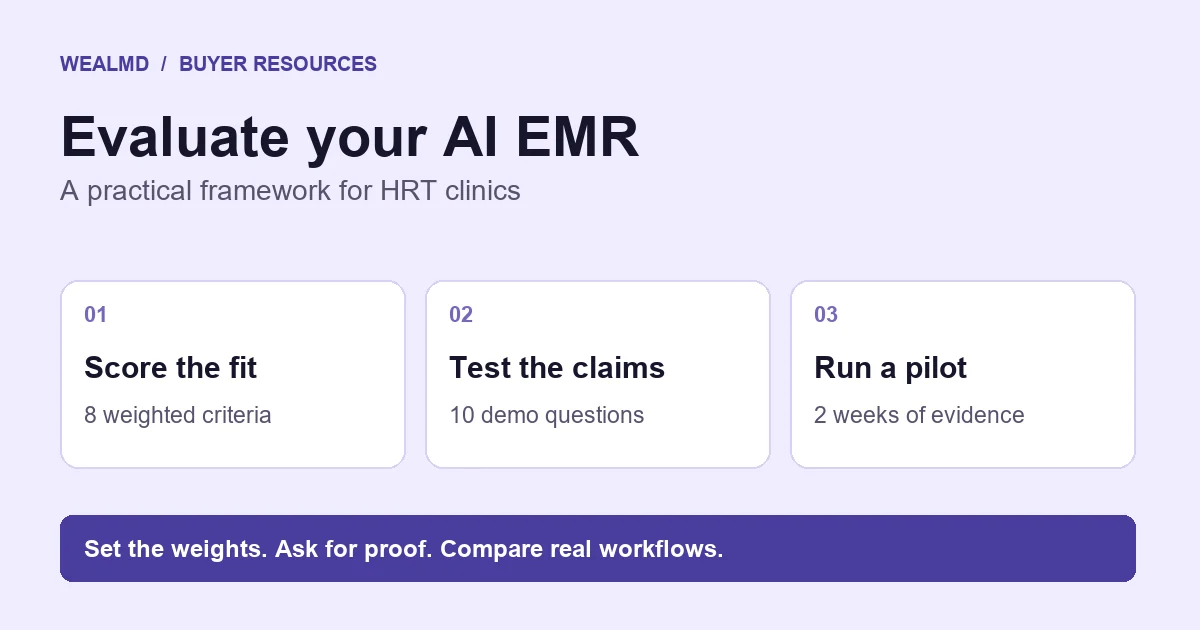
Feature lists do not tell you how a system performs under your actual patient load. Scores do — when the weighting reflects what breaks first in an HRT clinic. This framework scores the HRT EMR features that actually predict retention, weighted by how often each criterion determines whether a clinic stays on a platform past year one.
| Criterion | Weight | What we are actually testing |
|---|---|---|
| EPCS & controlled substance prescribing | 25% | Can a provider complete a testosterone prescription inside the visit workflow, with audit trail, without switching tools? |
| Lab integration | 20% | Direct Labcorp/Quest connectivity, trend visualization across repeat panels, not just PDF storage |
| Telehealth-native architecture | 20% | Built-in video visits, async intake, and multi-state workflows — versus a bolted-on Zoom integration |
| AI clinical documentation | 20% | Does AI meaningfully reduce charting time on hormone visits, or is it a generic ambient scribe with no HRT-specific structure? |
| Pricing transparency | 15% | Can you get a real number without a sales call, and are add-ons such as EPCS, telehealth, and texting disclosed up front? |
Honest Comparison: Seven EMRs Scored
Each platform is scored 1–5 per criterion using public vendor documentation, G2/Capterra reviews, and demo walkthroughs where available. Composite score is the weighted average.
| Platform | EPCS (25%) | Lab (20%) | Telehealth (20%) | AI Doc (20%) | Pricing (15%) | Composite |
|---|---|---|---|---|---|---|
| 1WealMD | 4 | 4 | 5 | 5 | 3 | 4.25 |
| 2OptiMantra | 4 | 4 | 3 | 2 | 4 | 3.40 |
| 3Cerbo | 4 | 4 | 3 | 2 | 3 | 3.25 |
| Charm Health | 3 | 3 | 3 | 2 | 5 | 3.10 |
| PatientNow | 3 | 3 | 3 | 3 | 3 | 3.00 |
| Praxis EMR | 3 | 3 | 2 | 3 | 3 | 2.80 |
| Practice Better | 1 | 2 | 4 | 2 | 4 | 2.45 |
WealMD 4.25
Scores highest because telehealth-native workflows and AI clinical documentation are core to the product, not add-ons. Its weak spot is pricing transparency and smaller brand maturity.
OptiMantra & Cerbo
Strong options for integrative or functional medicine clinics that value lab-heavy workflows and established adoption more than HRT-specific AI documentation.
Charm, PatientNow, Praxis, Practice Better
Each can fit a specific clinic profile, but they require clearer caution around HRT workflows, EPCS depth, telehealth architecture, or true EMR status.
WealMD
Scores highest on composite, driven by telehealth-native architecture and AI documentation that goes beyond transcription into structured SOAP generation and coding assistance. Its honest weak spot is pricing transparency: as a newer entrant, published pricing tiers are less mature. See current WealMD pricing or book a demo.
OptiMantra
The established generalist in this space: deep customer base among integrative and wellness practices, with solid EPCS and lab connectivity. Its limitation is AI, where documentation tools are more transcription-based than structured clinical intelligence.
Cerbo
Strong in functional medicine workflows and lab-heavy practices, which overlaps well with BHRT. It lags in AI depth and telehealth architecture compared with HRT-first platforms.
Charm Health
The budget-friendly broad platform. It provides a working EMR, but clinics should expect more setup work because it was not built specifically around hormone workflows.
PatientNow
Fits aesthetic and medspa practices moving into HRT, especially when injectables and aesthetic services are already central. HRT-specific dosing history and pellet tracking are less developed than HRT-first tools.
Praxis EMR
Its Concept Processing approach appeals to some long-tenured providers, but the UX feels dated compared with newer systems and telehealth is a meaningful weak point.
Practice Better
Strong for coaching and wellness-adjacent practices, but it is not a true prescribing EMR and has no EPCS. It is not appropriate for clinics prescribing testosterone.
Go deeper
Explore the full HRT EMR comparison, or segment-specific pages for BHRT programs and menopause clinics.
Compounded Medications, Pellet Therapy, and Compliance Documentation
Two more things are worth checking before signing a contract, even though they did not make the five-criterion matrix.
Compounded and pellet therapy support
If your practice prescribes compounded BHRT or pellet implants, check whether the system supports flexible, individualized dosing protocols out of the box — or whether pellet insertions and compounding-pharmacy orders become free-text workarounds.
Compliance documentation
Ask every vendor for their Business Associate Agreement, SOC 2 report, and multi-state telehealth licensure documentation up front. A vendor that treats these as available on request is usually fine; one that cannot produce them is a problem.
Neither factor determines a winner on its own. But when two platforms land within half a point of each other on the matrix, pellet/compounding support and compliance documentation are the tie-breakers that matter most for BHRT and menopause clinic EMR buyers.
Pricing and Total Cost of Ownership
Subscription price is only the visible cost
Published pricing in this category is inconsistent. Some vendors list a rate card, but many require a sales call. As a directional reference, OptiMantra public pricing starts around $99/month for the first provider with roughly $49/month for each additional provider, before add-ons like EPCS or telehealth. Industry-wide, per-provider pricing for HRT-capable EMRs typically lands around $150–$600/month once EPCS, lab integration, and telehealth are bundled rather than priced separately.
The bigger cost driver is workflow drag
A $200/month platform that adds 15 minutes of manual lab entry per patient is not cheaper than a $350/month platform that does not. Ask vendors for time-to-first-prescription and time-to-chart-close benchmarks during the demo. Those numbers predict ROI better than the subscription price does.
The Migration Question
Failure point 1: Data structure mismatch
Older systems frequently do not export hormone-specific fields such as dosing history, lab trend data, or pellet insertion logs in a format the new system can ingest cleanly. That creates manual reconciliation work.
Failure point 2: Transition downtime
Most clinics run both systems in parallel for 30–60 days to avoid continuity-of-care gaps. The safest migration plan includes staged data transfer, a pilot with one or two providers, and validation of prescribing and lab workflows before the old system goes dark.
How to Run an EMR Demo That Actually Tells You Something
Vendor demos are designed to look good. Your job is to make them show the parts that are not rehearsed. Bring these questions to every demo:
- Walk me through prescribing testosterone from an existing patient's chart, start to finish — how many screens?
- What happens when a lab result comes back out of range — does it flag automatically, or do I have to notice it?
- Show me an async intake form actually populating structured fields in the chart, not just attaching a PDF.
- What does AI documentation produce for a real hormone follow-up visit — a transcript, or a structured SOAP note?
- How does the system handle a patient in a state where I am not licensed?
- What is included in the base price, and what is an add-on — specifically EPCS, telehealth, and texting?
- What is your typical onboarding timeline for a clinic our size?
- Can I see your EPCS audit trail and identity verification flow?
- How does pellet therapy or compounded medication dosing get documented?
- What does data export look like if we ever switch away from you?
- Who is my support contact after go-live, and what is the average response time?
- Can I talk to a current HRT clinic customer, not just a reference from your marketing team?
Red flags to watch for
A vendor who cannot answer #3 or #4 with a live example, pricing that requires three follow-up calls to pin down, or a rep who will not connect you with a current customer.
Which Type of Clinic Should Pick What
Solo TRT cash-pay telehealth
Needs EPCS reliability and telehealth-native architecture above everything else. That points toward WealMD, or OptiMantra if AI documentation matters less.
Functional-medicine BHRT practice
Often benefits from Cerbo's lab-first workflows unless AI charting time savings outweigh that fit.
Fast-scaling multi-provider clinic
Should weight AI documentation and onboarding speed heavily because staff time becomes the real constraint at that stage.
Coaching-adjacent wellness practice
This is the one profile where Practice Better's lack of EPCS is not disqualifying, provided the practice does not prescribe controlled substances.
Choosing the Right EMR Is a Growth Decision, Not Just a Tools Decision
The EMR you pick now becomes the operational floor for every patient you see over the next several years. Weight the five criteria by what actually breaks in your clinic today — not what a vendor's sales deck emphasizes — and score every platform, including WealMD, against that standard rather than a marketing pitch.
Want to score WealMD against your actual workflow?
See how the platform handles your clinic's EPCS, intake, lab, telehealth, and AI documentation needs instead of relying on a general matrix.
Frequently Asked Questions
It depends on what your clinic actually does day to day. In this framework, WealMD scored highest on composite due to telehealth-native architecture and AI documentation, but OptiMantra and Cerbo are strong choices if lab integration and an established customer base matter more to you than AI charting speed.
A generic EMR can work, but usually requires customization for EPCS workflows, async intake, and hormone-specific templates — costs that often do not show up until months into using the system.
Per-provider pricing for HRT-capable platforms typically runs $150–$600/month once EPCS, lab integration, and telehealth are included, though several vendors require a sales call to get an exact number. Confirm current pricing directly with each vendor before budgeting.
Most clinics run parallel systems for 30–60 days during migration, with additional time needed to validate that hormone-specific data — dosing history, lab trends, pellet logs — transferred cleanly.
Not for prescribing. Practice Better has no EPCS, which rules it out for any clinic prescribing testosterone. It can work for BHRT-adjacent coaching models that do not handle controlled substances.
Focus on live workflows, not feature lists: ask the vendor to prescribe testosterone from an existing chart, show a lab result triggering an automatic flag, and populate an async intake form into structured chart fields. Use the 12-question demo checklist above.
Yes. It is scored the same way as the other six, including where it is weaker — pricing transparency and brand maturity — rather than only where it is stronger.