AI Clinical Intelligencefor Hormone TherapyBeyond Ambient Scribes
An AI EMR for HRT should do more than finish a SOAP note. Clinical intelligence can carry reviewed encounter data into coding support, lab synthesis, prescription drafting, and the next chart action while the clinician remains in control.
Your AI scribe finishes the visit with a clean SOAP note. Then your medical assistant codes it, your prescribing system raises a medication warning the scribe never saw, and you draft the testosterone refill yourself because the AI stopped working when the recording ended. The tool completed one useful task. However, it left most of the operational work untouched.
That gap has a name, even though many vendors blur it. Ambient AI, including products such as Abridge, Suki, Nuance DAX, and Heidi, listens to a visit and turns the conversation into documentation. Clinical intelligence is the layer above it. It can take reviewed encounter data and support the work that follows, including coding, lab synthesis, and draft orders.
For many specialties, the distinction is useful. For hormone therapy, it is especially important because TRT and BHRT visits are recurring, lab-heavy, and connected to repeated prescribing workflows.
Meanwhile, “AI EMR” has become a broad marketing label that different vendors apply to very different products. This guide draws a precise line between the categories. By the end, you will have a practical framework for separating ambient AI from clinical intelligence, ten demo questions that expose the difference quickly, and a candid review of the failure modes that still require human oversight.
Workflow note: This article explains software architecture and clinical operations. It does not provide instructions on diagnosis, dosing, prescribing, or patient management. Every clinical output described below remains a draft for a licensed clinician to review, edit, approve, or reject.
The Four Layers of AI in an EMR
The phrase “AI EMR” is used for basic dictation tools and for platforms running structured clinical models. Therefore, buyers need a clearer framework. In practice, four distinct AI layers can exist inside a medical record, and most products occupy only one.
Voice transcription
Speech becomes text. The software does not distinguish a symptom, a lab value, and casual conversation beyond transcription context.
Typical examples: Dragon Medical and basic dictation toolsAmbient AI scribing
The system listens to the natural encounter and generates a structured SOAP note without requiring the clinician to dictate into a template.
Typical examples: Abridge, Suki, Nuance DAX, and HeidiClinical intelligence
The reviewed note becomes an input to coding support, lab synthesis, draft prescriptions, and connected chart actions.
WealMD is building around this layerAutonomous clinical AI
The system would make and execute clinical decisions with little or no human review.
This remains primarily a research and regulatory discussionLayer 1 has existed for decades. It reduces typing, but it does not materially reduce the work of structuring, coding, reviewing labs, or preparing orders. Layer 2 is a genuine step forward because it can restore eye contact and reduce after-hours documentation. Still, the job usually ends when the note appears.
Layer 3 begins with the finished encounter. The input might be an ambient-generated note, a structured visit, or an async intake form. From there, the platform can help move reviewed data through the rest of the chart without asking staff to re-enter information that the system already has.
Layer 4 is different in kind, not only degree. It would execute clinical decisions with minimal human review. Current mainstream software and prescribing frameworks do not provide a responsible production path for fully autonomous prescribing. Therefore, vendors should describe clinician review as a core design requirement, not as a temporary limitation.
The practical test is simple. Ask the vendor to show what happens after the note is generated. If the next step involves exporting, copying, or opening a separate tool, you are probably looking at Layer 2 presented with Layer 3 language.
Ambient scribing is still valuable. Nevertheless, it is a different product from a clinical intelligence layer, so its price and workflow impact should be evaluated differently. The framework also stays useful as established EMRs add scribe features, because buyers can evaluate the workflow itself instead of relying on an “AI-powered” label.
See AI Scribe vs Ambient AI for a focused comparison of documentation-only tools and the clinical AI layer above them.
What Clinical Intelligence Does That Ambient AI Does Not
The functions below describe how a clinical intelligence layer can use encounter data. Every output remains a draft. Consequently, the clinician still owns the diagnosis, code, prescription, and final chart.
Automated ICD-10 coding support
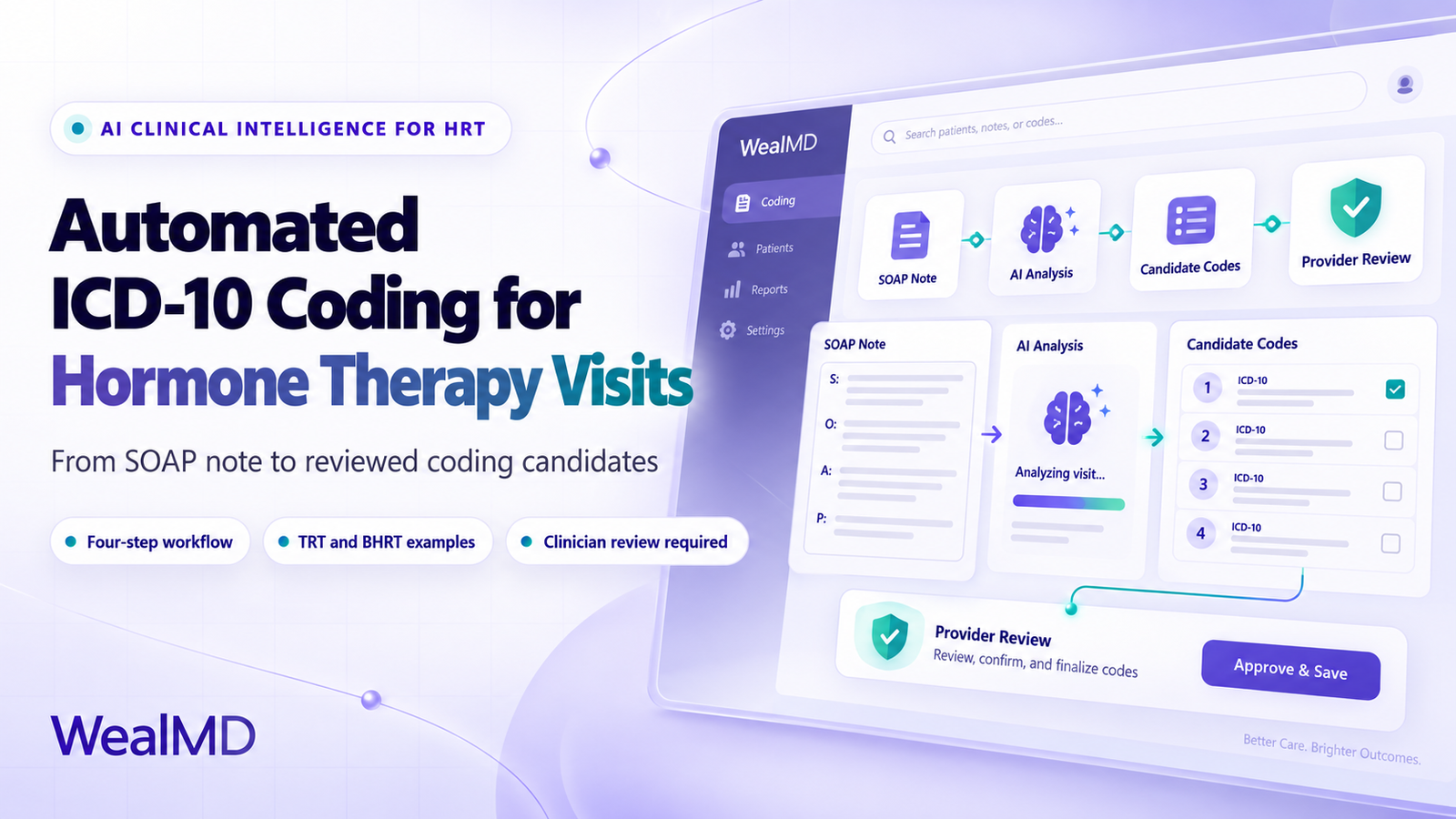
An ambient scribe hands the practice a clean note. Someone still has to translate the documentation into codes, often while reopening the encounter and reconstructing why the visit occurred. Clinical intelligence can suggest the ICD-10 codes supported by the finished SOAP note and present them for confirmation. For example, a routine TRT follow-up and a menopause consultation produce different coding patterns, but both can begin with the same reviewed encounter data. As a result, a coder or clinician reviews the suggestion instead of originating every code from scratch.
Lab synthesis inside the chart
Hormone therapy visits depend on repeated lab review, including testosterone, estradiol, SHBG, hematocrit, lipids, and other values based on the program. Ambient AI can transcribe a clinician saying that the labs are stable, but it does not necessarily read a new lab feed or compare the result with prior panels. Clinical intelligence can ingest structured results and surface the trend before the visit. The system presents the data, such as a value moving across three consecutive panels. The clinician decides what the pattern means for the patient.
Prescription drafting from the visit
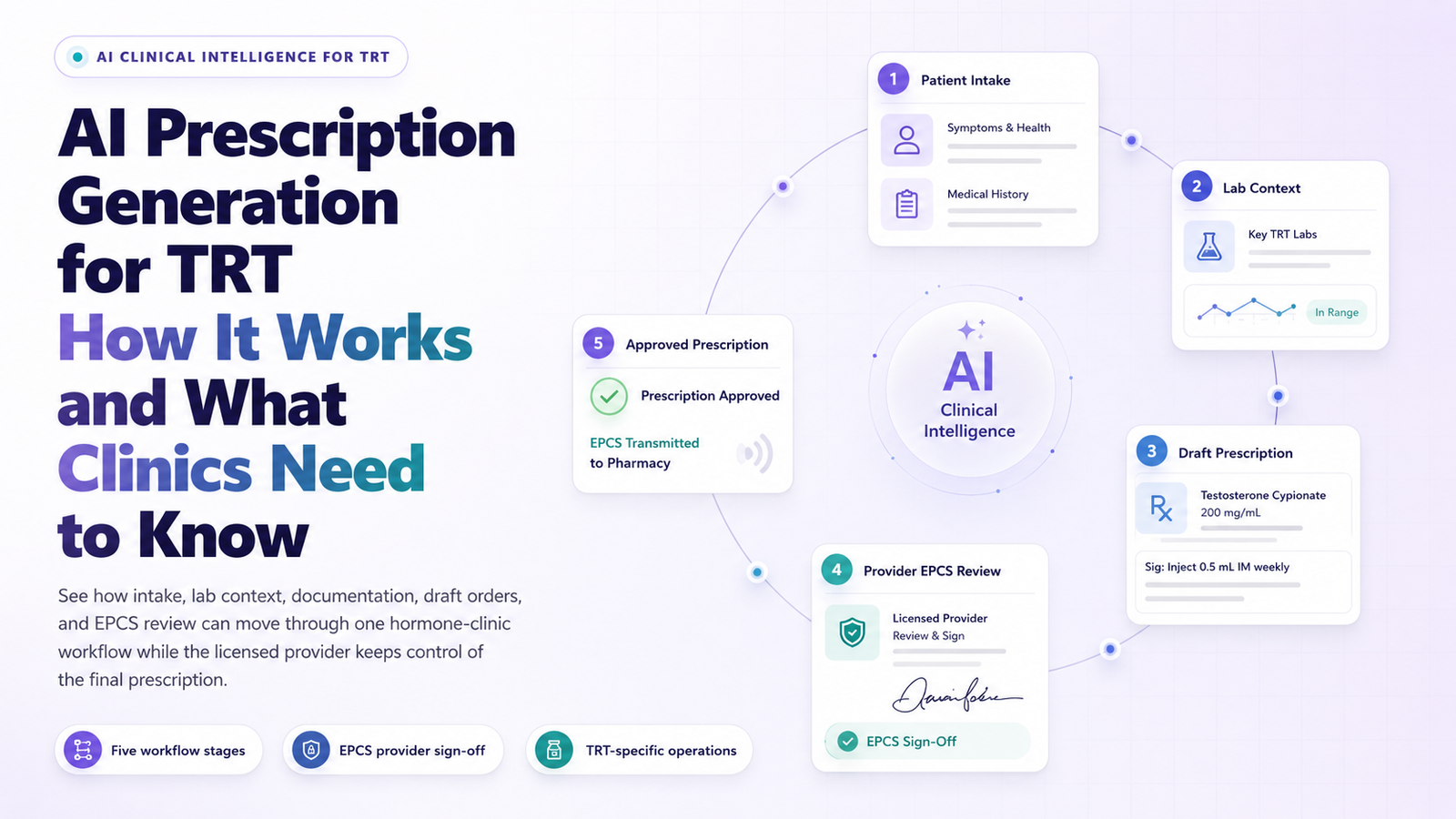
When the documented plan includes a medication change or refill, the system can prepare a draft order for clinician review instead of leaving a blank prescribing screen behind a completed note. It does not issue the prescription. Instead, the prescriber reviews the medication, strength, instructions, and patient context, edits if needed, and signs through the same authorized workflow used for manually entered orders. For controlled substances such as testosterone, the draft still remains inside the required prescriber-controlled process.
Async intake summarization
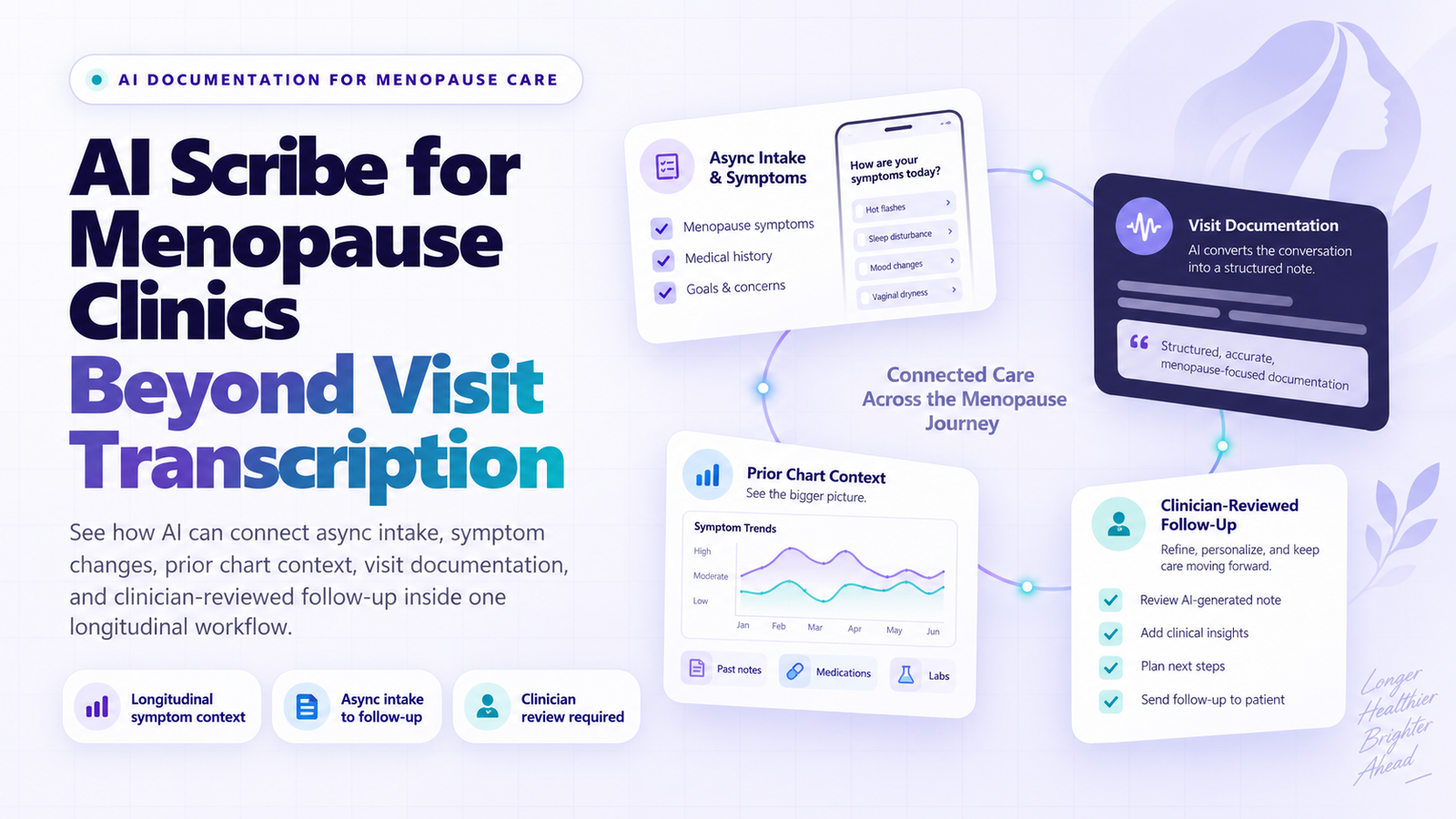
Many telehealth HRT visits start with symptom questionnaires, medication history, consent forms, and uploaded outside records. Ambient AI does not help until a live conversation starts. By contrast, clinical intelligence can summarize the intake and flag changed information before the chart is opened. A clinician can therefore begin with a concise pre-visit brief rather than reading a long form cold while the patient waits.
One connected operating workflow
The same clinical intelligence layer can support TRT, BHRT, and menopause visit types because the underlying job remains consistent: organize encounter data, surface relevant context, and draft the next administrative action for review. WealMD connects this direction with AI Assistance, wellness records, forms, telehealth, and the broader practice workflow.
Taken together, these functions separate an EMR that automates the note from one that can also reduce the paperwork the note creates. That includes coding preparation, lab review, and order drafting, not only transcription.
The Same HRT Visit, Two Different Workflow Endpoints
Both workflows may start with the same patient encounter. However, they stop at very different points.
Ambient AI workflow
Clinical intelligence workflow
The distinction applies to both TRT and BHRT workflows. For example, a perimenopause follow-up involves different codes, lab patterns, and medications than a testosterone follow-up. It may focus on estradiol, FSH, LH, progesterone, symptom trajectories, or a different prescription cadence. Even so, the operating pattern remains the same: present the right context and draft the next step without removing clinician review.
That is why a separate AI product is not required for every hormone therapy segment. The same clinical intelligence architecture can support different visit types when the templates, data mappings, and review rules are tuned to each workflow.
The Honest Limits of AI Clinical Intelligence
Trust in this category comes from explaining where it breaks, not from claiming that it never fails. Five limitations apply to any clinical intelligence platform, including WealMD.
A peer-reviewed study of 97 outpatient encounters found detected hallucinations in 20% of physician-authored comparison notes and 31% of ambient AI notes. The result does not provide a universal accuracy score for every product. Instead, it reinforces the need for human review of every generated artifact.
Notably, reviewers still preferred the ambient notes overall in many cases because they were more thorough and organized. Therefore, the lesson is not that AI documentation has no value. The lesson is that useful output still needs verification.
Hallucination risk is measurable
A generated note, code suggestion, lab summary, or prescription draft can contain information that is fluent but unsupported. For that reason, every item needs clinician review before it becomes final.
Edge cases degrade faster
Rare presentations, complex medication histories, and inconsistent source data are exactly where a model is more likely to generate a plausible but incorrect result. In one evaluation of commercial ambient scribes, a tool misstated a patient's age in a complex trauma scenario. The broader lesson is that review scrutiny should increase, not decrease, on visits that are already difficult.
Human review is the design
Clinical intelligence proposes. It does not independently finalize a diagnosis, code, prescription, or dose. The review step is not an afterthought. It is the architecture that makes Layer 3 appropriate.
The clinician owns the chart
The professional who signs the note, code, or prescription remains accountable for it. No AI vendor can transfer that responsibility through marketing language or terms of service.
Privacy contracts must cover the complete data path
A BAA is essential, but it must cover every vendor and model provider that touches patient data. Before a pilot, ask which subprocessors receive audio, transcripts, notes, or structured clinical data. Review WealMD's published security controls as part of your due diligence.
Finally, vendor-specific accuracy numbers remain limited. Published studies evaluate particular products, model pipelines, prompts, and test conditions. Research on one commercial scribe should not be treated as a blanket accuracy rating for an entire category.
Every vendor should be able to discuss internal audits, correction workflows, and the benchmark used for its own product. Ask whether the audit measured missing facts, invented facts, medication errors, coding errors, or all of them. A single percentage is difficult to interpret when the definition of an error remains unclear.
How to Evaluate an AI EMR Vendor: Ten Questions for Every Demo
Every AI EMR demo is designed to look impressive. These questions make it much harder to hide the difference between a scribe and a true clinical intelligence workflow.
Practical asset: Print this section and use it as a live vendor evaluation checklist.
Do not accept a feature list. Ask for the actual next step in the workflow.
Ask what the platform does before the clinician opens the chart.
Clarify whether it supports coding or only produces the SOAP note.
Ask whether the order screen is prepared or remains blank after the visit.
Ask which benchmark, dataset, and error definition produced the number.
Confirm that it covers every third-party model provider in the patient data path.
Ask what happens when the AI is wrong, not only what the disclaimer says.
Determine whether it uses the existing EMR workflow or requires another login and manual re-entry.
Ask whether it can summarize forms before the visit or only works after recording starts.
Request a TRT follow-up or perimenopause consultation instead of a generic primary care example.
No single vendor is automatically right because it answers every question. The purpose is to make product boundaries visible. A vendor that welcomes these questions and demonstrates the complete workflow is more likely to be clear about what it has actually built.
Why HRT Clinics Benefit Disproportionately
Clinical intelligence can help many specialties. Hormone therapy clinics gain more than most because their core workflow repeats the same high-value administrative patterns.
High-volume recurring prescribing
TRT and BHRT practices often repeat a relatively small set of medication workflows on a recurring cadence, sometimes every 60 to 90 days. The fifth refill for an established patient is structurally similar to earlier refills, although the clinician must still confirm the current plan and patient context. Therefore, a drafting layer can reduce repeated data entry while preserving prescriber review.
Lab synthesis at nearly every follow-up
Hormone panels frequently need comparison with prior results at baseline and follow-up intervals. A generic record may treat each report as a static document. A specialty-aware workflow can present the trend instead of forcing staff to open and compare separate PDFs or retype values into a spreadsheet.
Async-heavy practice models
Many telehealth and cash-pay clinics rely on forms before the visit rather than a traditional front-desk check-in. Patients may complete symptoms, history, medication updates, and consent steps asynchronously. Ambient recording cannot help with that stage. Clinical intelligence can summarize the submitted information before the conversation begins.
Multi-state telehealth complexity
Multi-state operations add licensure, documentation, and prescribing checks to every visit. For testosterone, controlled-substance requirements add another layer of workflow complexity. Integrated support matters more as that administrative load grows. WealMD's telehealth features keep virtual care connected to the same practice system.
None of this makes ambient scribing useless. It remains a meaningful improvement over typing during a visit. Still, the ceiling on the value of an “AI EMR” is set by the layer where its work ends.
Put another way, a general practice may use an ambient scribe to optimize one part of a varied day. An HRT clinic can use clinical intelligence to improve a larger share of its operating spine because the same visit types, lab panels, and prescribing patterns repeat at scale.
The Bottom Line
Ambient AI solved a real documentation problem. It can restore eye contact, reduce typing, and produce useful draft notes. As a result, ambient scribing is becoming a baseline feature rather than the final competitive advantage.
The next meaningful difference in HRT software is what happens after transcription. Does the platform support coding, place new labs in context, prepare the next draft order, and keep the chart moving without removing clinician oversight?
That is the layer described here: clinical intelligence. WealMD is building around that direction for hormone therapy workflows, including async intake, hormone-panel context, documentation support, coding suggestions, and connected follow-up actions. The goal is not a more impressive transcript. The goal is a more complete and reviewable operating workflow.
None of it replaces clinical judgment, and none of it should. Instead, it targets the manual coding, chart searching, and retyping that sit between a good visit and a closed chart. Ambient AI was never designed to remove all of that work, so buyers should not assume that a strong scribe automatically provides a strong clinical intelligence layer.
If you are evaluating vendors, use the ten questions above before signing anything. Insist on a real HRT visit type, a real correction workflow, and a live demonstration of what happens after the note appears.
For a complete platform selection framework, read the HRT EMR Buyer's Guide 2026 before signing a vendor contract.
Frequently Asked Questions
How is clinical intelligence different from an ambient AI scribe?
An ambient AI scribe turns a visit into a draft note and usually stops there. Clinical intelligence continues beyond documentation by supporting coding suggestions, lab synthesis, draft prescriptions, and async intake summaries for clinician review.
Does an AI EMR replace clinical judgment?
No. Every function described here produces a draft or a data presentation for a licensed clinician to review, edit, approve, or reject. The clinician remains accountable for the final note, code, and order.
How accurate is AI-generated clinical documentation?
Accuracy varies by product, specialty, source data, and study method. One 2025 study of 97 outpatient encounters detected hallucinations in 20% of physician-authored comparison notes and 31% of ambient AI notes. The finding supports mandatory review rather than a universal accuracy score for every vendor.
Can clinical intelligence integrate with an existing EMR?
Some platforms are built as add-on layers, while others include clinical intelligence natively. Ask the vendor to demonstrate the integration, including how data enters the chart and whether staff need a second login or manual re-entry.
Does clinical intelligence change who can prescribe testosterone?
No. A draft prescription still requires the same authorized prescriber review and sign-off as a manually entered order. AI does not receive prescribing authority.
Is clinical intelligence useful for BHRT and menopause care?
Yes. The same workflow functions apply across hormone therapy visit types. The codes, labs, and medication patterns differ, but the system can still organize encounter data, surface relevant context, and prepare draft actions for clinician review.
References
- Palm E, Manikantan A, Mahal H, Belwadi SS, Pepin ME. Assessing the quality of AI-generated clinical notes: validated evaluation of a large language model ambient scribe. Frontiers in Artificial Intelligence. 2025;8:1691499. View DOI
- Jain J, Kaan J, Jain S, et al. An LLM-Based Comparison of Ambient AI Scribes for Clinical Documentation. medRxiv. Posted June 26, 2025. View DOI
- Stetson PD, Bakken S, Wrenn JO, Siegler EL. Assessing electronic note quality using the physician documentation quality instrument (PDQI-9). Applied Clinical Informatics. 2012;3:164-174. View DOI
- Shah SJ, Crowell T, Jeong Y, et al. Physician Perspectives on Ambient AI Scribes. JAMA Network Open. 2025;8(3):e251904. View DOI
- Cain CH, Davis AC, Broder B, et al. Quality assurance during the rapid implementation of an AI-assisted clinical documentation support tool. NEJM AI. 2025;2. View DOI
- Duggan MJ, Gervase J, Schoenbaum A, et al. Clinician experiences with ambient scribe technology to assist with documentation burden and efficiency. JAMA Network Open. 2025;8:e2460637. View DOI
- Ma SP, Liang AS, Shah SJ, et al. Ambient artificial intelligence scribes: utilization and impact on documentation time. Journal of the American Medical Informatics Association. 2025;32:381-385. View DOI
- Asgari E, Montana-Brown N, Dubois M, et al. A framework to assess clinical safety and hallucination rates of LLMs for medical text summarisation. npj Digital Medicine. 2025;8:274. View DOI
- Leung TI, Coristine AJ, Benis A. AI scribes in health care: balancing transformative potential with responsible integration. JMIR Medical Informatics. 2025;13:e80898. View DOI
- Bhasin S, Brito JP, Cunningham GR, et al. Testosterone Therapy in Men With Hypogonadism: An Endocrine Society Clinical Practice Guideline. Journal of Clinical Endocrinology and Metabolism. 2018;103(5):1715-1744. View DOI
- The 2022 Hormone Therapy Position Statement of The North American Menopause Society Advisory Panel. Menopause. 2022;29(7):767-794. View DOI
See what happens after the note is generated.
Explore how WealMD connects AI-assisted documentation with records, forms, telehealth, security controls, and the operating workflow hormone therapy clinics manage every day.