AI Scribe vs Ambient AI: What's the Difference?
In practice, the two terms usually describe the same documentation layer. However, the distinction that changes an HRT clinic's workflow is ambient AI versus clinical AI: software that only writes the note, versus software that can also support coding, lab synthesis, and the next administrative step for clinician review.
Why the AI Scribe vs Ambient AI Comparison Is Confusing
“AI scribe” and “ambient AI” are the two terms every HRT clinic operator hears from vendors promising to fix documentation, and most people use them to mean exactly the same thing. In fact, that is not entirely wrong. For example, nearly every product marketed as an AI scribe is an ambient AI system: it listens to the visit and drafts a note afterward.
However, that overlap hides the more useful question. More importantly, it is not really AI scribe versus ambient AI. Instead, it is ambient AI versus clinical AI. Does the software only listen and write, or does it understand the visit well enough to support coding, pull relevant labs into the workflow, and draft the next step for clinician review?
Consequently, for a TRT or BHRT clinic running testosterone titrations, hormone panels, and async intake reviews every week, that distinction separates a documentation shortcut from a system that can reduce an entire chain of administrative work.
“AI Scribe” and “Ambient AI” Are Mostly the Same Thing
To begin with, it is worth admitting that the search behind this article is a bit of a false choice. In vendor marketing, “AI scribe” and “ambient AI” describe the same basic technology layer: a system that listens to a patient encounter, whether live or recorded, and generates a draft clinical note.
For example, Abridge, Suki, Nuance DAX, and Heidi are often described as ambient AI scribes because the two parts of the phrase describe different sides of the same workflow. In this context, ambient describes how the software listens quietly in the background. Meanwhile, scribe describes what comes out: a SOAP note, progress note, or encounter summary ready for review.
Generally, yes. Both terms usually refer to encounter listening plus structured note drafting.
Instead, that is a question about ambient AI versus clinical AI, specifically where the software stops working after the note is created.
Therefore, that second question is worth answering because it changes what staff still have to do after the visit ends.
The Four Layers of AI in Clinical Documentation
Most clinical documentation tools sit in one of four layers. “AI scribe vs ambient AI” mainly describes Layer 2, while the more useful buying comparison is Layer 2 against Layer 3.
Voice transcription
Speech is converted to text. As a result, there is no note structure and no clinical reasoning.
Typical output: dictation textAmbient AI scribing
Next, the encounter becomes a structured SOAP note, progress note, or summary.
Typical output: draft documentationClinical AI
Then, the note becomes an input to coding, lab synthesis, draft prescriptions, and chart updates.
WealMD builds toward this layerAutonomous clinical AI
Finally, systems make clinical decisions with minimal human review.
Largely research-stage; clinician review remains essentialHowever, almost every vendor comparison online collapses Layers 1 and 2 together and stops there. Therefore, the more useful comparison is ambient documentation against clinical intelligence that continues into the next workflow step.
What Ambient AI Actually Does
Every ambient AI scribe follows roughly the same five-step workflow:
That workflow is genuinely useful. As a result, for an HRT clinic running 15- to 20-minute virtual visits back-to-back, reducing several minutes of note drafting to a brief editing pass is a real time save. Because of this, ambient scribes have spread across primary care, cardiology, and hormone clinics.
What ambient AI does not do, by design, is act on the note once it is written. However, ambient AI does not decide which ICD-10 code the documentation supports. Likewise, it does not automatically surface the patient's latest testosterone, estradiol, SHBG, hematocrit, or DUTCH panel values. Finally, it does not prepare a prescription draft for the clinician to review.
Therefore, coding, lab entry, billing preparation, and prescription paperwork still happen afterward.
By contrast, the visit data can continue into the connected administrative workflow.
Review WealMD's current AI Assistance features, including note suggestions, summaries, alerts, form pre-fill, and billing-code suggestions.
What Clinical AI Does That Ambient AI Doesn't
Clinical AI starts where ambient AI stops. Instead of ending at a signed note, it treats the note as an input to the rest of the visit's paperwork. In an HRT-specific workflow, that can include the following:
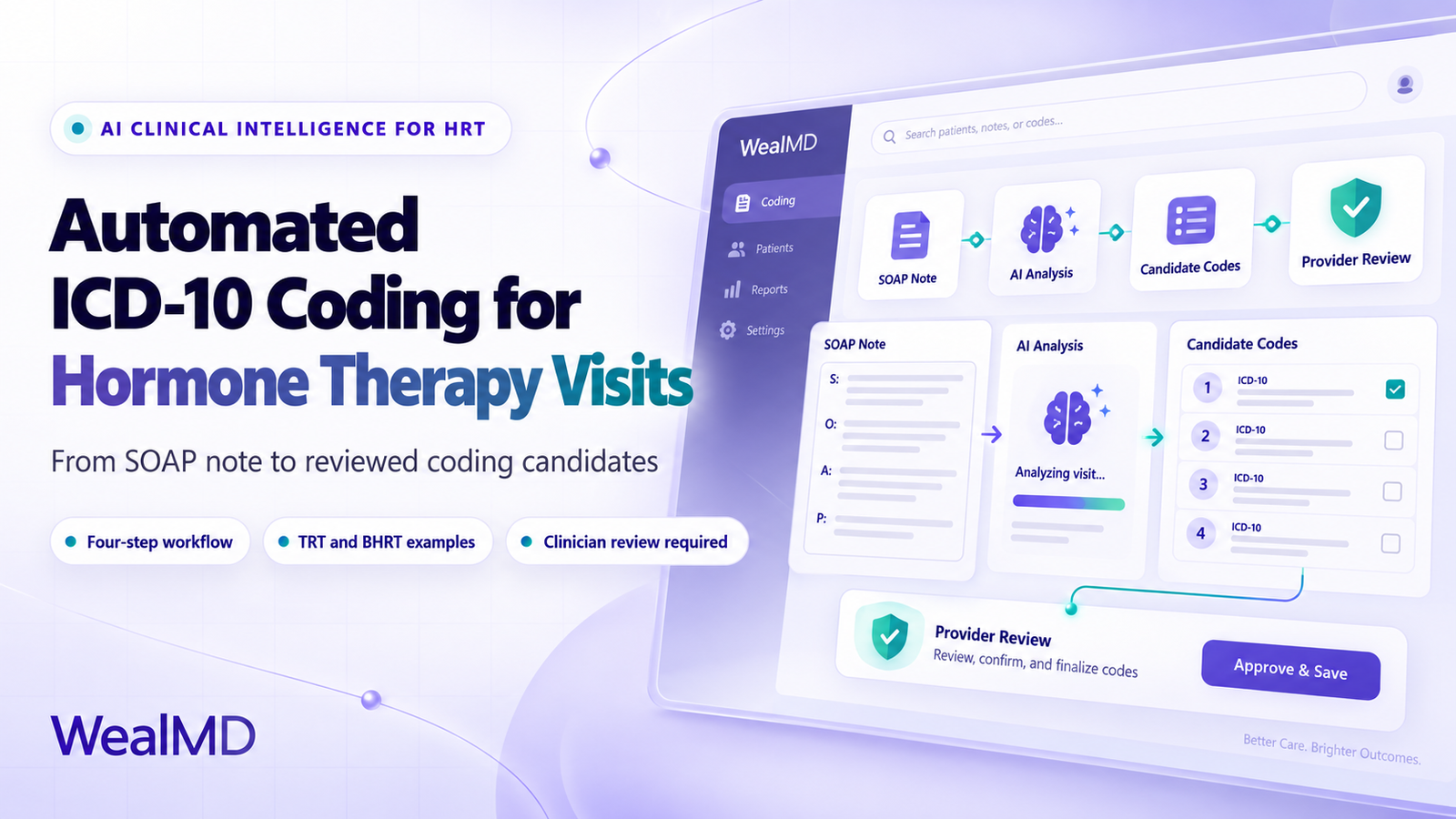
Automated coding suggestions
The system can suggest ICD-10 codes from the documented visit for a coder or clinician to confirm, rather than asking staff to rebuild the encounter context after the visit.
- Suggestions remain reviewable
- The clinician or coder confirms the final code
Lab synthesis inside the chart
For example, relevant values from total and free testosterone, SHBG, estradiol, hematocrit, or specialty panels can be surfaced in the current workflow instead of manually re-entered from a separate document.
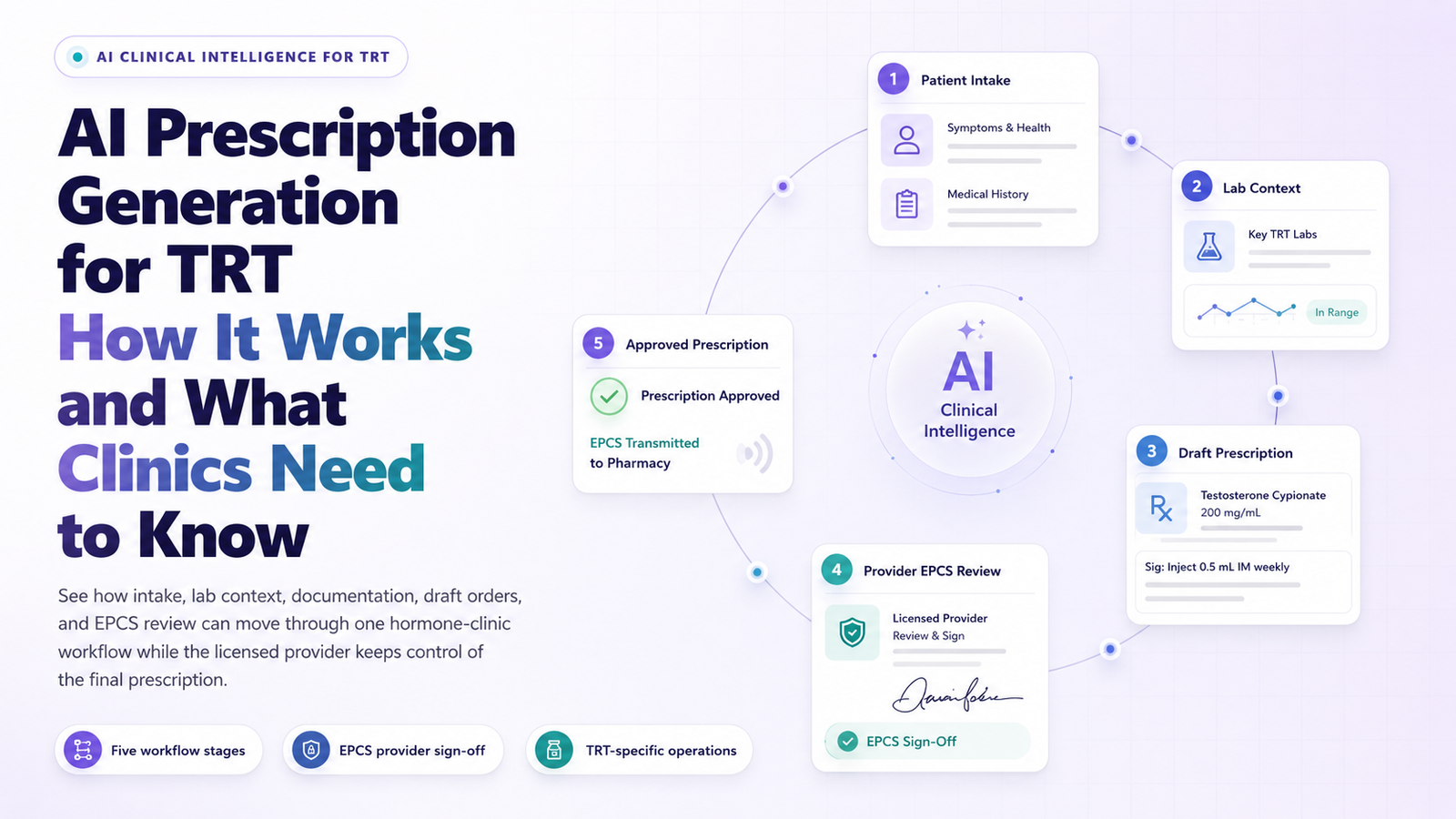
Prescription drafting for review
Likewise, for a testosterone or estradiol dose adjustment, clinical AI can prepare a draft based on the documented plan and established protocol. Importantly, it drafts; it does not prescribe. Then, the clinician reviews and signs every prescription.
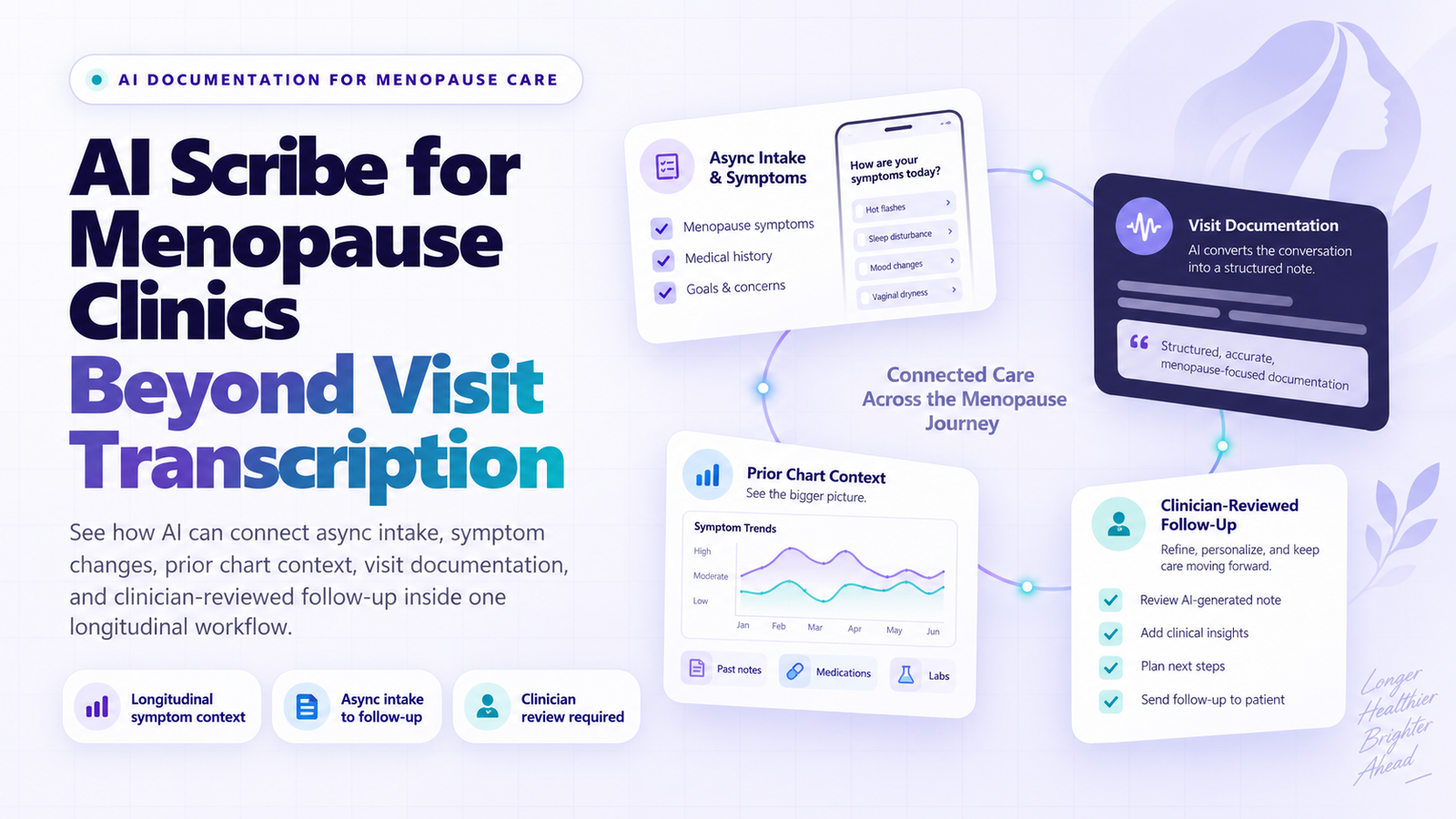
Async intake summarization
Symptom questionnaires, medication history, and patient-submitted forms can be summarized into a pre-visit brief before the clinician opens the encounter.
Connected chart updates
In addition, the value continues beyond documentation because the same visit data can support the record, coding preparation, follow-up tasks, and the next visit. The client portal and clinical record remain part of one operating workflow rather than disconnected systems.
Still, none of this replaces clinical judgment. Instead, it replaces the string of small administrative tasks that happen after the ambient scribe's job is already done. Consequently, these are the tasks that can keep a medical assistant an hour behind by mid-afternoon.
Ambient AI / AI Scribe vs Clinical AI
In other words, this table focuses on where the product's value stops, rather than how impressive the note looks during a vendor demo.
| Capability | Ambient AI / AI Scribe | Clinical AI (WealMD direction) |
|---|---|---|
| What it does | Listens to the visit and drafts a note | Understands the visit and supports actions from the data in it |
| Core output | Draft SOAP note or progress note for editing | Coded-note support, synthesized labs, draft Rx, and connected chart updates |
| Example tools | Abridge, Suki, Nuance DAX, Heidi | WealMD's clinical intelligence layer |
| ICD-10 coding | Usually manual or handled by a separate coder | Suggests codes from the note for confirmation |
| Lab synthesis | Usually outside the scribe workflow | Surfaces relevant lab results in the chart workflow |
| Prescription drafting | No. It may transcribe a dose mentioned in the visit | Drafts for clinician review; never autonomous |
| Where value stops | When the note is signed | Continues through coding preparation, labs, follow-up, and next-visit preparation |
How to Tell Which One You're Actually Being Sold
At first glance, most vendor demos are engineered to look similar: a clinician talks, then a polished note appears. Fortunately, these five questions reveal which layer you are actually evaluating in about ten minutes.
For example, “You export it” or “your biller picks it up from there” is an ambient-scribe answer.
By comparison, clinical AI should show suggested codes attached to the visit for confirmation. Meanwhile, an ambient scribe usually shows clean prose and stops.
For example, “The clinician enters them” indicates a separate manual step. Instead, clinical AI should surface relevant values from connected data.
In particular, do not ask whether it can transcribe a dose. Ask whether it prepares the actual draft workflow for the clinician to approve.
Typically, scribes listen only during an encounter. By contrast, clinical AI can also summarize information the patient submitted before the conversation starts.
Ultimately, these questions are not about accuracy or price. Instead, they are about where the product's job ends. Therefore, this is the quickest way to separate scribe marketing from a system built to do more.
Why This Distinction Matters More for HRT Clinics
Although every specialty benefits from documentation automation, HRT clinics gain more from connected workflow automation. Specifically, their workflow repeatedly connects notes, prescriptions, labs, controlled-substance documentation, and recurring care.
High visit-to-prescription ratio
For example, TRT and BHRT visits frequently lead to a prescription, refill, or dose adjustment. In that case, ambient AI drafts the note about that decision. By contrast, clinical AI can support the paperwork the decision requires.
Lab-heavy recurring monitoring
Similarly, baseline panels and follow-up monitoring create repeated lab-review work. However, a sentence saying “reviewed labs” does not remove the task of surfacing the actual values.
Controlled-substance documentation
Importantly, testosterone is a Schedule III controlled substance. Therefore, EPCS workflows require accurate documentation and a clinician-controlled signing process, not only a well-written note.
Cash-pay, high-volume operations
Finally, subscription clinics can scale visit volume faster than manual coding, lab entry, and refill preparation. As a result, the tasks left behind by a scribe compound across the day.
A provider seeing 15 patients daily creates 75 minutes of follow-up work when a medical assistant spends even five minutes per visit assigning codes and re-entering lab values the ambient scribe never touched.
However, this is not a verified client case study. Instead, it is a simple operational example showing why “time saved on notes” can understate the work that remains.
For clinics using virtual visits, WealMD's verified telehealth workflow keeps the encounter inside the same platform as the patient record and documentation.
The Honest Limits: Human-in-the-Loop Still Matters
None of this works without a clinician actively reviewing what AI produces at either layer.
For example, generative systems can produce fluent, plausible text that is not fully grounded in the encounter. However, published ambient-scribe error and hallucination rates vary widely because studies use different definitions and methods, but the consistent operational lesson is that every generated note, code suggestion, and prescription draft requires review.
Moreover, that risk does not disappear when a system moves from ambient scribing to clinical AI. In fact, it matters more because clinical AI can touch coding and prescription preparation, not only prose. Therefore, the safeguards that make the workflow appropriate are straightforward:
The clinician signs everything
Notes, code suggestions, and draft prescriptions are reviewed before they become final or leave the system.
Drafting, not deciding
Clinical AI proposes. It does not independently finalize a diagnosis, code, medication, or dose.
HIPAA-aware handling
Confirm BAAs, access controls, and how protected health information moves through every model and vendor.
Ultimately, liability does not move to the software. The professional who signs the chart owns it, just as before AI-assisted documentation existed.
Review WealMD's existing security and HIPAA controls, including encryption, role-based access, audit logs, backups, and monitoring.
Frequently Asked Questions
Is an AI scribe the same as ambient AI?
In most cases, yes. Specifically, both terms describe software that listens to a visit and drafts a note afterward. However, differences between individual products are usually about accuracy, integrations, and specialty tuning rather than a separate product category.
What is the real difference between an AI scribe and clinical AI?
In practical terms, an AI scribe, or ambient AI, stops at the drafted note. By contrast, clinical AI continues past it by supporting coding suggestions, surfacing lab results, and preparing draft actions for clinician review.
Is WealMD an AI scribe?
WealMD includes ambient-style documentation support, but it builds toward the broader clinical AI category: connected documentation, coding suggestions, lab context, forms, alerts, and workflow support inside one EMR rather than a separate transcription tool.
Do AI scribes make mistakes?
Yes. Published error and hallucination rates vary by study, and every AI-generated note or draft at any layer needs clinician review before it becomes part of the medical record.
Which layer should an HRT clinic buy first?
Initially, an ambient scribe is a reasonable starting point for a clinic with no AI documentation. However, a clinic that already uses one but still relies on staff to code, re-enter labs, and prepare refills manually has likely outgrown Layer 2 and should evaluate clinical AI.
Does switching to clinical AI mean replacing the existing EMR?
Not necessarily. For example, some products operate as add-ons. By contrast, WealMD builds AI assistance natively into the EMR because documentation, lab context, coding, forms, and chart updates read from the same visit data and are easier to govern when they do not live in separate systems.
Where This Leaves You
“AI scribe vs ambient AI” is a search with very little daylight between the two answers. Therefore, the terms are close enough to be interchangeable for most buying decisions.
However, the distinction that changes what an HRT clinic gets is ambient AI versus clinical AI: a system that listens and writes, versus one that understands the documented visit well enough to support coding, synthesize the relevant lab context, and draft what comes next for clinician review.
Consequently, for a hormone clinic managing recurring titrations, lab panels, EPCS-aware prescribing, and high patient volume, that second layer is where more of the administrative time can come back. Accordingly, WealMD builds toward that layer specifically for HRT, TRT, BHRT, and menopause workflows.
Research Note
Hallucination and error-rate discussion in this article reflects published clinical AI scribe research, including peer-reviewed note-quality evaluations and independent analyses of ambient-scribe accuracy across specialties. Therefore, reported rates vary substantially by study methodology and by how each study defines an error or hallucination; the article therefore describes the range and the operational implication rather than presenting one number as universal.
Do not stop the workflow when the note is signed.
See how WealMD connects AI-assisted documentation with patient records, forms, alerts, telehealth, and the clinical workflow HRT practices manage every day.