AI Prescription Generation for TRTHow It Works and What Clinics Need to Know
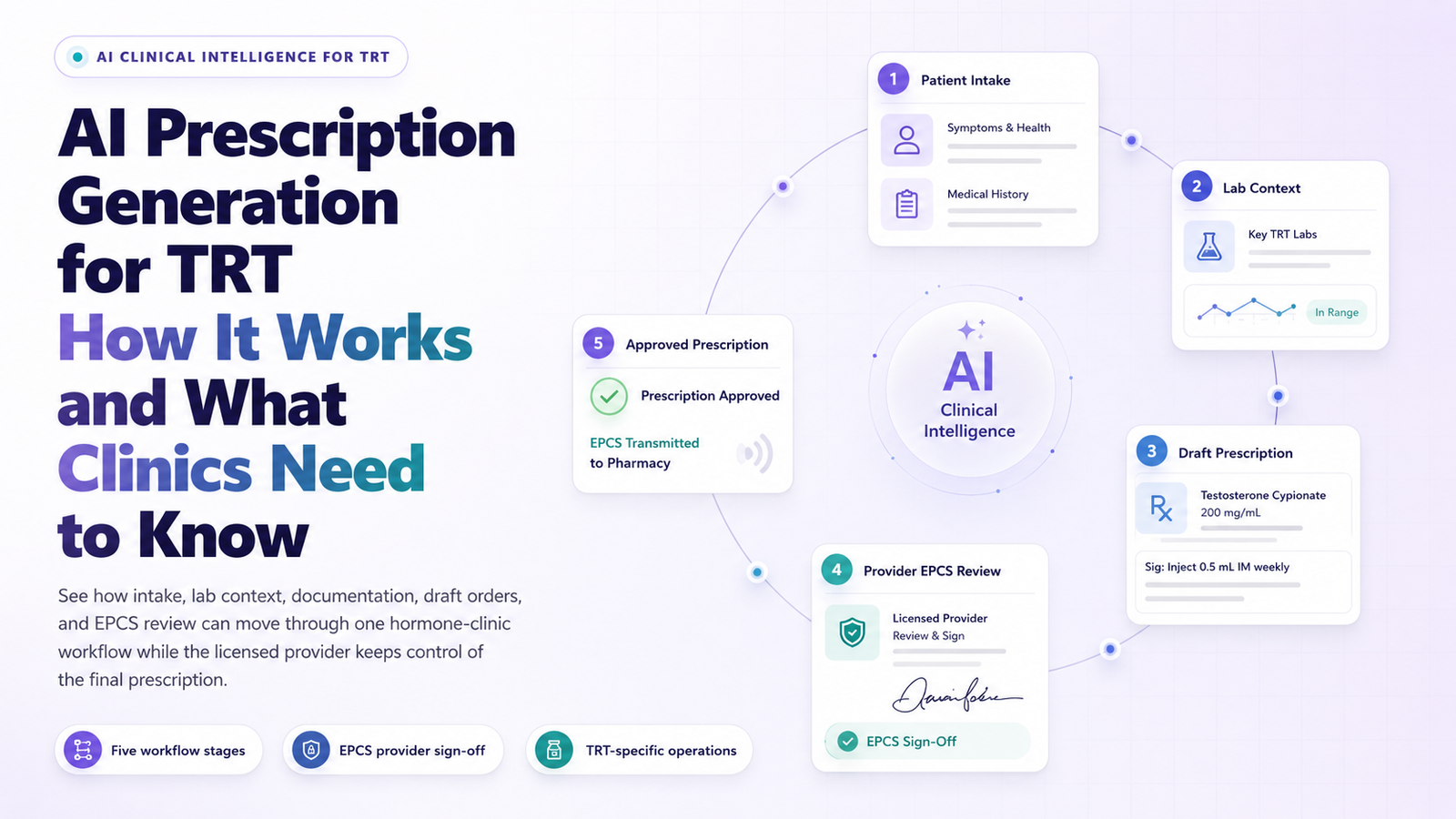
See how intake, lab context, documentation, draft orders, and EPCS review can move through one hormone-clinic workflow while the licensed provider keeps control of the final prescription.
Medical review pending: The source brief classifies this article as full MD/NP review tier because it discusses prescription drafting, controlled-substance workflows, and clinical decision support. The design is ready for CMS use, but the clinical claims should not be published as medically reviewed until a licensed reviewer signs off.
AI prescription generation for TRT is changing how hormone clinics move a patient from lab draw to a signed prescription. Testosterone Replacement Therapy and broader HRT clinics are growing quickly, yet clinicians still lose time sorting lab panels, re-entering information across disconnected systems, and manually rebuilding controlled-substance orders.
The operational opportunity is not autonomous prescribing. It is a connected workflow that can organize patient intake, bring lab context into the chart, prepare documentation, populate a draft order, and then stop at the point where the credentialed practitioner reviews and signs.
This guide breaks down that workflow, the role of EPCS, where telehealth rules fit, and why specialty software matters more for recurring hormone-care operations than a generic primary-care EMR.
The Operational Bottleneck in TRT and HRT Clinics
TRT is a recurring-care workflow. Each cycle can involve intake updates, hormone-panel review, documentation, prescribing, pharmacy coordination, and follow-up tasks. When those functions live in separate systems, the clinician repeatedly rebuilds the same patient context.
Review multiple biomarkers
Providers may need Total Testosterone, Free Testosterone, SHBG, Estradiol, CBC, PSA, and the patient's prior trend visible in the same review window.
Cross-reference history
Current values matter more when they are viewed beside earlier results, treatment history, symptoms, and the patient's existing medication record.
Prepare documentation
The consultation note, treatment rationale, and follow-up plan need to be complete before the final prescribing workflow is closed.
Complete controlled-substance steps
Testosterone is a DEA Schedule III controlled substance, so electronic prescribing must remain inside an authorized EPCS process with provider authentication.
Coordinate follow-up and pharmacy workflow
Multi-state licensure, patient location, preferred pharmacies, compounded formulations, and scheduled follow-up can all add operational steps after the clinical decision itself.
Generic EMRs often make each of those tasks possible, but not necessarily connected. That is where administrative friction accumulates: extra clicks, duplicated typing, portal switching, and more opportunities for the chart and the order to drift apart.
How AI Prescription Generation for TRT Works
Adding AI to prescription generation does not remove the provider. The useful design is an administrative and clinical-intelligence layer that prepares information for review while the final prescription stays under licensed practitioner control.
The platform's job is to reduce repeated data entry and make the relevant chart context easier to review. The clinician's job does not change: confirm that the prescription is appropriate, verify the content, and complete the authorized signing workflow.
Inside the AI-Assisted Prescription Workflow
Automated patient intake and data aggregation
The process begins before the live visit. Patients can complete structured questionnaires covering symptoms, medical history, lifestyle information, and treatment goals. Lab results can then arrive through integrated data feeds instead of being retyped from faxed reports or separate portals.
Lab synthesis and pattern recognition
The clinical intelligence layer can organize multiple biomarkers together rather than displaying isolated high or low flags. Current results can be placed beside prior trends and symptom context so the practitioner has a more complete review surface.
For a deeper look at this layer, see AI Lab Interpretation for Testosterone Panels.
Treatment-plan and order drafting
Clinic-configured protocols can help populate a draft treatment-plan workflow based on the information already present in the chart. The output remains a draft for the practitioner to evaluate rather than an autonomous prescribing action.
Ambient documentation and auto-populated prescription fields
Once the consultation note exists, the prescription workflow does not need to begin from an empty form. Patient demographics, documented diagnosis, history, and reviewed plan can flow into the draft order so staff are not typing the same information twice.
See AI SOAP Notes for HRT Visits for the documentation layer that feeds this workflow.
Provider review, validation, and EPCS authorization
The provider reviews the patient file, lab context, note, and proposed order together. They can modify, accept, or rewrite any part of the plan. Only after that review does the credentialed practitioner complete the controlled-substance signing workflow.
The Clinical and Operational Value for Specialized Practices
The biggest operational difference is not a single AI feature. It is how many manual handoffs disappear between the patient record and the final provider review.
| Clinical feature | Legacy workflow | Connected AI-assisted workflow |
|---|---|---|
| Lab data entry | Manual entry from PDFs, faxes, or separate lab portals | Structured lab ingestion and organized chart context |
| Lab and protocol review | Manual comparison against previous results and clinic references | Relevant trends and configured review logic surfaced for the practitioner |
| Documentation | Repeated typing across note and prescription workflow | Draft documentation prepared from available chart data |
| Prescription routing | Separate lookup, re-entry, and EPCS steps | Draft order prepared inside the same record, followed by provider-controlled EPCS authorization |
| Follow-up tracking | Manual spreadsheets or disconnected reminders | Task support linked to the patient record and follow-up schedule |
The practical gain is time recovery. When providers spend less time searching for lab values, moving between portals, and retyping routine chart information, they can close charts faster without turning the prescription decision over to software.
Navigating DEA, EPCS, and Telehealth Requirements
Because testosterone is a Schedule III controlled substance, any AI-assisted workflow has to fit inside federal and state prescribing requirements rather than bypass them.
EPCS stays provider controlled
DEA guidance requires the prescribing practitioner to review controlled-substance prescriptions before signing them. The electronic application must meet DEA requirements, and the practitioner still completes the required authentication and signing step.
Telehealth rules remain time sensitive
DEA and HHS extended the current telemedicine flexibilities through December 31, 2026. Multi-state clinics should still verify patient location, state law, licensure, registration, and any additional prescribing requirements that apply to each encounter.
Privacy and vendor governance matter
Clinics should verify HIPAA-aligned handling, appropriate Business Associate Agreements, encryption, access controls, auditability, and the path protected health information takes through any AI vendor or subprocessor.
DEA's December 31, 2025 announcement confirms that the fourth temporary extension of telemedicine flexibilities runs through December 31, 2026. Clinics should still confirm applicable federal and state requirements before prescribing.
Why Generic EMR Platforms Fall Short for TRT Workflows
General-purpose EMRs are built to cover many specialties. HRT clinics, however, repeat a narrower set of workflows at high frequency: longitudinal hormone-panel review, controlled-substance prescribing, async intake, recurring follow-up, and coordination with specialty pharmacies.
Longitudinal hormone context
A specialty workflow should make recurring testosterone, estradiol, SHBG, and safety-marker trends easier to review without rebuilding a spreadsheet.
Connected EPCS workflow
The prescribing process should remain close to the chart and provider review step rather than forcing multiple logins and manual re-entry.
Async intake
Patient-entered symptoms and history should feed the visit instead of living in a separate form that staff have to summarize manually.
Specialty pharmacy context
Hormone clinics often need workflows that accommodate compounded medications and preferred pharmacy relationships alongside standard e-prescribing.
That is why the platform decision matters as much as the AI feature. A strong draft generator sitting on top of a fragmented operating system can still leave staff with the same handoffs after the note is finished.
Use WealMD's HRT EMR Buyer's Guide 2026 to compare EPCS depth, lab integration, async intake, AI clinical intelligence, telehealth architecture, and compounded-medication support.
Where WealMD Fits
WealMD is built around hormone and wellness clinic operations rather than generic primary-care workflows. The platform brings patient intake, lab context, documentation, AI assistance, prescribing workflow, telehealth, and recurring practice operations into one clinical record.
The goal of the AI layer is not to create an autonomous prescriber. It is to make the provider's review surface more complete, reduce duplicated typing, and connect the patient data already in the chart with the administrative steps that follow the consultation.
Async intake
Patient history and structured responses can enter the record before the visit starts.
AI-assisted documentation
Clinical notes and summaries can be prepared as drafts for provider review.
Lab context
Hormone-panel information can stay connected to the same longitudinal chart instead of living in a separate portal.
Prescribing workflow
Draft order preparation can lead into the provider-controlled prescribing and EPCS process without forcing staff to rebuild the record.
Read AI Clinical Intelligence for HRT for the framework that connects ambient documentation, lab synthesis, coding support, and draft clinical actions inside the same EMR.
Frequently Asked Questions
Does AI prescription generation remove the doctor from the loop?
No. The workflow can organize data, draft documentation, and prepare a proposed order, but a licensed practitioner must review the clinical context, validate the prescription, and complete the authorized signing process before it reaches a pharmacy.
Can AI automatically prescribe testosterone?
No. Testosterone is a controlled substance. AI can support the preparation workflow, but the prescription remains subject to practitioner review, applicable controlled-substance rules, and the required EPCS authorization when prescribed electronically.
What does EPCS change in an AI-assisted workflow?
EPCS establishes the controlled electronic-prescribing process. The software may prepare prescription information, but the credentialed practitioner reviews the controlled-substance prescription and signs it using the required authentication workflow.
How can the workflow handle custom compounding-pharmacy prescriptions?
A specialty platform can support clinic-specific medication records, strengths, formulations, and preferred pharmacy routing. Clinics should verify the exact compounding-pharmacy capabilities available in the vendor's production system before purchase.
What are the current federal telemedicine flexibilities for controlled-substance prescribing?
DEA and HHS extended the current federal telemedicine flexibilities through December 31, 2026. The extension does not remove other requirements, so practitioners still need to comply with DEA guidance, federal regulations, state law, licensure, registration, and any rules that apply to the patient and encounter.
Primary References
- U.S. Drug Enforcement Administration. DEA Extends Telemedicine Flexibilities to Ensure Continued Access to Care. December 31, 2025.
- U.S. Drug Enforcement Administration, Diversion Control Division. Electronic Prescriptions for Controlled Substances Q&A.
- Endocrine Society. Testosterone Therapy for Hypogonadism Guideline Resources.
Keep prescription drafting connected to the chart, labs, and provider review.
See how WealMD brings AI assistance, hormone-clinic records, telehealth, documentation, and practice workflows together without removing the practitioner from the prescribing decision.