AI Scribe for Menopause Clinics Beyond Visit Transcription
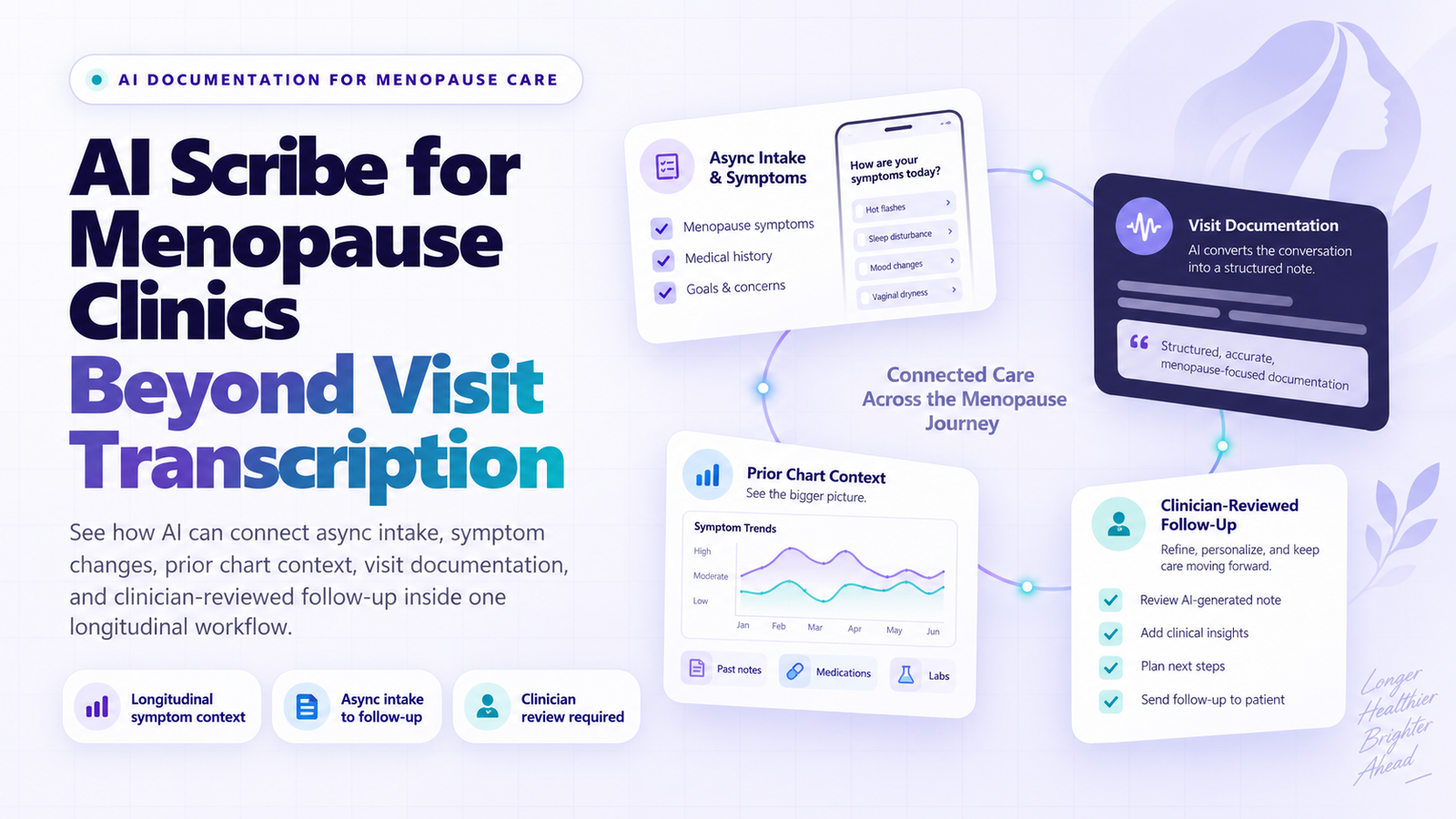
See how AI can connect async intake, symptom changes, prior chart context, visit documentation, and clinician-reviewed follow-up inside one longitudinal workflow.
Workflow scope: This article discusses documentation and clinic operations. It does not provide guidance on HRT dosing, diagnosis, treatment selection, or interpretation of individual patient results. AI-generated clinical content should remain draft material until reviewed and signed by the treating clinician.
An AI scribe for menopause clinics should do more than turn a conversation into a SOAP note. The useful test is what happens after the transcript. Can the system preserve symptom changes across visits, bring structured intake into the chart, surface relevant longitudinal data, prepare an HRT follow-up note, and leave every clinical decision with the practitioner?
That distinction matters because menopause and BHRT care is longitudinal. A follow-up is rarely an isolated encounter. The practitioner may need to understand what changed since intake, which symptoms improved or persisted, what the patient reported between visits, which medications are currently documented, and which items need clinician attention.
A conventional ambient scribe can reduce the work of writing today's note. An AI-native EMR can potentially reduce the work of reconstructing the patient's story across several encounters.
Why Menopause Documentation Is a Longitudinal Problem
Consider a typical follow-up. A patient completes an intake or interval questionnaire before a virtual appointment. The practitioner opens the chart and reviews symptom changes, prior documentation, medication history, messages since the last encounter, and any available laboratory information. New details emerge during the visit. Afterward, the practitioner documents the assessment and plan, updates the chart, and establishes the next follow-up.
None of those tasks is unusual. The operational problem is fragmentation.
A concern recorded during intake can become difficult to compare with the same concern described differently during later visits.
Patient-reported changes between encounters may sit outside the note the practitioner opens for the next appointment.
The current list, last documented plan, and what the patient says today may not appear together without manual reconciliation.
Two accurate encounter notes still leave work for the practitioner if the system does not make the change between them visible.
The practitioner often has to reconstruct the timeline mentally. That is why the right AI scribe for menopause clinics should be evaluated as part of the broader documentation system, not only by how accurately it transcribes a 20-minute conversation.
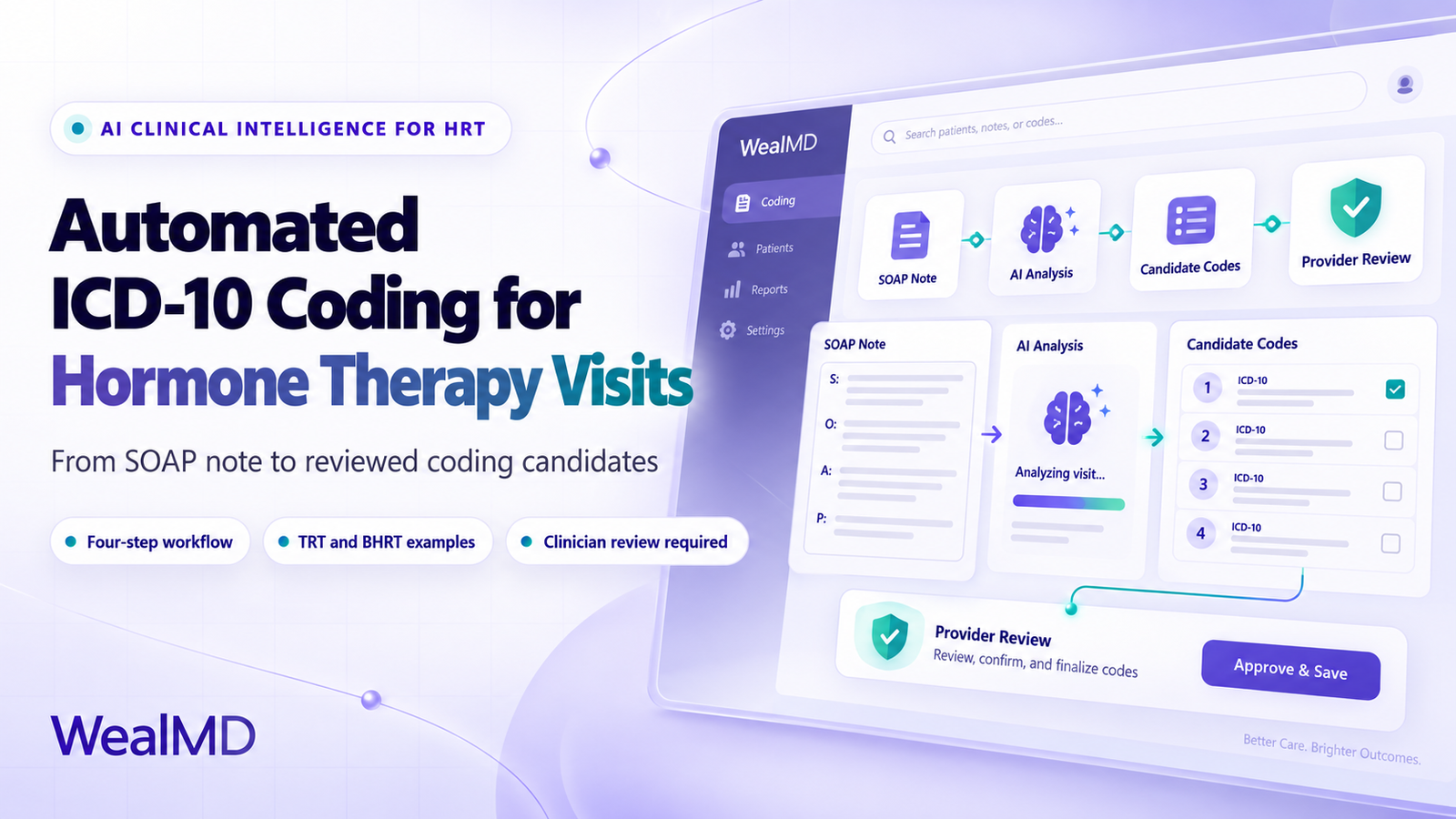
See AI Clinical Intelligence for Hormone Therapy for the difference between a documentation layer and a workflow that continues after the note is created.
Ambient AI Scribe Versus Menopause Clinical Workflow
A basic ambient scribe and an AI-native menopause EMR can both draft a visit note. The difference is the context available around that note and how far the workflow continues.
| Workflow | Basic ambient scribe | AI-native menopause EMR |
|---|---|---|
| Capture the visit conversation | Yes | Yes |
| Draft a structured visit note | Yes | Yes |
| Summarize pre-visit async intake | Varies | Can be native to the chart |
| Compare symptoms with prior visits | Usually limited | Can use longitudinal chart context |
| Surface relevant prior information | Varies by integration | Built around the longitudinal record |
| Prepare coding suggestions | Varies | Can be integrated for review |
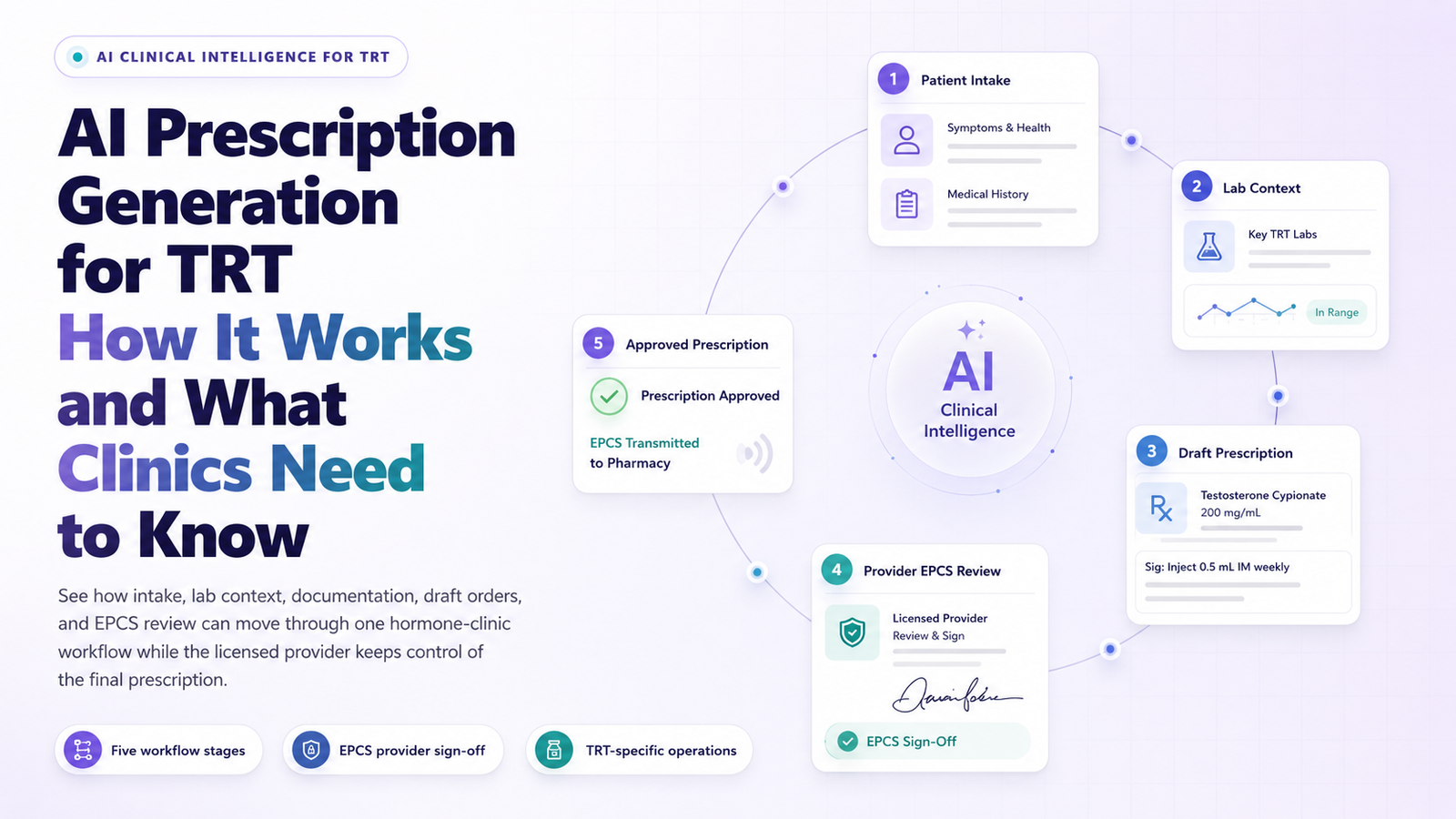
| Prepare a prescription workflow | Usually outside scope | Can prepare a draft for clinician review |
| Keep telehealth, charting, and follow-up together | Usually requires integrations | Can operate as one workflow |
| Act autonomously on treatment | No | Should not |
The final row matters most. Clinical intelligence should not mean autonomous medicine. It should use information already available in the authorized workflow to reduce repetitive chart work while the licensed practitioner remains responsible for clinical judgment and final documentation.
A 2026 review found evidence of reduced documentation burden, along with frequent omissions and occasional clinically significant hallucinations. Review the PubMed record.
A Veterans Health Administration evaluation compared 11 AI scribe tools with human note takers across five standardized primary care cases. The AI-generated notes had lower quality scores. Review the PubMed record.
Symptom Tracking Should Survive the Visit
A menopause clinic gains little from capturing a symptom perfectly if that symptom disappears into free text afterward. Suppose an intake captures several patient-reported concerns. At the next visit, some have improved, some are unchanged, and a new concern appears. A weak workflow produces two polished but disconnected notes. A stronger workflow preserves structured information so the practitioner can see the trajectory without rereading the entire chart.
Patient-reported symptoms enter the authorized chart workflow.
Questionnaires and messages add new patient-reported context.
Improved, persistent, and newly reported concerns are separated for review.
The practitioner decides what the documented change means for care.
The AI should not decide whether a symptom is clinically meaningful. Its job is to make the documented change visible to the practitioner who makes that determination.
Ask the vendor to show symptom change across three fictional visits. Do not settle for one impressive note generated from a clean recording.
HRT Follow-Up Notes Need Context, Not Only Transcription
Medication-related follow-ups expose the limits of a stand-alone scribe quickly. An ambient tool can document what the practitioner and patient said. The workflow may still require someone to open the medication list, review earlier documentation, find the last plan, reconcile the current record, prepare subsequent documentation, and move to a separate prescribing interface.
An AI-native system has access to more workflow context because the documentation layer and chart live together. It can prepare a draft that clearly separates the following information:
What the patient says has changed since the prior encounter.
Relevant history that was already documented in the authorized record.
The medication information currently recorded in the EMR for reconciliation.
Information captured during the present encounter and organized into draft documentation.
The plan documented by the treating practitioner after review.
Conflicts or missing information surfaced for a person to resolve.
The system should not independently decide that an HRT regimen must be increased, decreased, started, or stopped. Ask what the model can draft, what requires a clinician action, what enters the chart automatically, and what cannot become final without approval.
Read AI SOAP Notes for HRT Visits for the provider review step between generated documentation and the signed chart.
The Follow-Up Workflow Starts Before the Video Call
Telehealth-heavy menopause clinics have another problem with the traditional scribe model. Substantial work happens when nobody is speaking. There may be async intake before the visit, questionnaires between visits, portal communication, lab information, and staff preparation. A voice-only scribe sees none of that unless another system supplies the information.
Structured forms capture interval changes before the appointment.
Relevant history is prepared for the practitioner's review.
The visit adds current detail and produces draft documentation.
The clinician corrects, approves, signs, and establishes the next action.
This connected model targets the work surrounding the encounter. A recording-to-transcript-to-note workflow primarily targets documentation time. Both can be valuable, but clinics should know which one they are buying.
Across 198,178 encounters, ambient AI was associated with a 1.6-minute reduction in adjusted median documentation time per note compared with no scribe. The study found no significant difference in clinical productivity. Review the PubMed record.
In a trial of 238 outpatient physicians, Nabla reduced time in notes by 9.5 percent versus control, while DAX showed no significant change on that outcome. Both tools still required vigilance for inaccuracies. Review the PubMed record.
For an HRT operator, the takeaway is practical: do not buy the category claim. Test the clinic's actual workflow.
What WealMD Does Differently and Where It Still Has to Prove Itself
WealMD's direction is broader than placing an ambient recorder beside an existing EMR. The platform is being built around hormone therapy workflows that can connect async intake, virtual visits, chart-based AI assistance, SOAP note generation, coding suggestions, lab context, and draft actions inside the EMR workflow. Clinical outputs remain subject to clinician review.
Documentation can draw from the same authorized record that contains forms, prior notes, medications, and follow-up information.
Coding support, alerts, form pre-fill, and connected chart actions can sit beside documentation instead of requiring a separate tool.
The clinician reviews the output before it becomes final. That boundary applies to notes, codes, and draft prescription workflows.
The system is designed around recurring TRT, BHRT, and menopause workflows instead of adding specialty context after the fact.
There are limitations worth stating clearly. WealMD is a newer brand than established platforms such as OptiMantra and Cerbo, so clinics that prioritize years of market history may prefer an incumbent. Pricing transparency is another weakness. A public, self-service rate card would make early comparison easier.
No architecture eliminates the central AI risk. Generated documentation can omit, misstate, or overgeneralize information. Clinician review remains necessary. The useful comparison is how much repetitive workflow the AI can safely prepare before the practitioner has to intervene.
Explore WealMD's live AI Assistance features, including note suggestions, summaries, pattern detection, code suggestions, alerts, and form pre-fill.
The 8-Minute Demo Test for a Menopause AI Scribe
Do not let a vendor choose its cleanest prerecorded encounter. Give the sales team a fictional longitudinal menopause workflow and ask them to demonstrate it live.
| Demo test | What you are looking for |
|---|---|
| 1. Import pre-visit intake | Does the information become usable chart context or only a PDF? |
| 2. Show the prior encounter | Can the system retrieve relevant history without chart hunting? |
| 3. Record a follow-up | Does it create structured draft documentation? |
| 4. Change one reported symptom | Can it show what changed since the previous visit? |
| 5. Mention a medication discrepancy | Does it flag the inconsistency for review instead of silently resolving it? |
| 6. Show available lab context | Is longitudinal information accessible without opening multiple screens? |
| 7. Generate the draft note | Can the clinician see and edit what the AI produced before signing? |
| 8. Correct the AI | Is the correction workflow fast, traceable, and easy to audit? |
If two products create similarly good notes, the number of screens, manual handoffs, and repeated entries usually says more about operational fit than the length of the AI feature list.
Red Flags When Evaluating an AI Scribe for a Menopause Clinic
Be cautious when a vendor cannot explain how data moves through the workflow or only demonstrates a perfect final note. A responsible evaluation should cover the complete documentation path.
The vendor should explain where recordings and generated data are processed, how source audio is retained, and who can access it.
Confirm that the appropriate agreements cover every relevant vendor and subprocessor that may handle protected health information.
The product should distinguish a generated draft from the clinician-approved documentation that becomes part of the legal medical record.
Ask the vendor to show a mistake being corrected, not only a polished note produced from ideal input.
The interface should make uncertain or conflicting information easy to identify instead of hiding it behind fluent prose.
Be wary of claims that the system independently chooses treatment, finalizes diagnoses, or executes prescriptions without clinician approval.
What happens when the AI is uncertain? The answer should describe a visible review, correction, or escalation path, not a general disclaimer.
Frequently Asked Questions
What is the best AI scribe for menopause clinics?
There is no universal winner. A clinic seeking faster encounter documentation may be well served by an ambient scribe. A telehealth-heavy menopause or BHRT clinic that also wants async intake, longitudinal chart context, integrated documentation, and downstream workflow support should evaluate an AI-native EMR as well as stand-alone scribes.
Can an AI scribe track menopause symptoms between visits?
Only if the product has access to structured longitudinal information or is integrated deeply enough with the EMR. A stand-alone ambient scribe primarily captures the current encounter. Ask vendors to demonstrate symptom changes across multiple fictional visits.
Can AI write HRT follow-up notes?
AI systems can draft structured follow-up documentation from authorized encounter and chart information. The practitioner should verify the output for omissions, factual errors, and inappropriate inferences before signing it.
Is an AI scribe the same as an AI EMR?
No. An AI scribe is primarily a documentation layer. An AI EMR is the system of record and can connect AI assistance with intake, chart history, labs, coding, prescribing workflows, telehealth, and follow-up processes.
Should menopause clinics use AI-generated notes without reviewing them?
No. Current research continues to identify omissions and factual errors in AI-generated documentation. A licensed clinician should review generated clinical documentation before it becomes final.
What should a menopause clinic ask during an AI scribe demo?
Ask the vendor to demonstrate a complete longitudinal workflow: pre-visit intake, prior chart context, symptom changes, the encounter, note generation, correction, clinician approval, and follow-up. Also ask about data handling, auditability, integrations, and exactly which actions require human approval.
The Decision Is Bigger Than the SOAP Note
An AI scribe for menopause clinics is useful when documentation itself is the bottleneck. Menopause and BHRT practices should still avoid optimizing one 20-minute encounter while leaving the rest of the patient journey fragmented.
If staff still summarize intake, hunt through earlier notes, reconcile longitudinal information, prepare downstream chart work, and move between separate telehealth, prescribing, and EMR systems, a better transcript solves only one part of the problem.
The dividing line is whether the technology stops at ambient documentation or supports a connected, clinician-reviewed workflow. When evaluating WealMD or another platform, bring the eight-step test to the demo and make the system work through the clinic's actual menopause follow-up process. A polished note is easy to show. A connected workflow is harder to fake.
Research References
The studies below inform the discussion of documentation burden, note quality, implementation variability, and clinician oversight.
- Transforming clinical documentation with ambient artificial intelligence scribes. Narrative review of technology, impact, and implementation. Cardiovascular Diagnosis and Therapy. 2026.
- Rapid Evaluation of Artificial Intelligence Technology Used for Ambient Dictation in Primary Care. Comparison of AI-generated and human-produced clinical notes. Annals of Internal Medicine. 2026.
- Medical Scribe and Ambient Artificial Intelligence Impact on Emergency Physician Documentation Burden and Clinical Productivity. Annals of Emergency Medicine. 2026.
- Ambient AI Scribes in Clinical Practice. A randomized trial of two ambient scribe applications. NEJM AI. 2025.
Test the complete menopause workflow, not only the transcript.
See how WealMD connects AI-assisted documentation with intake, chart context, records, alerts, telehealth, and the operating workflow hormone therapy clinics manage every day.