AI Lab Interpretation for Testosterone PanelsA Practitioner's Guide
AI lab interpretation for testosterone panels can help hormone clinics organize total testosterone, free testosterone, SHBG, estradiol, hematocrit, and related markers into one reviewable clinical picture. The software surfaces patterns and drafts documentation. The clinician still interprets the patient and signs the chart.
Medical review pending: The source brief classifies this article as full MD/NP review tier because it discusses lab interpretation and safety monitoring. The page structure is ready for CMS use, but the clinical content should not be published as medically reviewed until a licensed reviewer signs off and their name and credentials are added.
AI lab interpretation for testosterone panels is becoming an important operational layer for hormone optimization clinics that can no longer keep pace with manual chart review. A comprehensive endocrine panel is not one number. Providers have to interpret interacting biomarkers, historical trends, symptoms, and treatment context together.
As TRT and BHRT volumes grow, that work can create a recurring bottleneck. A well-designed interpretation layer can organize the data, highlight changes that deserve attention, and prepare a structured summary without taking the clinical decision away from the provider.
The Analytical Challenge of Modern Endocrine Panels
Interpreting a comprehensive hormone profile is rarely as simple as checking whether a single result falls inside a reference range. A diagnostic panel designed to assess gonadal function includes multiple biomarkers that influence one another, and the provider has to evaluate those relationships at the same time.
Total testosterone
Represents the full amount of circulating testosterone, including hormone bound to transport proteins and the smaller unbound fraction.
Free testosterone
Represents the biologically available fraction that is not tightly bound to transport proteins and can be considered alongside the rest of the panel.
Sex hormone-binding globulin
SHBG binds testosterone with high affinity and can materially change how a normal-looking total testosterone result relates to the patient's free fraction.
Albumin
Albumin acts as a weaker secondary binding protein and contributes to calculated estimates of bioavailable and free testosterone.
Luteinizing hormone
LH is part of the pituitary signal involved in testosterone production and helps provide context when a provider is evaluating gonadal feedback patterns.
Follicle-stimulating hormone
FSH contributes additional gonadal context and is relevant to the broader evaluation of reproductive and pituitary signaling.
Estradiol
Estradiol is an important companion marker because changes can track with aromatization and the broader hormone picture.
Prolactin
Elevated prolactin can be relevant to gonadal signaling and is another example of why an isolated testosterone number does not tell the whole story.
A patient can have a total testosterone result that appears ordinary on a standard report while elevated SHBG reduces the free fraction. Likewise, a low testosterone result can mean something different depending on the accompanying pituitary markers. The software's role is to make these relationships easier to see consistently. The provider's role is to interpret what they mean for the actual patient.
How AI Lab Interpretation for Testosterone Panels Works
An AI interpretation engine can ingest structured biomarker data from laboratory feeds and evaluate that data alongside the patient's history and prior results rather than forcing the clinician to start from a flat list of numbers every time.
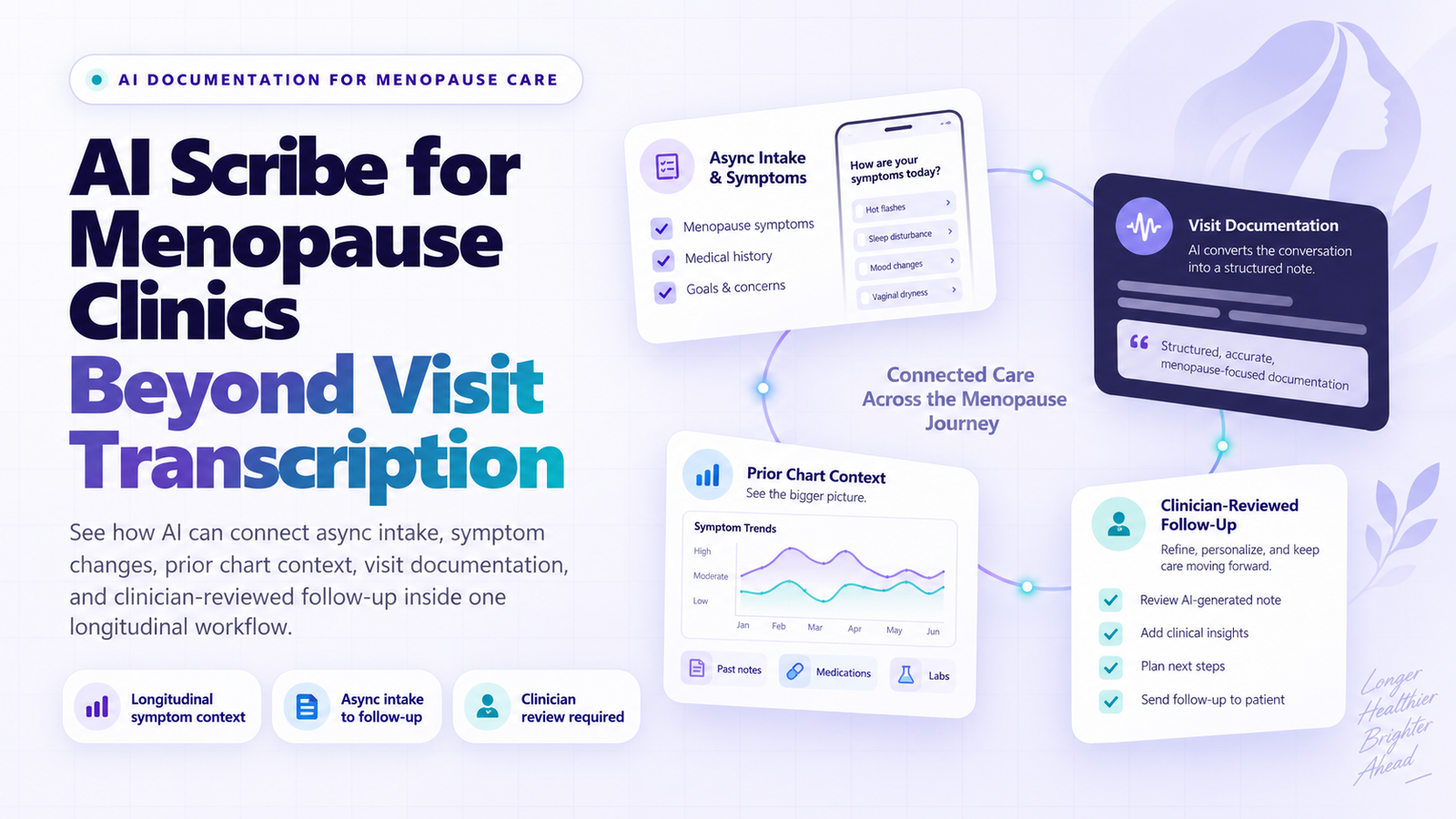
That longitudinal view is the operational advantage. If estradiol rises while free testosterone falls, or hematocrit moves consistently upward over several visits, the system can surface the pattern rather than depending on a busy provider to notice it while scanning separate reports.
Importantly, the engine does not decide what treatment should change. It identifies the pattern, puts the relevant information together, and gives the clinician a better starting point for review.
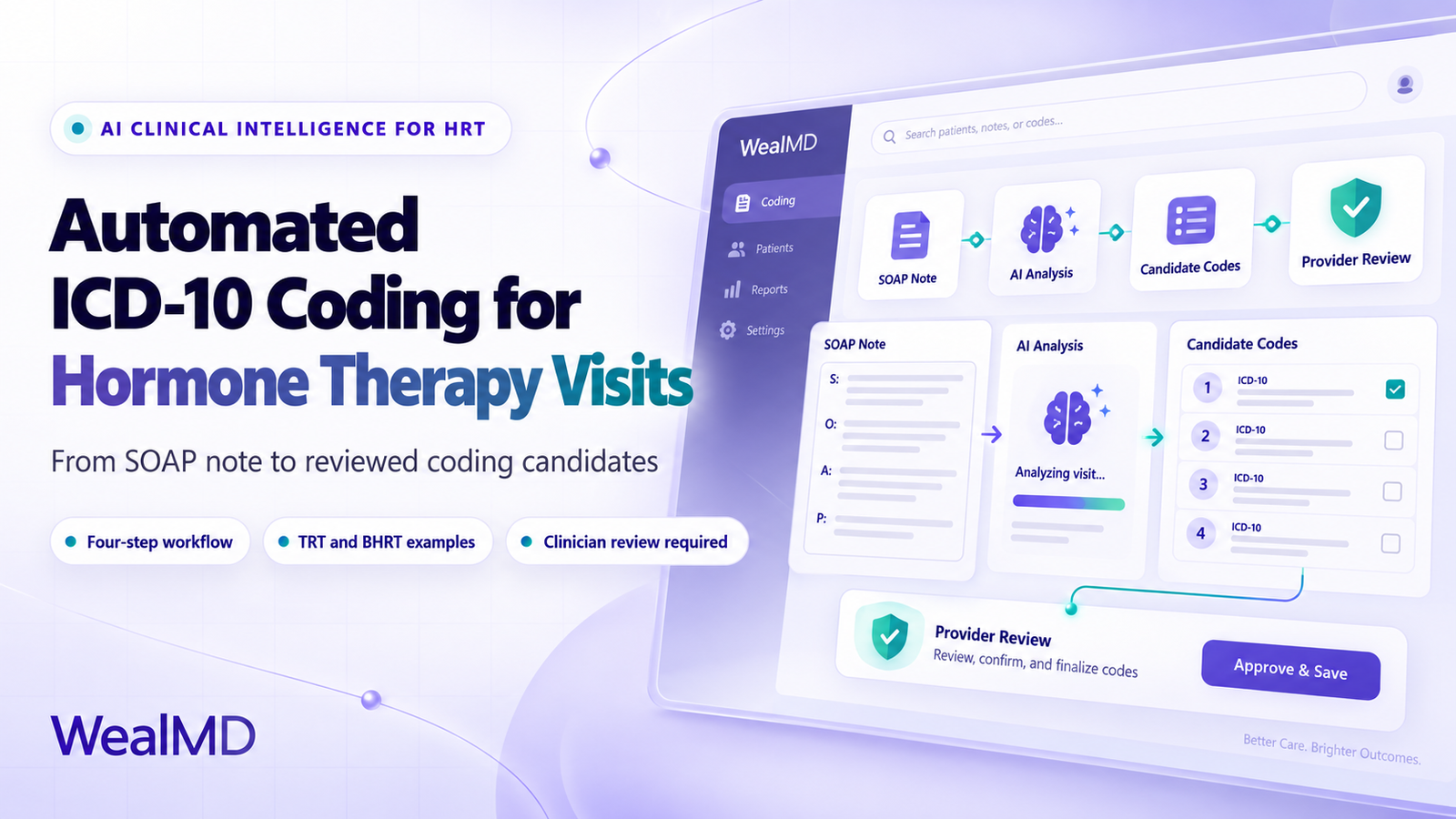
WealMD's live AI SOAP Notes for HRT Visits guide shows the same operating principle on the documentation side: AI drafts, the provider reviews, and the signed chart remains a clinician-owned record.
Free vs Total Testosterone: Where Static Calculators Fall Short
Total testosterone alone is an incomplete proxy for androgen status, which is why interpreting free testosterone versus total is one of the recurring challenges in TRT and BHRT chart review. Many laboratory reports calculate free testosterone using a fixed formula that incorporates assumed binding relationships.
The context matters. SHBG and albumin influence how much testosterone is bound versus available. An AI interpretation layer can recompute and compare the calculated picture using current patient data, then place that result next to the patient's own prior trend.
This does not replace direct measurement when a clinician considers it indicated. It makes the calculated estimate and the longitudinal context easier to review between direct measurements.
The practical advantage is not that the software invents a new endocrine formula. It is that the chart no longer treats each lab draw as an isolated event. A provider can review the current estimate, the binding-protein context, and the patient's prior trajectory in one place.
Hematocrit and Red Blood Cell Safety Monitoring
Hematocrit belongs in the same review workflow as the hormone panel. The source brief emphasizes that testosterone therapy can increase erythropoiesis, which makes hematocrit and related blood-count markers important longitudinal safety data rather than a separate afterthought.
Baseline context
The panel should make the patient's baseline blood-count markers easy to locate before treatment history is interpreted.
Trend visibility
A rising trajectory across several draws can be more useful to notice early than waiting for a single result to become obviously abnormal.
Provider-controlled action
If a safety marker needs attention, the system should surface it and hold downstream automation for clinician review instead of allowing the workflow to proceed automatically.
The source brief discusses guideline-based monitoring intervals and threshold decisions, but those details require full MD/NP review before publication. The operational point is simpler and safer: the software should make hematocrit trend impossible to miss, keep it connected to treatment history, and route any concerning pattern back to the licensed provider.
Enhancing Clinical Workflows and Reducing Documentation Fatigue
Beyond lab analysis itself, the operational case for AI interpretation is significant. Providers need to document each review clearly, explain clinically meaningful changes, and close the chart accurately. Repeating that process across a high-volume hormone practice creates administrative load on top of direct patient care.
When the interpretation layer sits inside the EMR, it can draft a structured summary as soon as the results arrive: the current hormone picture, meaningful deviations from the patient's own baseline, the safety markers that deserve attention, and a narrative the provider can edit before signing.
The benefit is not autonomous medicine. It is less retyping and less chart reconstruction. The provider starts with an organized draft rather than a blank note.
Read AI Clinical Intelligence for HRT for the full framework showing how documentation, lab context, and draft workflow actions fit together inside a clinician-reviewed system.
Controlled Substance Workflow and Laboratory Integration
A useful lab intelligence layer depends on reliable data movement. Laboratory results should enter the chart as structured data rather than through repeated manual transcription or portal hopping. In practice, healthcare systems commonly exchange that information through standards such as HL7 or FHIR, with the exact implementation depending on the connected laboratory and EMR.
That structured feed matters because it gives the system discrete biomarker values that can be compared over time. It also reduces the operational risk created by copying numbers from one screen into another.
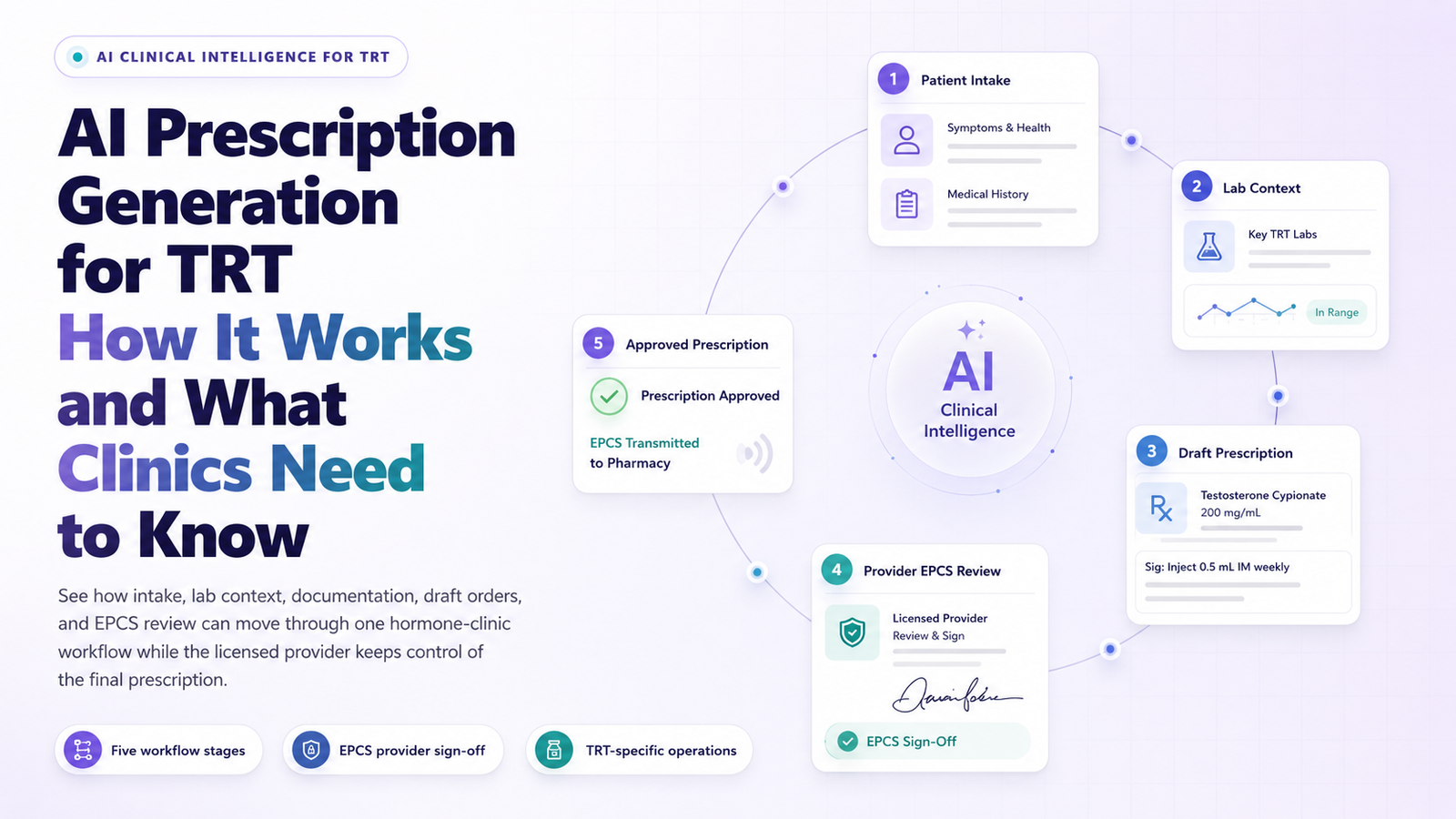
Testosterone prescribing adds another workflow boundary. AI can prepare context and draft documentation, but the prescribing action remains inside the authorized clinical workflow. For an HRT platform, that means lab context, patient history, and prescribing review should be close enough that the clinician can make the decision without rebuilding the chart manually.
Security and vendor governance matter here as well. Clinics should confirm HIPAA-aligned data handling, a signed Business Associate Agreement where required, encryption practices, access controls, and the exact path patient data takes through any AI processor.
Technical Architecture of AI Clinical Intelligence Engines
These systems are not only text generators. A serious implementation is a structured healthcare data pipeline with distinct stages for ingestion, normalization, clinical logic, and secure output.
Ingestion
Structured laboratory transmissions are parsed into discrete biomarker fields that the EMR can store and trend.
Clinical logic
Rules and pattern detection evaluate current results against the patient's history and the review logic configured by the clinic.
Safety screening
Relevant monitoring markers can be surfaced before downstream chart or prescribing actions continue.
Secure output
The interpretation becomes a reviewable chart summary rather than an autonomous clinical decision.
WealMD's existing AI Assistance page describes smart note suggestions, summaries, alerts, pattern detection, form pre-fill, and other AI-supported workflow features already presented on the platform.
Quick Reference: Lab Patterns an AI Interpretation Engine Should Surface
The table below is adapted directly from the source brief. It is a review aid, not a treatment protocol. Each pattern should be presented to the clinician as context for interpretation rather than acted on automatically.
| Pattern | Why it matters |
|---|---|
| Normal total T with elevated SHBG | Free testosterone may be lower than the total value alone suggests. |
| Low total T with low LH | The source brief identifies this as a pattern that can point the provider toward secondary rather than primary gonadal dysfunction. |
| Rising estradiol with falling free T | A changing relationship between the two values can deserve focused clinical review rather than being read as isolated numbers. |
| Hematocrit rising across visits | The trajectory can be a meaningful safety signal and should remain visible to the provider before renewal or follow-up actions are completed. |
| Elevated prolactin | The source brief notes that prolactin can affect gonadal signaling independently of the testosterone result itself. |
The Role of Medical Software in Modern Specialized Practices
Generic EMRs are usually built for broad primary-care workflows, which means hormone-specific lab relationships can end up scattered across PDFs, generic flowsheets, or external portals. A specialty platform can bring lab integration, AI-assisted pattern detection, documentation support, and the rest of the HRT workflow closer together.
The distinction matters because a lab intelligence feature is only as useful as the record around it. If the current medication list, prior hormone panels, patient history, and next follow-up action live in different systems, the provider still spends time reconstructing context manually.
When evaluating an AI-enabled EMR, compare the whole workflow rather than the interpretation screen alone. Ask where the lab data comes from, how trends are stored, how draft output is reviewed, what happens when the model is wrong, and whether the system keeps the clinician in control of every final chart and prescribing action.
The live AI EHR vs AI Scribe guide explains why a documentation layer and a system of record solve different parts of the HRT workflow.
Frequently Asked Questions
How does AI compute free testosterone differently than a standard lab calculator?
A standard report may calculate free testosterone from a fixed formula using total testosterone, SHBG, albumin, and assumed binding relationships. An AI interpretation layer can place that estimate beside the patient's current SHBG, albumin, prior results, and longitudinal trend so the provider sees more context than a single isolated calculation.
Can an AI hormone panel interpretation tool replace clinical judgment?
No. The source brief defines the tool as an analytical assistant. It can organize data, calculate trends, surface patterns, and draft documentation, but the licensed provider reviews, edits, interprets, and signs the final record.
What can an AI estradiol interpretation workflow flag?
It can surface a significant change relative to the patient's own baseline, a mismatch between estradiol movement and the broader hormone trend, or another configured follow-up signal. Those observations should be routed to the provider rather than acted on automatically.
What security standards should this kind of software support?
Clinics should verify HIPAA-aligned handling, appropriate Business Associate Agreements, encryption in transit and at rest, access controls, auditability, and the data path through any AI subprocessors. Additional certifications should be described only when the vendor can substantiate them.
How do direct lab integrations improve the workflow?
Direct structured feeds reduce manual transcription, keep the current result connected to prior values, and give the interpretation engine discrete data that can be trended and surfaced for provider review inside the chart.
Bring lab context into the same workflow as the chart.
See how WealMD connects AI assistance with patient records, documentation, alerts, forms, telehealth, and the broader operating workflow hormone therapy clinics manage every day.