FDA BHRT Regulations: Compounding Compliance for Clinics
A clinic guide to FDA rules for compounded BHRT: 503A and 503B supply, ingredient and copy limits, pharmacy checks, and testosterone controls.
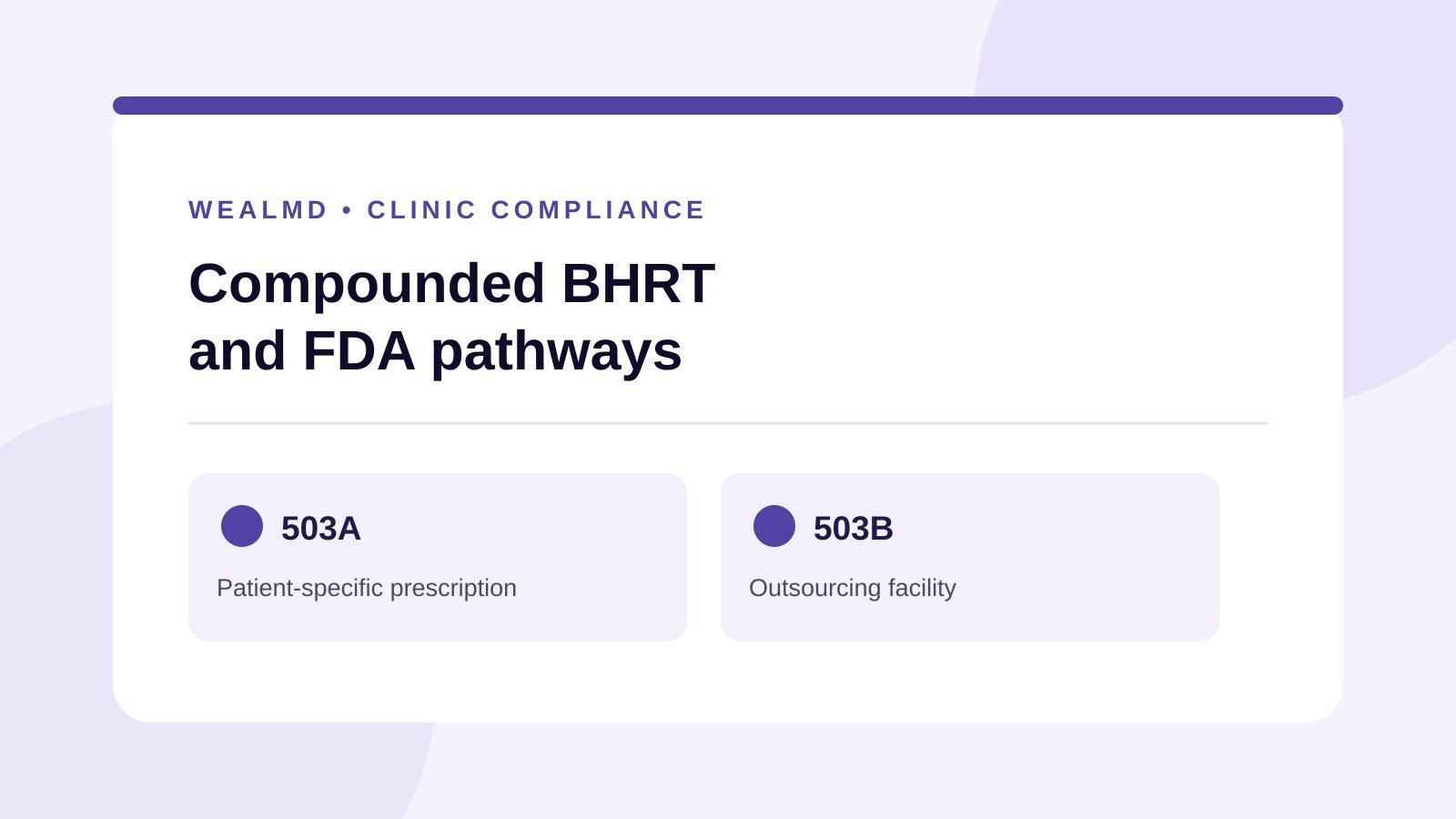
Quick answer: Compounded bioidentical hormone therapy (BHRT) is not FDA-approved. A clinic considering a compounded hormone product should identify the exact formulation and patient need, determine whether the compounder operates under section 503A or 503B of the Federal Food, Drug, and Cosmetic Act (FD&C Act), check the conditions that apply to that pathway, and verify the specific pharmacy or facility, product, and state requirements. A 503A pharmacy generally compounds against a valid prescription for an identified patient; a registered 503B outsourcing facility may make eligible products for office stock without a patient-specific prescription. Neither pathway is a blanket permission to compound any hormone or a finding that a particular product is safe and effective. FDA compounding laws; FDA compounding Q&A; FDA 503B registration Q&A.
This is a purchasing and compliance guide for US TRT, menopause, and BHRT clinic owners and practitioners. It does not tell a clinician which hormone, dose, or route to use for a patient. The clinical justification for a compounded preparation and the applicable state and controlled-substance rules require separate review.
“Bioidentical” does not tell you the drug’s FDA status
“Bioidentical” describes a hormone’s relationship to a naturally occurring hormone; it is not an FDA approval category or a compounding exemption. FDA-approved hormone drugs can contain hormones identical to those produced by the body. Many products marketed as compounded “bioidentical” hormones, however, have not been reviewed by FDA for safety, effectiveness, and quality before marketing. FDA says it lacks evidence that compounded bioidentical hormone products are safer or more effective than approved therapies and recommends an approved hormone therapy when an available approved drug can meet the patient’s medical need. FDA menopause guidance; FDA compounding Q&A.
This distinction matters in consent materials and advertising. Do not describe a compounded estradiol cream, progesterone capsule, or testosterone pellet as “FDA-approved” because an ingredient appears in an approved medicine, the pharmacy is licensed, or a facility is FDA-registered. FDA also says no drug containing estriol is FDA-approved and has not found evidence that estriol is a safer estrogen. Claims that a compounded product is universally “natural,” safer, or free of the risks of approved hormone therapy need a defensible evidence and promotional review. FDA menopause guidance; FDA study summary on compounded BHRT.
The clinic’s first decision is therefore clinical and operational: is there a patient-specific need that an available FDA-approved option cannot meet? Document the prescriber’s reasoning and ask the pharmacy exactly what it will make. FDA’s recommendation to prefer an available approved drug when it meets the patient’s need does not itself determine whether every individual prescription for a compounded alternative is lawful; that depends on the product and the relevant compounding conditions. FDA compounding Q&A.
503A versus 503B: the decision that changes the supply model
Sections 503A and 503B provide conditional exemptions from certain FD&C Act requirements. A compounder must meet all applicable conditions to qualify; products that do not qualify remain subject to the otherwise applicable provisions of the Act. FDA’s comparison gives the following core distinctions. FDA provisions comparison.
| Question | Section 503A | Section 503B |
|---|---|---|
| Who compounds? | A licensed pharmacist in a state-licensed pharmacy or federal facility, or a licensed physician, meeting 503A conditions. | An FDA-registered outsourcing facility engaged in sterile drug compounding, which may also compound nonsterile drugs; compounding is by or under a licensed pharmacist’s direct supervision. |
| Patient-specific prescription? | A valid prescription for an identified individual patient is central to the exemption. Limited anticipatory compounding is possible under statutory conditions, but dispensing follows receipt of the patient-specific order. | A facility may distribute eligible compounded drugs against a patient-specific prescription or an order without one, including for permitted office use. |
| Quality framework and oversight? | Qualifying 503A drugs are exempt from federal current good manufacturing practice (CGMP) requirements; state boards generally have primary day-to-day oversight of state-licensed pharmacies, while FDA can inspect and act. | CGMP applies; FDA registers and inspects outsourcing facilities on a risk-based schedule, and they have product and adverse-event reporting duties. |
| What does the exemption cover? | If all conditions are met, exemptions include premarket drug approval, CGMP, and labeling with adequate directions for use. | If all conditions are met, exemptions include premarket drug approval, labeling with adequate directions for use, and certain drug supply chain security requirements. There is no CGMP exemption. |
Sources: FDA human drug compounding laws, FDA provisions comparison, and FDA compounding Q&A.
For an individualized cream or capsule sent to a named patient, a 503A pharmacy may be the proposed route. For a clinic asking to hold pre-made products for future patients, ask whether an eligible 503B product and lawful office-use distribution are available. Do not treat a 503A pharmacy’s ability to compound in anticipation as a general authorization to sell non-patient-specific office stock. FDA explains that 503A’s anticipatory provision operates in limited quantities and still requires a valid patient-specific prescription before distribution under that pathway. State law can add conditions in either model. FDA 503A prescription guidance; FDA compounding laws.
What is not automatically allowed under either pathway?
Any requested ingredient. Bulk drug substance rules differ. Under 503A, a substance generally must have an applicable USP/NF monograph, be a component of an approved drug if no such monograph exists, or appear on the relevant FDA bulks list if neither condition applies. Under 503B, the substance generally must be on FDA’s clinical-need bulks list or used in a drug on FDA’s shortage list at the relevant times. FDA also describes interim enforcement policies for nominated substances, so a clinic should ask the compounder for its current, product-specific legal basis rather than assume an ingredient is allowed merely because another facility sells it. The source and certificate of analysis for a bulk substance also matter. FDA bulk-substance overview; FDA 503B bulk guidance.
Routine copies of approved products. The 503A and 503B copy restrictions are not identical. Section 503A restricts regular or inordinate compounding of products essentially copying a commercially available drug; section 503B generally disallows products that are essentially copies of approved drugs as a condition of its exemptions. An individualized difference may matter under the applicable statutory definition and FDA guidance, but simply changing a name or marketing the result as “custom BHRT” does not settle the question. Ask the pharmacy to explain the relevant approved comparator and why the proposed preparation qualifies. FDA provisions comparison; FDA 503A copy guidance; FDA 503B copy guidance.
Products withdrawn for safety or effectiveness, or difficult-to-compound products restricted under the statute. FDA lists additional conditions involving products removed from the market and products identified as presenting demonstrable difficulties for compounding. A formulation should be screened against the current lists and rules. Nor does a 503A exemption from CGMP permit insanitary conditions; FDA can inspect state-licensed pharmacies and act on serious quality concerns. FDA provisions comparison; FDA compounding Q&A.
Avoid turning these summaries into a yes/no ruling for an estriol blend, pellet, or other specific formula. The ingredient, source, dose form, route, proposed supply model, applicable FDA policy, and state rules all affect the review. The pharmacy’s compliance lead and the clinic’s qualified reviewer should document the conclusion before purchasing.
How FDA and state oversight fit together
State boards of pharmacy generally oversee the day-to-day operation of 503A state-licensed pharmacies. FDA retains federal authority and may conduct surveillance or for-cause inspections and take action. A 503B outsourcing facility chooses to register with FDA, is subject to CGMP, and is inspected according to a risk-based schedule. Registration is not FDA approval and does not mean FDA has found the facility compliant with every 503B condition. FDA’s public list even includes registered facilities not yet inspected. FDA compounding Q&A; FDA 503B registration Q&A; registered outsourcing facilities.
Before approving a supplier, verify the specific legal entity and physical location. For 503B, check FDA’s current registration list, inspection history, recalls, warning letters, and other actions; also check the relevant state board. FDA notes that a Form 483 records investigators’ observations and is not itself a final agency determination. A clean-looking list entry, an inspection date, or a corporate brand shared by several locations is not a quality guarantee. For 503A, verify active state licensure, any relevant board actions, and any FDA actions; the absence of a 503A pharmacy from the 503B list is expected. FDA registered facilities and explanatory notes; FDA inspections, recalls, and actions.
Ask the pharmacy for current documentation on the proposed formulation and route: its compounding pathway, permitted ingredients, quality procedures, lot and beyond-use-date labeling, storage and shipping instructions, recall contacts, and how it receives quality complaints. These are diligence questions, not a claim that one FDA rule specifies the same documentation package for every product. Recheck licensure for any state to which the pharmacy will ship and the clinic’s state rules for possession, administration, and recordkeeping.
Testosterone adds a controlled-substance layer
Testosterone is federally a Schedule III controlled substance. Compounding under 503A or 503B does not erase the Controlled Substances Act. A clinic considering a testosterone-containing prescription or office stock needs a separate review of prescriber and dispenser DEA authority, how the product is ordered or prescribed, custody, inventory and administration records where applicable, and any state controls. An electronic controlled-substance prescription must also use the applicable DEA EPCS process. Do not infer that FDA registration of a 503B facility alone authorizes a clinic to acquire or hold testosterone stock. DEA controlled-substance schedules; DEA practitioner’s manual; DEA EPCS FAQ.
Keep the two reviews separate in the chart and purchasing procedure: FDA compounding pathway and product quality on one side; DEA and state controlled-substance authority on the other. A pharmacy may give an adequate answer to one and still leave the other unresolved. For the electronic-prescribing workflow, see WealMD’s EPCS guide for HRT clinics.
Build a clinic workflow around the actual product
Consider a fictional menopause clinic offered a compounded estradiol/progesterone cream for a named patient and testosterone pellets for future office use. The operator should not approve both under a single “BHRT pharmacy” line item.
- Record the clinical request. Identify the exact ingredients, strength, dosage form, route, and patient-specific reason for a compound rather than an available approved product. The clinician makes the treatment decision; the operator confirms the request is complete. FDA menopause guidance.
- Classify the transaction. Is the cream made under 503A against a valid patient-specific prescription? If the clinic wants pellet stock, is the proposed supplier the specific registered 503B facility and is this exact product eligible for non-patient-specific distribution? Do not assume that “503B” answers ingredient, copy, or state-law questions. FDA compounding laws; FDA bulk-substance overview.
- Verify and receive. Check the pharmacy or facility, its actions and licenses, the product label, lot, beyond-use date, storage and transport instructions, and recall route. For testosterone, add the DEA and state controlled-substance checks. Log what arrived and connect any administration to the correct patient and product lot under the clinic’s applicable rules. FDA outsourcing facility registration FAQ; DEA practitioner’s manual.
- Monitor and respond. Tell the pharmacy promptly about a suspected quality defect, identify affected lots, follow a recall, and report suspected adverse events or quality problems to FDA MedWatch as appropriate. FDA has highlighted reporting gaps involving compounded hormone pellets; lack of reported events should not be treated as proof of safety. FDA compounding risk alerts and MedWatch route; FDA statement on pellet adverse-event reporting.
This example is a review sequence, not an assertion that either fictional preparation qualifies for a statutory exemption. A qualified clinician and compliance reviewer must resolve the particular formulation and jurisdiction.
What WealMD can and cannot establish for this review
WealMD’s supplied product specification documents medication records, prescription fields, controlled-substance flags, sign-off tasks, and pharmacy-routing options. It lists 1st Rx as connected in the audited environment, while Life File and Vios are listed as available, rather than connected for every clinic. Those software descriptions do not establish a compounding pharmacy’s legal pathway, a particular formulation’s eligibility, current integration availability for a customer, EPCS certification, or the clinic’s inventory compliance. Confirm the proposed deployment and pharmacy workflow with a product specialist and the responsible pharmacy.
When evaluating an EMR, ask it to show the patient-specific order, the pharmacy and formulation details, product and lot documentation where needed, and a way to retrieve the history for a recall. Request evidence for each capability in the actual configuration. WealMD’s BHRT EMR buyer’s guide covers general software selection; this page addresses FDA compounding decisions. For a wider launch checklist, see how to start an HRT clinic.
Frequently asked questions
Is compounded BHRT FDA-approved if a 503B facility makes it?
No. FDA registration of an outsourcing facility does not approve the facility’s individual compounded drugs or demonstrate that its current production complies with every requirement. Products compounded under qualifying 503B conditions may be exempt from the normal premarket approval requirement, but they have not passed FDA’s drug approval review. FDA 503B registration Q&A.
Can a 503A pharmacy supply a clinic with BHRT office stock?
Do not assume so. The 503A exemption centers on valid prescriptions for identified patients; its limited anticipatory-compounding provision is not a general non-patient-specific distribution pathway. A 503B facility may distribute qualifying products without an individual prescription, subject to its own conditions and applicable state and controlled-substance law. Have counsel or a qualified compliance specialist review a proposed stock model. FDA 503A prescription guidance; FDA compounding laws.
Does “bioidentical” mean a hormone must be compounded?
No. FDA has approved hormone products containing hormones identical to those naturally made by the body. The word does not determine approval status, quality, or whether compounding is necessary for an individual patient. FDA menopause guidance.
Next step: Before entering a standing pharmacy arrangement, obtain a product-specific explanation of the compounding pathway, approved-drug comparison, ingredient basis, supplier status, and state and DEA requirements. Have a qualified compliance reviewer and the responsible clinician review those records; revisit them when the formula, facility, law, or FDA policy changes.