HRT Informed Consent Template for Clinics
Use this editable HRT informed consent sample to document a patient-specific conversation about benefits, risks, alternatives, monitoring, and choice. Clinics must adapt and approve the form before patient use.
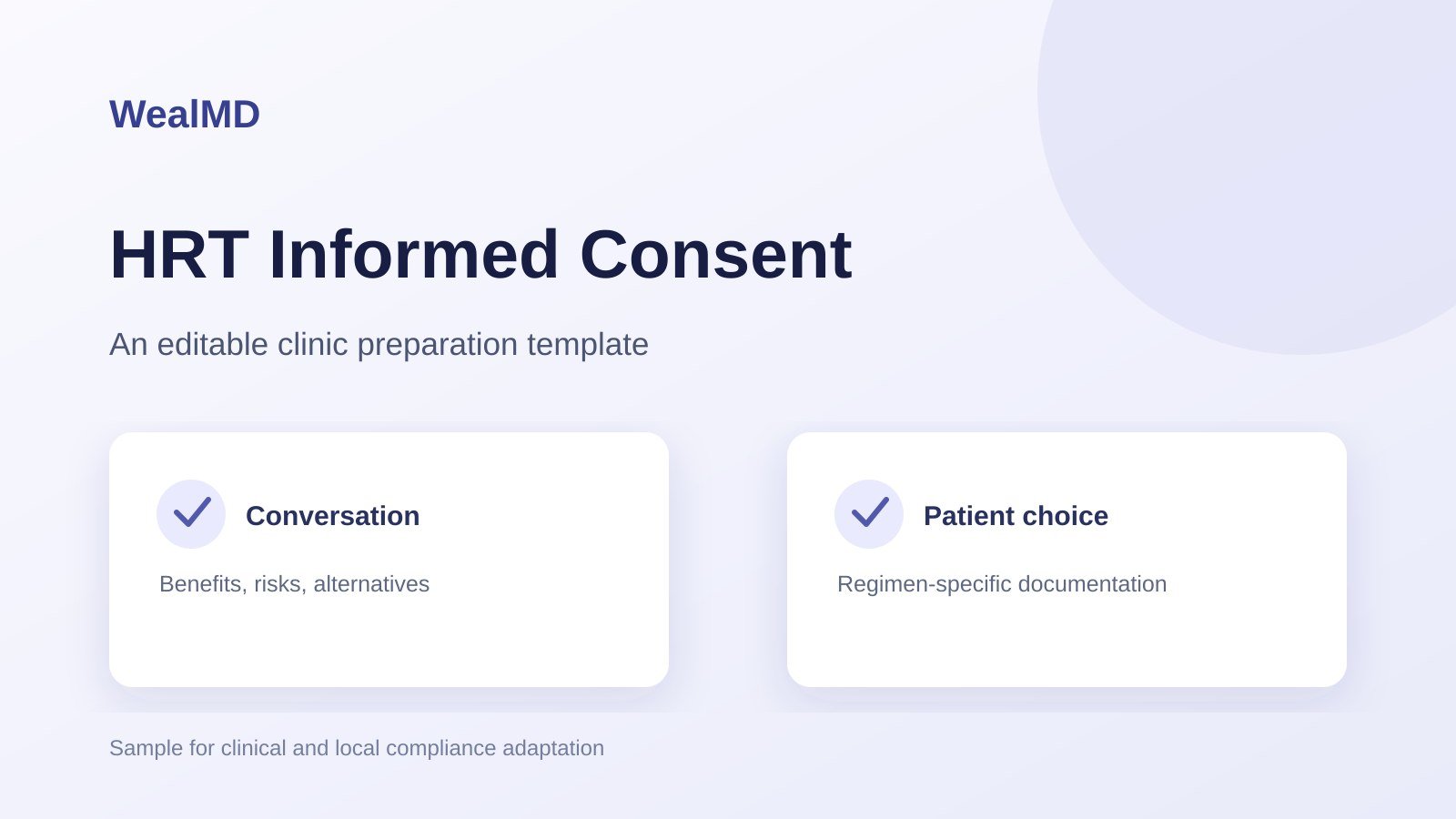
Quick answer: An HRT informed consent form should document a conversation about the patient’s reason for treatment, the specific hormone and route proposed, expected benefits and limits, material risks, reasonable alternatives including no treatment, monitoring, and the patient’s questions and voluntary choice. A signature records part of that process; it does not replace the conversation. Use the editable template accompanying this guide as a starting point, then have the treating clinician and compliance reviewer adapt it to the regimen, current product labeling, state law, and the patient’s circumstances before clinical use. ACOG informed consent guidance.
Download the editable HRT informed consent sample (DOCX)
Use this as a starting point. It is not approved for any clinic or state; a treating clinician and local compliance reviewer should adapt and approve it before patient use.
This is an operator and practitioner guide for US TRT, menopause, and BHRT clinics. It is a general workflow and sample document, not a universal legal form or a clinical recommendation to prescribe. This page covers the common consent process and shows where regimen-specific language belongs.
What the download contains
The editable form has a core conversation record and three optional clinical modules: systemic menopausal hormone therapy; testosterone therapy; and a compounded product. Clinicians should select only the modules that apply, replace prompts with the actual drug and patient-specific discussion, and remove unused sections. A local or vaginal therapy, an oral systemic estrogen product, a transdermal product, an injectable testosterone product, and a pellet do not share identical labels or risks. Check the current prescribing information for an FDA-approved product and the relevant evidence for a compounded one. FDA updated menopause labels; FDA testosterone information; ACOG compounded hormone consensus.
The download is intentionally editable. A clinic cannot make a generic risk paragraph accurate by putting it on every patient’s form. Keep the patient-facing language plain, record the specific decision, and link the signed version to the encounter. ACOG advises documenting the conversation in the medical record, including challenges to consent and a written form when used. ACOG informed consent guidance.
Seven elements to cover before the signature
1. The patient’s condition and purpose of treatment
Describe the indication being evaluated and the treatment’s intended purpose in terms the patient understands. Record the assessment that supports the clinician’s plan; do not make the form itself the diagnosis. A person asking about hot flashes, someone seeking treatment for documented hypogonadism, and someone considering a compounded formulation have different evidence and choices. For testosterone therapy in men with hypogonadism, the Endocrine Society recommends diagnosis only in men with symptoms and signs consistent with deficiency and consistently low testosterone concentrations, with appropriate evaluation of the cause. Endocrine Society guideline resources.
If the plan changes after labs or a follow-up, update the decision record. A form signed at intake for a hypothetical future therapy is weak evidence that the patient understood the eventual drug, route, and risks. The clinician’s note should connect the conversation to the proposed regimen and the patient’s goals.
2. The exact product, route, and expected benefit
Enter the drug or compounded formulation, route, proposed schedule, and the benefit the clinician reasonably expects. Explain what is uncertain, when the patient and clinician will evaluate response, and that benefit is not guaranteed. Keep the treatment description specific enough to distinguish systemic from local therapy and an FDA-approved drug from a compounded drug. FDA-approved testosterone products have approved indications tied to an associated medical condition; FDA’s June 2026 requests for additional label changes should not be treated as finalized product labeling without checking the exact product. FDA testosterone information.
3. Material risks and reasons to pause
The clinician should review risks relevant to the actual product, route, dose, history, and goals, including contraindications or situations requiring further assessment. For menopausal hormone therapy, FDA notes that benefits and risks vary and identifies circumstances such as unexplained vaginal bleeding, certain cancers, prior blood clots, and liver disease for review. A patient with a uterus considering systemic estrogen needs a discussion of endometrial risk and the role of a progestogen when indicated. Do not apply a blanket risk statement to every local and systemic product. FDA menopause information.
For testosterone in men, the treating clinician should discuss relevant issues such as fertility plans, erythrocytosis, sleep apnea, prostate evaluation where appropriate, and monitoring. FDA issued class-wide testosterone labeling changes in 2025 concerning blood pressure and cardiovascular wording; check the current label for the product rather than recycling an old boxed-warning statement. An Endocrine Society guideline also lists conditions in which treatment should not be started or should be deferred. FDA testosterone labeling update; Endocrine Society guideline resources.
For delivery methods, add the risks of that method: for example, a transdermal product may require counseling about transfer to others, while a procedure or implant needs its own procedure discussion. The exact label, procedure, and clinic protocol determine the content. Do not use a generic HRT signature as the sole record for a distinct insertion or injection procedure. FDA testosterone product labeling information; ACOG compounded hormone consensus.
4. Alternatives and the choice to decline
Record reasonable alternatives for this patient: a different FDA-approved formulation or route, a nonhormonal option when appropriate, symptom-focused care, observation, or no treatment. Explain the likely consequences and uncertainty of each meaningful choice, including declining the recommendation. ACOG’s consent framework asks clinicians to cover benefits, burdens, risks, and alternatives, including forgoing treatment. ACOG informed consent guidance.
Avoid a preprinted line claiming there are “no alternatives.” If a particular formulation is needed because of an ingredient intolerance or dosage form issue, record that reason and the alternatives actually discussed. The patient can ask questions, take time to decide, or refuse; staff should not make access to unrelated care appear conditional on accepting HRT.
5. Monitoring, follow-up, and when to contact the clinic
State the plan for follow-up, clinical assessment, and any tests, with responsibility for reviewing and communicating results. The exact schedule is a clinical decision, not a universal interval supplied by this sample. For testosterone treatment, the Endocrine Society recommends monitoring response and adverse effects and evaluating hematocrit and prostate risk where applicable. Endocrine Society guideline resources.
Tell the patient how to report new symptoms or possible adverse effects and when urgent evaluation may be needed; have the clinician tailor those instructions to the regimen. Record what happens if a lab is missed, the patient switches pharmacies, or a dose changes. Consent is revisited when the material treatment decision changes, not treated as a one-time intake task.
6. Compounded and off-label use, if applicable
When the plan uses a compounded drug, identify it accurately. A compounded preparation is not FDA-approved and has not undergone the same premarket review of safety, effectiveness, and quality as an approved product. ACOG recommends FDA-approved menopausal hormone therapies over compounded bioidentical products when approved formulations exist, while recognizing selected patient-specific compounding circumstances. Document why an approved alternative does not meet this patient’s need, the uncertainty of the proposed compound, and any formulation-specific or route-specific risk. “Bioidentical” does not establish superior safety. FDA menopause information; ACOG compounded hormone consensus.
An FDA-approved drug prescribed for a use outside its approved labeling is a different situation from a compounded, unapproved product. Explain the applicable evidence and uncertainty without treating a signed form as permission to bypass prescribing, compounding, or controlled-substance rules. For the sourcing framework, link to WealMD’s FDA BHRT regulations guide. The consent record and the pharmacy’s legal supply pathway are separate checks. FDA compounding Q&A.
7. Understanding, voluntary choice, and signatures
Ask the patient to explain back the decision in their own words when useful, address questions, and record any interpreter or accessible communication support. If decision-making capacity or a legally authorized representative is in question, follow the applicable clinical and state-law process. Provide space for the patient or representative, clinician, date and time, and version of the form. ACOG says a signed document alone does not establish meaningful shared decision making; the encounter note should capture the conversation and decision. ACOG informed consent guidance.
Use the template in the clinic workflow
Before the visit: Select the applicable module, current product label, and local legal language. Prefill only facts that have been verified. The clinical lead should approve the risk and monitoring language for each regimen; the compliance lead should review state consent rules, signature or representative requirements, and records policies. ACOG notes that legal standards for the adequacy of consent information vary by state. ACOG informed consent guidance.
During the visit: The treating clinician explains benefits, uncertainties, risks, alternatives, and the monitoring plan. Record patient-specific questions and the decision. Offer a copy. The patient’s signature can occur in a portal or on paper according to a reviewed local process, but the signed version and encounter note should be retrievable together. WealMD’s public HRT EMR features checklist provides questions for evaluating documentation workflows; no software feature by itself validates the consent discussion.
After the visit: Route new findings or a changed plan to the clinician. If a patient moves from an FDA-approved transdermal product to a compounded pellet, the route, approval status, reversibility, and risks have changed; document a new discussion and any procedure consent rather than relying on the old HRT form. ACOG specifically raises uncertainty and irreversibility concerns for testosterone pellets used in menopausal symptom care. ACOG compounded hormone consensus.
An example of a useful encounter note
Consider a hypothetical patient who asks for a compounded preparation because they believe every FDA-approved hormone is synthetic. A useful note identifies the proposed product and indication, records that the clinician explained the approved options that may meet the same need, and describes the patient’s specific concern and the response. If the patient has an ingredient intolerance, record the actual ingredient and how it affects the alternatives. The note then records the individualized benefit and risk discussion, follow-up plan, unanswered questions if any, and the patient’s decision. It should not turn the patient’s question into a stock statement that compounded products are safer. ACOG notes that FDA-approved bioidentical hormone products exist and advises counseling patients on the lack of FDA approval and compounding-specific uncertainty when considering a compounded menopausal product. ACOG compounded hormone consensus.
For a telehealth visit, preserve the same substance of the conversation. Record who participated, how questions were answered, the chosen regimen, and how the signed form and visit note were captured together. A digital signature is useful for retrieval, but it does not demonstrate that the clinician reviewed the treatment choice. If the patient needs an interpreter or more time, document the support and the later decision rather than rushing the signature at the end of an intake form. ACOG informed consent guidance.
What to review before adopting a form
Have a clinician compare each optional module with the actual approved label, current clinical evidence, patient population, and monitoring protocol. Have a qualified compliance reviewer check the state and organizational consent requirements, representative and interpreter rules, record retention, and whether any separate procedure consent is required. Record the form’s owner, version, approval date, and next review trigger so a regulatory or label change has a clear update path. FDA approved labeling changes for six menopausal hormone therapy products in February 2026; a clinic should not assume every product’s label changed in the same way. FDA 2026 labeling announcement; FDA list of updated prescribing information.
Frequently asked questions
Is a signed HRT consent form legally sufficient by itself?
No form establishes that a discussion occurred merely because it was signed. Record the diagnosis or purpose, the relevant risks and alternatives, questions, and voluntary decision in the chart. State law and the clinical setting affect specific legal requirements. ACOG informed consent guidance.
Can one form cover both TRT and menopausal hormone therapy?
A shared core process can, but the product-specific risk, alternative, and monitoring sections must change. Use the relevant module and current product information. Do not make a patient sign unused therapy sections. FDA testosterone information; FDA menopause information.
Does the template authorize a compounded BHRT prescription?
No. It helps document the patient discussion. Clinical appropriateness, the compounder’s legal pathway, product quality, and applicable state and federal requirements need their own review. FDA compounding Q&A.
Next step: Download the editable template, select the applicable module, and have the clinic’s clinical and compliance leads approve a version for its actual regimens before staff use it with patients.