503A vs 503B Compounding for HRT: What Practitioners Must Know
Compare the 503A patient-specific prescription pathway with 503B office supply for compounded HRT, including the checks a clinic should make before ordering.
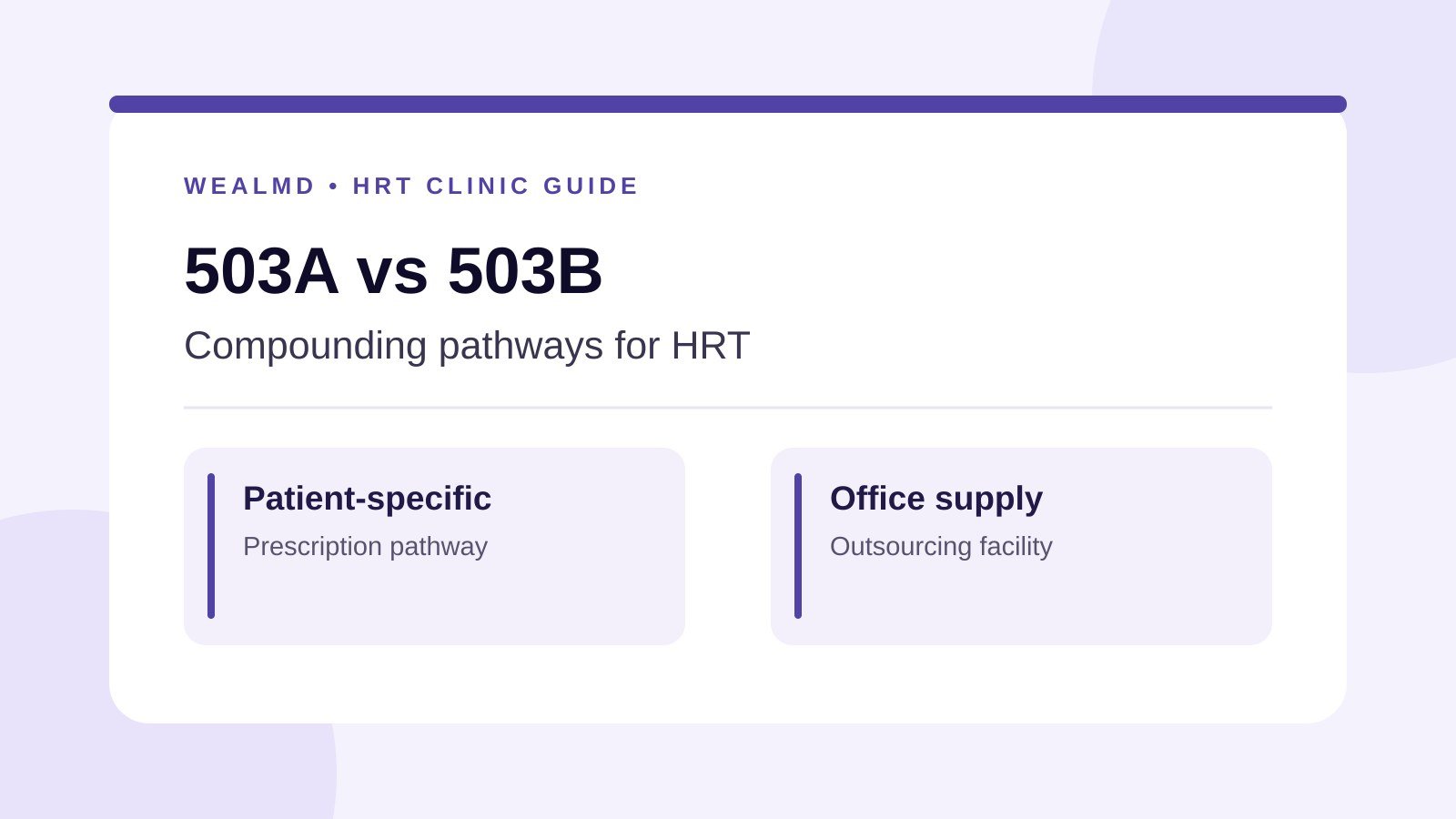
Quick answer: A practitioner choosing a source for a compounded HRT product must first decide how the product will reach the patient. Under section 503A of the Federal Food, Drug, and Cosmetic Act, a qualifying pharmacist or physician compounds for an identified patient under a valid patient-specific prescription or order; limited anticipatory compounding does not allow a pharmacy to distribute unnamed-patient office stock under 503A. An FDA-registered 503B outsourcing facility may distribute an eligible compounded drug to a clinic without identifying a patient first, subject to 503B conditions and other federal and state law. Neither pathway makes the resulting drug FDA-approved or automatically permits a particular hormone formulation. FDA human drug compounding laws; FDA 503A prescription guidance; FDA 503A/503B comparison.
For an HRT clinic, this is a supply decision followed by a product-specific legal and quality review. The responsible clinician and qualified compliance reviewer must determine whether an actual product and transaction qualify.
Choose the transaction before comparing pharmacy labels
Start with the intended transaction. Who compounds the hormone? Is there a valid order for a named patient? Is it delivered for that patient or held for future patients? Who dispenses or administers it, and in what state? FDA describes 503A and 503B as conditional exemptions from certain drug-law requirements. FDA provisions comparison.
| Proposed HRT workflow | Likely starting point for review | Question that cannot be skipped |
|---|---|---|
| A pharmacy makes an individualized hormone capsule for a named patient after receiving a valid prescription. | 503A may fit if the pharmacy and product meet all its conditions. | What patient-specific order, formulation, ingredient basis, and state pharmacy rules apply? |
| A pharmacy prepares in advance because it historically receives similar patient-specific prescriptions, then distributes after an order arrives for the named patient. | 503A anticipatory compounding may fit within its limits. | Did the pharmacy receive a valid patient-specific prescription before the product left the facility? |
| A clinic wants pre-made compounded hormone products on hand for future, unnamed patients. | Ask whether a 503B outsourcing facility can lawfully supply that exact product as office stock. | Is this facility currently registered, and does the product meet 503B’s ingredient, copy, labeling, and other conditions? |
| A physician compounds in their own office in limited quantities for their own patients who may present later. | A distinct 503A physician anticipatory scenario may be possible. | Does the physician meet FDA’s conditions and document the patient-specific need before administering or dispensing? State law may add limits. |
FDA’s 503A prescription guidance distinguishes a pharmacy distributing a product from a physician compounding and holding a limited quantity in the physician’s own office. The examples above are screening questions, not determinations that any hypothetical hormone product qualifies.
What a 503A practitioner actually needs to document
Section 503A covers compounding by a licensed pharmacist in a state-licensed pharmacy or federal facility, or by a licensed physician, when its conditions are met. A valid prescription for an identified individual patient is central. FDA’s guidance recognizes limited preparation before the order arrives based on a history of receiving such prescriptions, but it says the compounder needs the valid patient-specific prescription before distributing the drug under 503A. An order for “20 pellets for clinic use” with no patient name is not transformed into a 503A patient-specific prescription by calling it anticipatory. FDA 503A prescription guidance; FDA compounding laws.
For a named-patient HRT prescription, identify the ingredients, strength, dosage form, route, and individualized need. Link the prescription, pharmacy, product received, and patient in the record. FDA recommends an available FDA-approved drug when it meets the patient’s medical need because compounded drugs have not passed premarket review. FDA compounding Q&A.
The physician’s own office is a separate edge case. FDA’s 503A guidance describes a physician who compounds limited quantities in advance, based on the history of administering or dispensing that drug to the physician’s patients, and makes the relevant patient-record entry when a patient presents. That is not permission for an unrelated 503A pharmacy to ship anonymous stock to the clinic. It also does not resolve state authority to compound, office quality standards, or any controlled-substance requirements. A clinic considering in-office compounding should have the actual process reviewed before treating it as a stock workaround. FDA 503A prescription guidance.
Qualifying 503A products are exempt from federal current good manufacturing practice (CGMP), premarket approval, and the requirement to label with adequate directions for use. They are not exempt from all federal law: FDA can inspect and act against insanitary conditions, while state boards generally oversee state-licensed pharmacies day to day. Ask for the pharmacy’s current license and quality procedures, and check the relevant state’s rules. FDA provisions comparison; FDA compounding Q&A.
What a 503B office-supply order does and does not solve
A 503B outsourcing facility is a facility at a particular location engaged in sterile drug compounding, registered with FDA, and compounding by or under the direct supervision of a licensed pharmacist. It may also compound nonsterile drugs. Unlike a 503A pharmacy, an eligible 503B facility can distribute a drug on a provider order without a prescription for an identified individual patient, including for permitted office use. That helps a clinic evaluate a genuine need for ready-to-administer stock, but 503B status does not validate every product the facility offers. FDA information for outsourcing facilities; FDA compounding laws.
Qualifying 503B drugs are exempt from premarket drug approval, labeling with adequate directions for use, and certain drug supply chain security requirements. The facility remains subject to CGMP, FDA risk-based inspections, registration and product reporting, specified labeling, and adverse-event reporting. The 503B pathway also has a statutory restriction on sale or transfer by an entity other than the facility that compounded the drug, while allowing administration in a health care setting and dispensing pursuant to a valid prescription under the provision. Ask how the supplier’s distribution model works; do not assume a reseller may freely move compounded stock between practices. FDA 503A/503B comparison; FDA wholesaling guidance, draft.
FDA’s registered outsourcing facilities list identifies facilities by location and provides inspection and action information. Registration does not mean FDA approved the drugs or determined that the facility currently complies with CGMP. Some registered facilities have not yet been inspected. Match the actual compounding address on the order and label to the listing; check inspections, recalls, and other actions and the state board. A Form FDA 483 is an investigator’s observation, not a final violation finding, so read the subsequent response or action in context. FDA outsourcing registration Q&A; FDA list notes.
The same hormone may face different ingredient and copy tests
The pathway changes the product analysis. Under 503A, a bulk substance generally must meet an applicable USP/NF monograph, be a component of an FDA-approved drug when no monograph exists, or appear on the 503A bulks list when neither applies. Under 503B, a bulk substance generally must be on FDA’s clinical-need list or be used in a drug on FDA’s shortage list at the specified times. FDA has interim policies for certain nominated substances while lists are developed. A substance nominated for a list is not automatically authorized for every formulation or pathway. Ask the compounder to identify the exact source of its claimed eligibility and any interim-policy conditions for the proposed ingredient and product. FDA bulk-substance overview; FDA 503B bulk policy.
Copy restrictions differ as well. A 503A compounder must not regularly or in inordinate amounts make drugs that are essentially copies of a commercially available drug. A 503B product must not be essentially a copy of one or more approved drugs to qualify for its exemption. FDA guidance and the statutory definitions address certain differences and exceptions; simply changing a formulation label or saying “bioidentical” is insufficient. Have the pharmacist identify any relevant approved comparator and explain the proposed difference and applicable rule. FDA comparison; FDA 503A copy guidance; FDA 503B copy guidance.
A hormone name alone cannot establish whether a product qualifies. Check the formula, ingredient, route, patient need, supplier pathway, and current rules. Compounded drugs, including 503B products, are not FDA-approved. FDA compounding Q&A.
Three HRT purchasing decisions to rehearse
1. Individualized prescription for one patient. A menopause practitioner requests a custom capsule for a named patient. The 503A pharmacy receives the prescription and confirms ingredients and copy restrictions. The clinic records the individual need and verifies pharmacy licensure and delivery state. This hypothetical does not establish that any particular capsule qualifies. FDA 503A guidance.
2. Supply for an upcoming clinic session. A clinic asks for 30 unnamed-patient compounded pellets. The pharmacy’s 503A anticipatory preparation does not permit distribution of that non-patient-specific order by itself. The clinic asks a 503B facility whether the exact product and transaction qualify, then checks state rules, lot, beyond-use date, storage, and recall route. FDA 503A prescription guidance; FDA compounding laws.
3. Physician makes a preparation on site. The physician proposes limited anticipatory compounding for their own patients. Analyze this as the physician’s 503A activity, with historical use, a patient-specific chart entry, state authority, quality process, and ingredient and copy restrictions. FDA 503A prescription guidance.
If any of these scenarios involves testosterone, add a separate DEA and state controlled-substance review. Testosterone is federally Schedule III; neither FDA compounding pathway alone grants prescriber authority or permission to possess, prescribe, dispense, or administer controlled stock. An electronic prescription for a controlled drug has its own EPCS requirements. See WealMD’s EPCS guide for HRT clinics for the prescribing side. DEA schedules; DEA practitioner’s manual.
Questions to send a prospective compounder
Send the questions with the specific product and supply model rather than asking whether the pharmacy is simply “503A or 503B”:
- What legal entity and address will compound this product? Is this a state-licensed 503A pharmacy, a compounding physician, or an FDA-registered 503B facility? What additional destination-state authorizations apply?
- For 503A, when will the valid patient-specific prescription be received, and to whom will the product be distributed? If preparation is anticipatory, what makes it qualify under that policy?
- For 503B office supply, is this exact formulation eligible? What is the basis for each bulk ingredient, the approved-drug copy analysis, and the facility’s permitted distribution model?
- What quality evidence, label, lot number, beyond-use date, storage instructions, and recall contact will accompany it? What are the latest relevant inspection, recall, and board-action records?
- If testosterone is involved, how will the supplier and clinic handle the separate controlled-substance permissions, order, custody, and records?
These questions combine FDA’s compounding comparison, 503A prescription guidance, registered facility list, and DEA’s practitioner guidance. Record the answers and have the clinic’s qualified reviewer evaluate the product rather than accepting a generic sales sheet.
How the EMR fits the decision
Build two separate workflows in the clinic’s records: a patient-specific prescription with its named recipient and pharmacy, and an office-supply purchase with its supplier, product, lot, receipt, storage, and administration details. Record the clinician’s rationale and preserve the supplier’s eligibility and quality documents where the team can retrieve them. An EMR can support that documentation, but software does not determine whether a formulation or transaction satisfies 503A or 503B.
Practices planning the broader service can use WealMD’s HRT clinic startup guide. The BHRT EMR buyer’s guide addresses software selection rather than validating a compounded drug.
Frequently asked questions
Can a 503A pharmacy make an HRT drug before receiving the prescription?
In limited circumstances, yes. FDA recognizes anticipatory compounding based on a history of valid patient-specific orders, but the 503A compounder must receive the order for the identified patient before distributing that product under the pathway. Preparation in advance is not the same as an unrestricted office-stock sale. FDA 503A prescription guidance.
Is every product from a registered 503B facility suitable for clinic stock?
No. Registration does not approve a product or establish that the facility meets every 503B condition. The particular drug must meet applicable ingredient, copy, labeling, reporting, and other conditions, and the order must comply with other federal and state law. FDA 503B registration Q&A; FDA provisions comparison.
Next step: Put one real proposed HRT formulation and its intended supply route through the questions above. Resolve the FDA pathway, state law, and any DEA controlled-substance requirements with the responsible pharmacist, clinician, and qualified compliance reviewer before ordering.