Automated ICD-10 Codingfor Hormone Therapy Visits
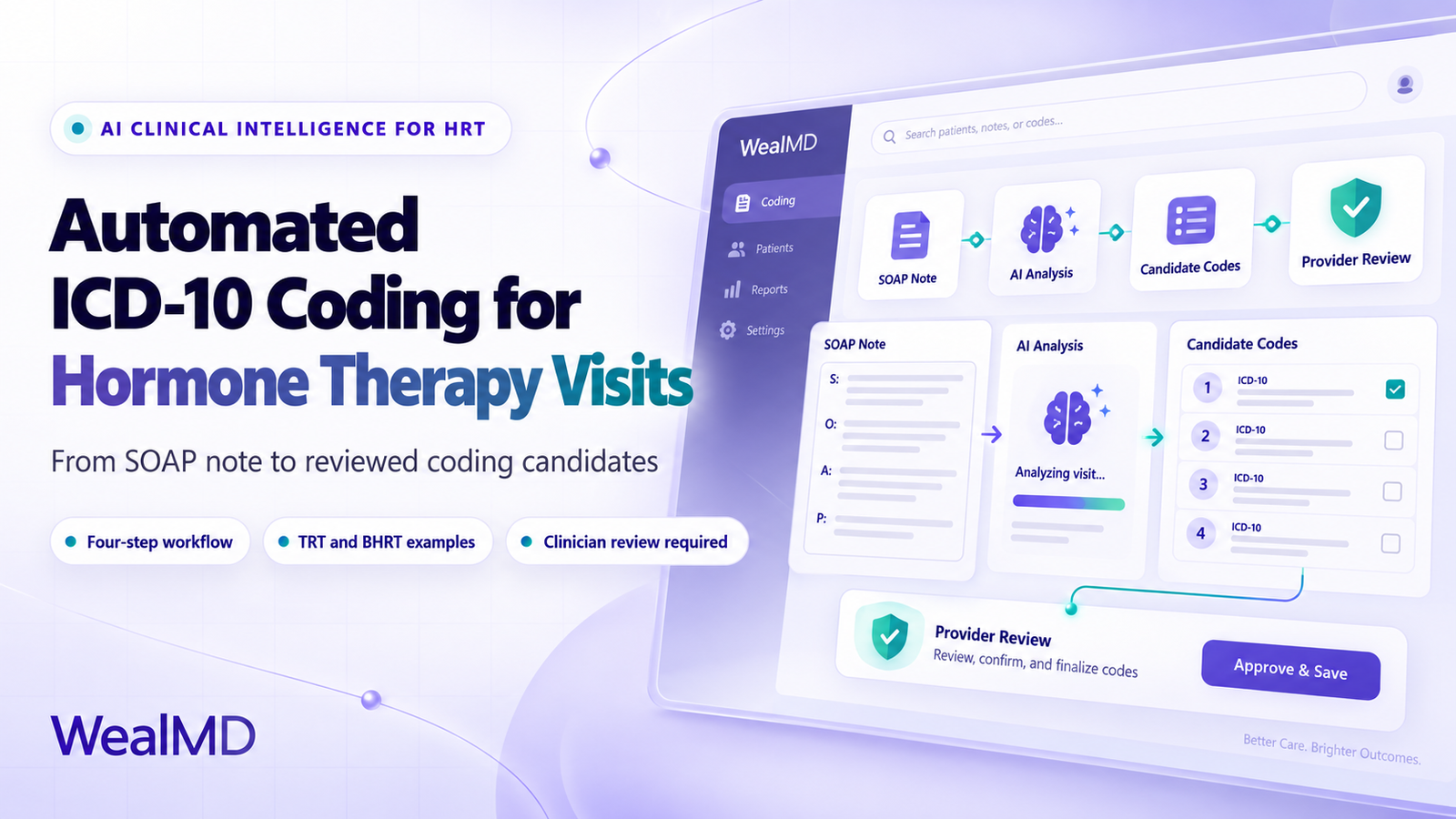
See how AI can read a finished SOAP note, surface candidate ICD-10 codes, flag documentation gaps, and hand the final coding decision to a provider or credentialed coding professional.
Automated ICD-10 coding for hormone therapy visits is how a growing number of TRT and BHRT clinics are closing the gap between a finished SOAP note and a clean claim. Instead of a coder re-reading every chart line by line, coding software reads the note first, proposes candidate codes, and leaves the final call to a human.
Hormone therapy clinics run on recurring visits, recurring labs, and recurring documentation. That repetition creates exactly the kind of first-pass coding work automation handles well. The value is not autonomous coding. It is a more consistent starting point for the person who still owns coding accuracy.
Why ICD-10 Accuracy Matters in HRT Visits
HRT clinics code a relatively narrow group of conditions repeatedly, including hypogonadism, perimenopause, ovarian failure, and ongoing therapy status codes. That repetition should make coding straightforward. In practice, it can also make inconsistent habits harder to notice because the same small mistakes repeat across a high volume of encounters.
A code can be technically related to the visit but still be less specific than the documentation supports. When that happens, a payer may request clarification, reject the claim, or trigger manual review. Across a busy hormone clinic, even a small inconsistency rate creates avoidable rework.
This is a clinic-operations problem as much as a billing problem. Whether coding is handled by a solo provider, an in-house biller, or an outsourced RCM team, the selected code needs to match the chart without requiring someone to rebuild the clinical story from scratch every time.
Where Manual Coding Breaks Down
A SOAP note with history, labs, assessment, and a treatment plan takes real minutes to read closely enough to justify a specific diagnosis code.
One coder may default to an unspecified code while another queries the provider. The result is variation that later appears in denial and audit patterns.
High-volume coding encourages shortcuts, especially late in the day. The fastest code is not always the most specific code supported by the note.
Every coding error can lead to investigation, correction, and resubmission, which adds administrative work after the visit was already completed.
How Automated ICD-10 Coding Works, Step by Step
Automated coding tools use natural language processing to read a finished or nearly finished clinical note and compare its content with ICD-10 definitions and documentation requirements. A responsible workflow usually follows four stages.
The system extracts symptoms, lab statements, assessment details, and the treatment plan from the SOAP note.
It compares the documentation with code definitions, specificity requirements, and inclusion or exclusion logic.
If the documentation points toward a code but lacks required specificity, the encounter is routed back for clarification.
The provider or coding specialist sees the suggestion, supporting context, and any flags before submission.
The same workflow applies to BHRT and menopause visits, but the diagnosis set changes. Age, symptoms, lab findings, and the documented assessment determine whether an age-related menopause code or an ovarian-failure code is more appropriate. That is why automated coding should surface a reasoned candidate, not silently assign a code.
Automated coding works best when the note is already structured inside the same clinical system. See AI SOAP Notes for HRT Visits for how the documentation layer is created before coding begins.
Common ICD-10 Codes in Hormone Therapy Visits
The codes below reflect common diagnosis categories mentioned in the source brief across TRT and BHRT charts. They are a starting reference, not a complete coding manual. The correct code always depends on the documentation, encounter context, and payer requirements.
| ICD-10 Code | Description | Typical Use Case |
|---|---|---|
| E29.1 | Testicular hypofunction | Male hypogonadism and TRT visits when supported by documentation |
| N95.1 | Menopausal and female climacteric states | Perimenopause and menopause symptom visits |
| E28.310 | Symptomatic premature menopause | Early-onset menopause with documented symptoms |
| E28.39 | Other primary ovarian failure | BHRT visits tied to ovarian failure rather than age-related menopause |
| Z79.890 | Long term current drug therapy, hormone replacement therapy | Secondary status code for patients on ongoing hormone therapy when appropriate |
These entries are not substitutes for coder judgment. They are useful examples of why an automated engine needs to read the full note rather than match isolated keywords.
Where Automation Actually Reduces Coding Errors
The source brief does not provide a verified WealMD benchmark for denial-rate improvement, so this section stays qualitative. The strongest operational case is reducing three repeatable manual failure points.
Automation can flag when the note supports a more specific diagnosis than the shortcut code a busy coder might otherwise choose.
A full-note review can catch therapy-status documentation that may be overlooked when someone focuses only on the assessment line.
The same logic can be applied across recurring encounter types, narrowing variation between staff members who code similar clinical pictures differently.
Instead of silently downcoding, a good system can route an incomplete encounter back for clarification while the visit context is still fresh.
What to Look for in HRT Coding Automation
Use these criteria when evaluating any coding automation tool, not only WealMD.
The system should consider more than the assessment line so it can surface secondary and status-code context.
Missing specificity should trigger clarification rather than an automatic fallback to a less specific code.
No claim should move forward solely because the model proposed a code.
Coding should happen where the documentation already lives instead of adding another disconnected tool.
The product should make the supporting logic visible and preserve the role of a credentialed coding professional.
Inside WealMD, coding sits alongside documentation, lab synthesis, and other AI-assisted workflows. Explore the current AI Assistance features.
Frequently Asked Questions
What is automated ICD-10 coding for hormone therapy visits?
It is software that reads a clinical note, typically a SOAP note, and suggests ICD-10 diagnosis codes based on documented symptoms, labs, assessment, and treatment plan. A coder or provider then confirms the final selection before submission.
Can AI replace a certified coder in an HRT clinic?
No. The workflow described here treats AI as decision support. A CPC or equivalent credentialed coding professional should review suggested codes, especially when they affect medical necessity or reimbursement.
Which ICD-10 codes come up most often in HRT visits?
It depends on the visit type and documentation. The source brief highlights E29.1 for male hypogonadism, N95.1 for menopausal and female climacteric states, E28.310 and E28.39 for ovarian-failure categories, and Z79.890 as an ongoing hormone-therapy status code when appropriate.
How can coding automation help reduce claim denials?
Its main value is catching repeatable manual gaps before submission, including overuse of unspecified codes, missed secondary status codes, documentation gaps, and inconsistent coding across similar encounters.
Does this apply to telehealth HRT visits too?
Yes. The coding logic operates on the documentation rather than the physical visit format, so the same first-pass workflow can be used with an in-person SOAP note or a telehealth encounter note.
Does automated coding work the same for TRT and BHRT visits?
The workflow is the same, but the diagnosis sets differ. TRT visits often center on hypogonadism-related codes, while BHRT and menopause visits may require distinctions between age-related menopause and ovarian-failure categories based on the chart.
Automate the First Pass, Not the Final Judgment
Automated ICD-10 coding for hormone therapy visits does not remove the coder from the process. It removes the repetitive first pass so a coding professional can spend more time reviewing specificity, documentation gaps, and edge cases instead of reading every note from scratch.
For clinics running high visit volume across a narrow set of recurring diagnoses, that is where the operational value comes from: a more consistent handoff from documentation to coding without pretending that reimbursement decisions can be fully automated.
If coding automation is one part of a larger platform evaluation, read How to Choose an EMR for Your HRT Clinic to weigh it alongside EPCS, lab integration, telehealth, and workflow fit.
See how coding fits into the rest of the chart workflow.
WealMD connects AI-assisted documentation, coding support, records, lab context, and practice operations inside one hormone-clinic platform, with the final coding and clinical decisions still controlled by your team.