How to Evaluate an AI EMR Vendor: A Buyer’s Framework
Compare AI EMR vendors with an eight-criterion weighted scorecard, ten demo questions, red flags and a practical two-week pilot.
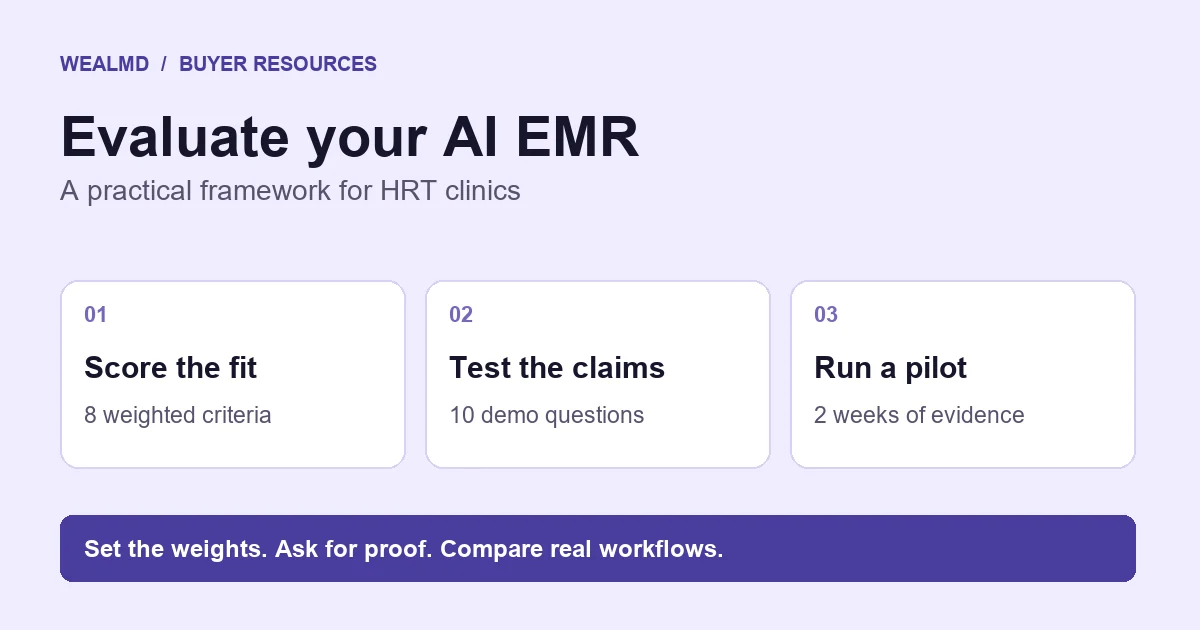
Knowing how to evaluate an AI EMR vendor is now a core skill for HRT clinic owners, because every platform on your shortlist claims to have AI and many of those claims fall apart on the first messy follow-up visit. This guide gives you a weighted scorecard, ten demo questions, and a red-flag list you can use on your next vendor call.
Disclosure: WealMD publishes this guide and is one of the vendor types scored below. We show our weights, our math, and our weak spots so you can check our work.
Why AI EMR demos are hard to compare
Demos are scripted. A scribe that turns a clean twelve-minute recording into a flawless note tells you nothing about a real follow-up with three lab panels, a protocol change, and a patient who talks over the clinician.
The word “AI” also covers products that do very different jobs. If you compare a transcription tool and a full AI EMR by counting features, you will pick wrong. A framework fixes this by forcing the same questions, the same weights, and the same evidence for every vendor, so the decision rests on what you measured and not on who gave the smoothest presentation.
Step 1: Identify which type of AI you are buying
Most shortlists mix three different product types:
- AI scribe add-on. Listens to the visit and drafts the note, then sends it to your existing EMR. Strong on documentation. Coding, lab review, and prescribing stay manual.
- EMR with an AI module. An established chart with AI features added later, often sold as a separate tier. Depth varies a lot from vendor to vendor.
- AI-native EMR. AI is designed into intake, charting, coding, labs, and prescribing from the start. This is where the gap between ambient AI and clinical intelligence matters, which is the difference between a tool that listens and a system that acts.
No type is automatically right. A solo clinic that loves its EMR may be well served by a good scribe. A multi-provider TRT or menopause clinic with heavy async intake and recurring lab cycles tends to feel the gap much sooner.
Step 2: Score vendors with the weighted scorecard
These weights reflect the priorities of an HRT clinic operator. If yours differ, change the weights before you open a demo, not after. Score each criterion from 1 to 5, multiply by the weight, add the results, and divide by 5 to get a score out of 100.
| Criterion | Weight | What a score of 5 looks like |
|---|---|---|
| 1. HRT workflow fit | 20 | Async intake, recurring lab cycles, protocol-based follow-ups, and telehealth visits work without custom builds |
| 2. AI depth | 15 | AI goes beyond transcription to SOAP drafting, ICD-10 suggestions, lab synthesis, and prescription drafting for clinician review |
| 3. EPCS and controlled-substance workflow | 15 | Certified EPCS for Schedule III prescribing, with audit logs, inside the same chart |
| 4. Security, HIPAA, and AI data handling | 15 | Signed BAA that covers AI subprocessors, no training on your PHI by default, documented access controls |
| 5. Accuracy and clinician-in-the-loop controls | 10 | Every AI output is editable, attributable, and requires clinician sign-off |
| 6. Integrations and data portability | 10 | Labs, pharmacies, and billing connect natively, and you can export your full chart |
| 7. Pricing transparency and total cost | 10 | Written pricing, AI included or clearly priced, no surprise onboarding or per-note fees |
| 8. Vendor viability and support | 5 | Reference customers in your segment, a named support team, uptime commitments |
How the three vendor types score
The table below applies the scorecard to each product type, not to named competitors. The scores are our judgment, and you should replace them with your own.
| Criterion (weight) | AI scribe add-on | EMR with AI module | AI-native HRT EMR (WealMD) |
|---|---|---|---|
| HRT workflow fit (20) | 2 | 3 | 5 |
| AI depth (15) | 2 | 3 | 5 |
| EPCS workflow (15) | 1 | 4 | 5 |
| Security and HIPAA (15) | 4 | 4 | 4 |
| Accuracy controls (10) | 4 | 3 | 4 |
| Integrations (10) | 3 | 3 | 3 |
| Pricing transparency (10) | 4 | 3 | 3 |
| Vendor viability (5) | 4 | 5 | 2 |
| Weighted total (out of 100) | 55 | 68 | 84 |
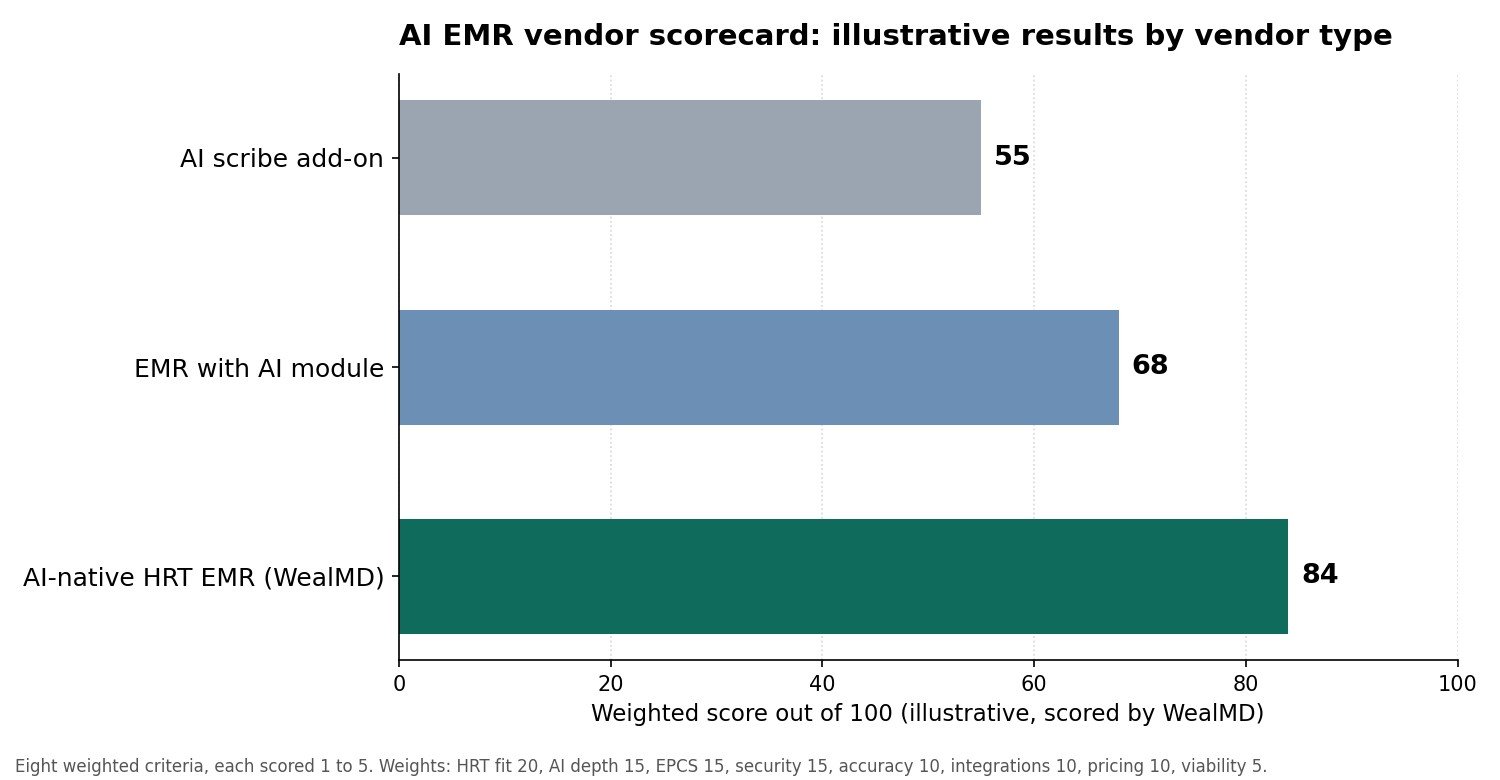
Illustrative weighted scores by vendor type. Scored by WealMD, so verify with your own evidence.
Read this carefully, because we scored our own category. The AI-native column wins mostly on the three heaviest criteria: HRT fit, AI depth, and EPCS. That is by design, since those are the problems an HRT-specific platform exists to solve. It scores lowest on viability because WealMD is a newer company with a smaller customer base than established EMRs. If you raise viability to 25 and scale the other weights down to fit, the AI-native and EMR-with-module totals land almost level at roughly 75 each, which is a fair reason to prefer the established vendor. Treat our column as a hypothesis and score every vendor, including us, from evidence you collect yourself.
Step 3: Pressure test the criteria that cause the most regret
AI depth
Ask to see one complete visit, from intake to signed prescription, using your data and not theirs. If coding or prescription drafting happens in a different tool, you are looking at an add-on dressed up as native.
EPCS
Testosterone is a Schedule III controlled substance, so e-prescribing it requires a workflow that meets DEA’s EPCS requirements. Ask for documentation of the application’s independent audit or approved certification and a sample audit log from a controlled-substance prescription. A vendor who handles this well should provide clear evidence. DEA’s EPCS guidance explains the application requirements.
Accuracy and clinician control
No AI is right every time, so the useful question is what happens when it is wrong. Ask whether every AI-generated field is visibly marked, whether edits are logged, and whether a note can be signed without review. The safest design makes the clinician the final author of everything in the chart.
Security and AI data handling
Under HIPAA, a vendor that handles protected health information on behalf of a covered entity as a business associate needs a business associate agreement, and that includes the AI layer. Ask which underlying model providers process PHI, how subcontractor BAAs cover them, and whether your patient data is used to train any model. Our overview of AI EMR HIPAA compliance lists the follow-up questions worth asking.
10 questions to ask in every AI EMR demo
- Is the AI built into the chart, or is it a separate product that writes into the chart?
- Which parts of a visit does the AI touch: notes, coding, labs, prescriptions, intake summaries?
- Can you run this demo on one of my own de-identified visits?
- What happens when the AI is wrong, and how is the clinician’s edit tracked?
- Does your BAA cover every AI subprocessor, and is my data used to train any model?
- Is your EPCS module certified, and can I see an audit log from a controlled-substance prescription?
- Which labs and pharmacies connect natively, and which need a custom interface?
- What is the full price, including AI, onboarding, extra providers, and any per-note fees?
- How do I export my chart data if I leave?
- Can I speak with two customers in my segment, TRT or menopause, who have used the AI for at least six months?
Red flags that should lower a score immediately
- The vendor only demos on its own data and refuses a pilot on yours.
- The AI feature list never mentions clinician review or sign-off.
- The BAA arrives after contract signature, or says nothing about AI subprocessors.
- Pricing “depends” and no range appears even after a discovery call.
- Accuracy claims come with no method, sample size, or rubric. Documentation quality instruments such as the PDQI-9 exist for this reason, so ask how the vendor measures quality.
- No reference customers in hormone therapy.
Step 4: Run a two-week pilot before you sign
Demo scores are a hypothesis. A pilot is the test.
- Shortlist the two vendors with the highest scorecard totals.
- Pick 20 de-identified visits across visit types: new patient, follow-up, lab review, protocol change, and telehealth.
- Time each task end to end with and without the AI: note, coding, lab review, and prescription drafting.
- Have two clinicians rate output accuracy independently and count edits per note.
- Re-score both vendors with the pilot data and compare against the demo scores.
As a practical rule of thumb, investigate any pilot score that lands more than 10 points below the demo score. The gap can reveal where the product fails to deliver in your clinic’s workflow.
Who should pick what
- Keep your EMR and add a scribe: single-provider clinic, EMR you like, documentation is the only bottleneck.
- Choose an EMR with an AI module: your current EMR already fits HRT workflows and you trust its AI roadmap.
- Choose an AI-native HRT EMR: multi-provider TRT, BHRT, or menopause clinic where async intake, recurring labs, and controlled-substance prescribing create the most manual work. For the wider buying process, see the HRT EMR buyer’s guide.
If two options feel equally right, score both with the same weights and let the numbers break the tie. Then confirm the winner in the pilot.