AI Scribe ROI Calculator Methodology and Benchmark Data
A practical methodology for US TRT, menopause and BHRT clinics to measure AI scribe documentation time savings, distinguish recovered hours from cash ROI, and interpret published research benchmarks.
Quick answer
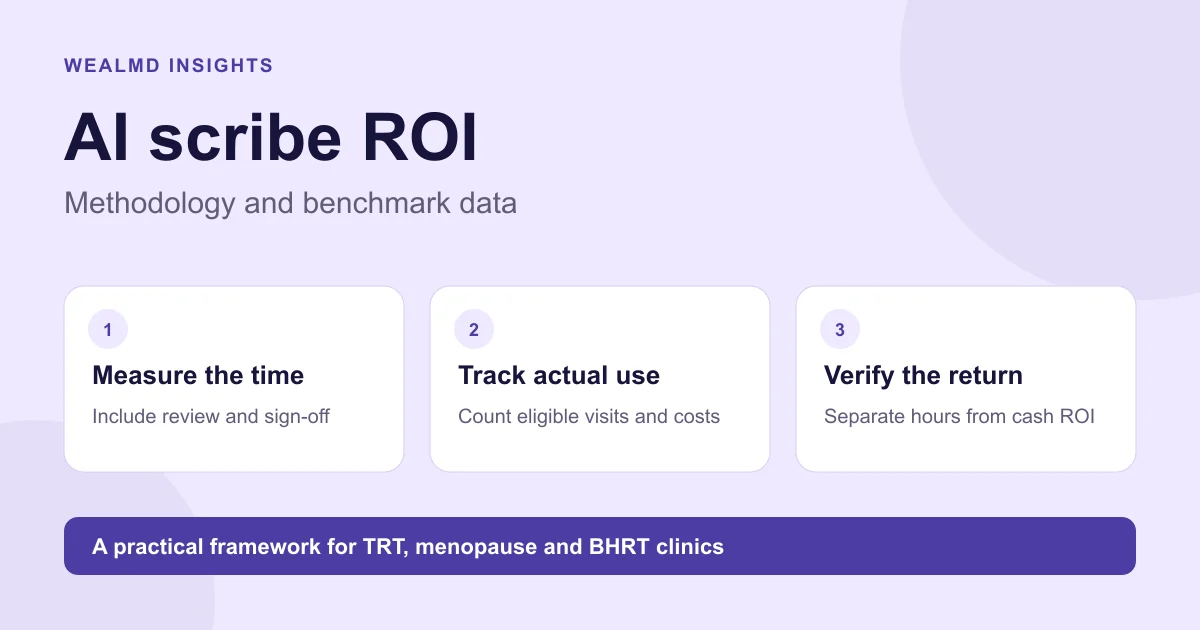
An AI scribe ROI calculator is useful only when its time savings reflect the work your clinicians actually stop doing. For an HRT clinic, the defensible starting point is a measured before-and-after documentation time per eligible visit, including the time to review, correct, and sign an AI draft. The calculator can then estimate hours released and, separately, any financial return the clinic can truly realize. It cannot turn every saved minute into cash or promise more appointments.
Key takeaways
- Measure the complete note workflow, including review, corrections and clinician sign-off.
- Scale time savings by eligible visits, clinical days and actual scribe adoption.
- Report recovered hours separately from verified cash savings or additional visit margin.
- Use published benchmarks to test assumptions, then validate the estimate in your own clinic.
What the calculator measures
This model focuses on the note-writing portion of a clinic visit. It compares the current documentation workflow with the AI-assisted workflow, then scales the difference by visit volume, clinical days, the number of clinicians, and the share of eligible visits on which the scribe is actually used. It does not credit the scribe for intake, lab review, prescribing, coding, or follow-up tasks unless those activities are separately measured and demonstrably changed.
That boundary matters in testosterone replacement therapy and menopause care. A routine follow-up, a first consultation, and a complex medication discussion may have very different note lengths. A single clinic-wide average can hide a poor fit in one visit type. Measure and model them separately when volumes justify it.
Which inputs should an HRT clinic use
Start with clinicians who will actually use the tool, eligible visits per clinician per clinical day, and clinical days per year. Exclude vacation, administrative sessions, and visit types where recording or AI drafting is not used. Adoption rate means the proportion of eligible visits with a completed AI-assisted note, not the proportion of staff who have access to a license.
For documentation time, sample representative visits before deployment and again after a short learning period. Time the entire note workflow: drafting or dictation, chart transfers, correction of the AI text, reconciliation with the record, and clinician sign-off. Do not enter zero minutes for an AI note. Record after-hours work separately, because it may move rather than disappear. Use the same measurement method and similar visit mix on both sides.
For cost, use the actual subscription quote plus implementation, training, integration, support, and ongoing quality oversight. If comparing a standalone scribe with an EMR that includes documentation assistance, allocate only the incremental cost of the workflow being evaluated. Do not treat a quoted clinician hourly rate as a cash saving unless payroll, overtime, contractor spend, or another real expense falls.
How the calculation works
Minutes saved per eligible visit equal baseline documentation minutes minus AI-assisted documentation minutes. If the result is negative, show the loss rather than silently replacing it with zero. Annual recovered hours equal clinicians multiplied by eligible visits per clinical day, clinical days per year, adoption rate, and minutes saved per visit, divided by 60. The calculator should expose each input so a clinic can test conservative and optimistic scenarios.
For example, two clinicians seeing 16 eligible visits a day over 220 clinical days, using the scribe on half those visits, and saving two measured minutes per used visit would release about 117 hours in a year. That is a hypothetical math example, not a WealMD outcome or a promise of capacity. A clinic still needs to decide where those hours go.
Financial ROI uses realized benefit, not the estimated value of time alone. Annual net benefit equals verified avoidable labor cost plus contribution margin from genuinely additional visits, minus all annual scribe costs. ROI is annual net benefit divided by annual scribe costs, multiplied by 100. Contribution margin means collected revenue less variable costs of delivering the added visit; gross billed revenue overstates the gain. Do not value the same hour both as avoided labor and as extra visit margin. If neither expense falls nor visits increase, report recovered hours as an operational benefit, but do not label them cash ROI.
What published benchmarks can and cannot tell us
Published AI scribe studies help frame a sensitivity range, not set a universal default. In a 2025 Stanford quality-improvement study of 45 physicians across eight ambulatory disciplines, the scribe was used in 55% of encounters and median time per note fell 0.57 minutes; individual results varied substantially [1]. A separate 2025 cohort study comparing 125 users with 478 balanced nonusers found 1.8 fewer mean minutes in notes per appointment, but no significant change in after-hours documentation or monthly visit volume [2].
A larger 2026 study across five US academic medical centers included 8,581 clinicians, 1,809 of whom adopted a scribe. Adoption was associated with 16.0 fewer documentation minutes per eight scheduled patient hours and 0.49 additional visits per week, while after-hours EHR time did not change significantly [3]. These are associations, not results from WealMD or HRT-only clinics. The studies differ in design, workflow, specialty mix, adoption, and what their EHR measures capture. Do not combine their estimates into a single promised time-saving percentage.
How to interpret the output
The first output should be hours recovered, with the assumptions visible. An optional time-value figure can multiply those hours by a fully loaded hourly rate, but it must be labeled opportunity value. It is not money in the bank. Only verified reductions in overtime or staffing expense, or profitable visits the clinic could not otherwise schedule, belong in the financial-return figure.
A sensitivity check makes the result more useful. Run at least three scenarios using lower, observed, and higher minutes saved per visit, while keeping adoption and all-in costs explicit. An apparently strong result that depends on near-perfect adoption, zero review time, or instantly filled appointment slots is fragile. If the clinic cannot demonstrate a route from released time to lower cost or additional margin, the business case may still be about less administrative pressure and better clinician experience, but those should be tracked separately rather than assigned invented dollar values.
How to validate the estimate in your clinic
Pilot the scribe in routine TRT follow-ups and menopause or BHRT consultations separately. Take a baseline from comparable visits, document the rollout date and training period, then sample the same measures after the workflow stabilizes. Track eligible visits, actual scribe use, note time, editing time, after-hours work, note quality issues, and any visits added to the schedule. Have clinicians review every generated note before it becomes final. Recalculate with observed inputs each month rather than leaving the original assumptions in place.
The calculator is a planning tool, not a clinical-safety assessment or a purchasing guarantee. If you are evaluating WealMD’s AI-assisted documentation, compare the complete workflow from draft through clinician review and signed chart, and request a demo using a real clinic visit type. The most credible ROI is the one your own records can reproduce.
Questions clinic operators often ask
Does less charting always mean more visits
No. A 2026 multisite study observed a small average increase in weekly visit volume, but a 2025 controlled cohort found no significant volume change [2, 3]. Extra visits require available demand, staff, rooms or telehealth slots, and a schedule that can absorb the released time. Model them only when those conditions are documented.
Should clinician pay be used as the hourly value
It can illustrate the opportunity value of time, but it is not automatically a cash benefit. A salaried clinician who finishes notes earlier may gain breathing room without reducing payroll expense. If a practice can remove paid overtime or avoid a documented contractor cost, use that specific avoidable amount in the financial case. Keep work-life and retention benefits visible as nonfinancial outcomes unless the clinic has reliable local data to price them.
References
1. Ma et al. Ambient artificial intelligence scribes utilization and impact on documentation time. JAMIA, 2025. Source
2. Pearlman et al. Use of an AI Scribe and Electronic Health Record Efficiency. JAMA Network Open, 2025. Source
3. Rotenstein et al. Changes in Clinician Time Expenditure and Visit Quantity With Adoption of Artificial Intelligence Powered Scribes. JAMA, 2026. Source