Cloud EMR for HRT Clinics: A Complete Guide for Modern Hormone Practices
If you're running an HRT clinic on software that wasn't built for hormone therapy, a cloud EMR for HRT clinics solves the three things that hurt most: nothing to install on clinic computers, secure access from any device, and a system that updates itself instead of waiting on an IT ticket.
Hormone Replacement Therapy clinics operate differently from traditional primary care practices. They manage recurring patient relationships, specialized hormone testing, telehealth consultations, ongoing treatment adjustments, controlled-substance prescribing for testosterone, and cash-pay or membership billing. As these clinics grow — often across multiple states and increasingly through telehealth — conventional EMRs built for general ambulatory medicine tend to create bottlenecks rather than solve them.
This guide explains what clinic owners should look for in a modern cloud EMR, why specialty platforms matter, and how to evaluate the best options for growing hormone therapy practices.
Disclosure: A quick disclosure: this guide references several platforms by name, including WealMD, alongside category names like OptiMantra and Cerbo. We've tried to keep the comparisons honest and general rather than promotional — verify current pricing and features directly with any vendor before you buy. For a deeper, feature-by-feature comparison of specific platforms, see our complete EMR buyer's guide for HRT clinics.
Why HRT Clinics Need a Specialized Cloud EMR
Many hormone therapy providers start out on general-purpose EMRs originally built for family medicine or hospital systems. These systems can satisfy basic documentation requirements, but they rarely handle the daily realities of hormone optimization clinics well.
HRT providers routinely manage recurring lab reviews, ongoing treatment monitoring, medication refill workflows, telehealth visits, and testosterone prescribing under DEA Schedule III controlled-substance rules — which means EPCS (Electronic Prescribing of Controlled Substances) has to work reliably, not just technically exist. Generic EMRs often support EPCS as an afterthought, with clunky two-factor workflows that slow down a busy prescribing day.
A specialized cloud EMR for HRT clinics centralizes patient records, automates administrative tasks, and reduces documentation burden while keeping compliance requirements — HIPAA, EPCS, multi-state licensure — front and center. The right platform supports growth without forcing a clinic to add administrative headcount just to keep the software running.
Key Features of Cloud-Based HRT EMR Software
Telehealth-Native Workflows and Async Intake
Virtual care is now a core part of hormone therapy delivery, not an add-on. Patients expect remote consultations, online scheduling, secure messaging, and digital intake — and many HRT clinics run substantial async intake, where patients complete detailed history and symptom forms before a visit rather than during it.
A cloud EMR built with telehealth-native architecture — rather than video bolted onto an on-premises system — lets providers run visits from anywhere while keeping full access to records, treatment plans, and lab results. That matters most for the growing number of DTC and subscription-based TRT and BHRT practices operating with minimal or no physical office space.
Lab Integration and Hormone Tracking
Hormone therapy decisions depend on lab data — testosterone, estradiol, thyroid panels, metabolic markers, and specialty hormone panels. Direct integration with lab partners like Labcorp and Quest Diagnostics (and DUTCH testing for practices that use it) lets results flow into the chart automatically instead of being scanned in and manually reconciled.
Access to historical lab trends, viewed alongside dosing history, is what actually helps providers catch patterns and adjust treatment — a static PDF result buried in a fax folder doesn't.
AI Documentation and Clinical Intelligence
AI in EMRs now spans a real range, and the distinction matters. Ambient AI scribing tools (the "AI listens to your visit and writes a note" category) save documentation time, but the note still has to be coded, checked against the treatment protocol, and turned into orders by a human. Clinical intelligence goes a step further — it can help draft ICD-10 coding, synthesize lab trends into the chart, and prepare a testosterone prescription draft for the clinician to review, rather than stopping at the transcript. WealMD's platform is built around this second, more complete model rather than transcription alone.
Whichever vendor you evaluate, ask specifically what happens after the AI produces a note — that's where the real time savings (or lack of them) show up.
Custom Templates for HRT Visits
Standard primary care templates rarely match hormone clinic documentation needs. Look for templates built for initial hormone consultations, follow-up and monitoring visits, symptom assessments, and compounded BHRT or pellet therapy protocols specifically — pellet insertion and dosing documentation in particular is a workflow generic EMRs handle poorly. Customized templates reduce documentation time and keep charting consistent across providers.
Patient Portals and Digital Engagement
Patient portals that let people complete intake forms, upload documents, review labs, schedule appointments, and message providers securely reduce administrative back-and-forth and support the recurring-relationship model most HRT clinics run on.
Compliance and Security Considerations
Because HRT clinics manage sensitive patient information and controlled-substance prescribing, security and compliance should be a top evaluation criterion, not an afterthought.
At minimum, a cloud EMR for HRT clinics should provide encrypted, HIPAA-compliant cloud storage, granular user access controls, audit logging, and a signed Business Associate Agreement (BAA). Because testosterone is a DEA Schedule III substance, confirm the platform's EPCS workflow is certified and genuinely fast to use during a visit — not just present in a features list. Many clinics also check for SOC 2 compliance, documented disaster recovery, and clear multi-state telehealth licensure support if they treat patients across state lines.
Benefits of Cloud-Based Infrastructure
No Installation, Any Device
Cloud platforms run in the browser. There's nothing to install on clinic workstations, and providers can securely access patient records from a laptop, tablet, or phone — useful for the growing share of HRT visits conducted by a provider working from home or between locations. This also removes the need for expensive on-premises servers.
Always Updated, Less IT Burden
Traditional on-premises software requires manual updates, patch cycles, and dedicated IT support. Cloud-based systems push updates automatically, so clinics get new features and security fixes without downtime or a support ticket — freeing staff to focus on patients instead of software maintenance.
Scalability for Growing Practices
A scalable cloud platform supports additional providers, locations, and workflows without a system replacement. This is particularly valuable for expanding TRT clinics, menopause clinics, and longevity medicine practices adding providers or states.
Cloud EMR and Practice Management Integration
The most effective platforms combine clinical documentation with operational tools — scheduling, intake, payment processing, reporting, and revenue management in one environment. Disconnected point solutions create duplicate data entry and more room for error.
For cash-pay and membership-based hormone clinics, this integration matters even more, since recurring billing and patient retention directly drive revenue.
What TRT Clinics Should Look For
A TRT clinic EHR needs to accommodate testosterone replacement therapy's specific rhythm: recurring follow-ups, ongoing lab monitoring (including hematocrit and PSA tracking), medication refill requests, and reliable EPCS for controlled-substance prescribing. Confirm the platform also supports telehealth, patient engagement tools, and reporting that reflects how the clinic actually operates — not a workflow built for a 15-minute primary care visit.
Choosing the Best EHR for Hormone Replacement Therapy Clinics
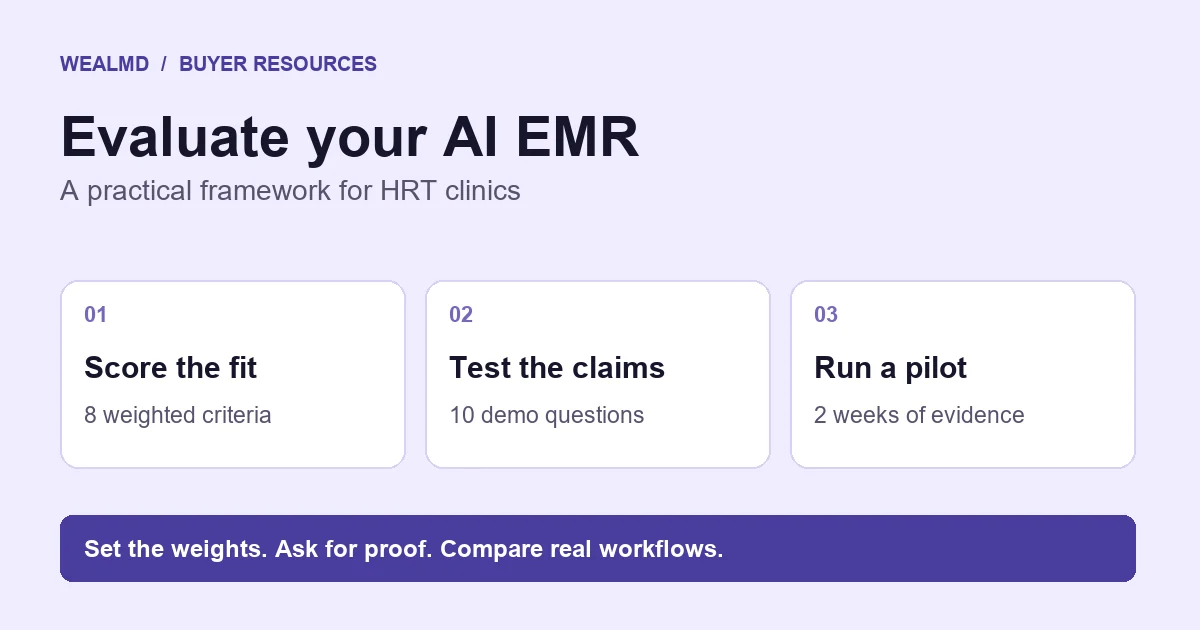
Before booking demos, it helps to have a short evaluation framework. Run any platform you're considering through this checklist:
| # | Question to Ask |
|---|---|
| 1 | Does EPCS work smoothly for testosterone prescribing, or does it add friction? |
| 2 | Can it support async intake and telehealth without a separate video tool? |
| 3 | Does it integrate directly with your lab partners (Labcorp, Quest, or specialty labs)? |
| 4 | Are templates built for HRT visits, or adapted from primary care? |
| 5 | Is pricing transparent, and does it scale sensibly as you add providers? |
| 6 | Is the vendor's compliance documentation (BAA, SOC 2, EPCS certification) available on request? |
For a full side-by-side comparison of specific vendors against these criteria, see our complete EMR buyer's guide.
Why Longevity and Anti-Aging Clinics Are Moving to the Cloud
Longevity and BHRT-focused clinics increasingly run on recurring testing, personalized treatment plans, and digital-first patient engagement rather than episodic visits. Cloud-based systems support that model by enabling flexible, remote-friendly workflows that adapt as treatment approaches and patient expectations evolve — including AI-assisted documentation and clinical intelligence built for this workflow, which we cover in more detail in our guide to AI clinical intelligence for hormone therapy.
Conclusion
Choosing the right cloud EMR for HRT clinics affects operational efficiency, patient experience, provider productivity, and long-term growth. Generic healthcare software often struggles to support hormone therapy's specific workflows — recurring testing, EPCS-compliant prescribing, telehealth-native visits, and cash-pay billing — while a specialized cloud platform brings documentation, telehealth, patient engagement, billing, and security together in one place.
Whether you run a testosterone replacement therapy practice, a menopause clinic, a BHRT program, or a longevity medicine practice, the right technology foundation is worth the evaluation time. If you'd like to see how WealMD's platform handles EPCS, async intake, and clinical intelligence specifically for HRT workflows, you can book a demo any time.
Frequently Asked Questions
What is a cloud EMR for HRT clinics?
A cloud EMR for HRT clinics is a web-based electronic medical record system built to support hormone therapy workflows — documentation, telehealth, EPCS-compliant prescribing, lab integration, and patient management — accessible from any device without local installation.
Why is cloud-based software better for hormone therapy practices?
Cloud platforms offer greater accessibility, lower infrastructure costs, easier scaling, and automatic updates compared with on-premises systems that require local installation and manual maintenance.
What features should an HRT clinic prioritize?
Reliable EPCS for testosterone prescribing, telehealth and async intake, lab integration, HRT-specific templates (including BHRT/pellet therapy), patient portals, transparent billing, and documented HIPAA/SOC 2 compliance.
Can a cloud EMR support TRT clinics specifically?
Yes. Look for platforms with EPCS built for controlled-substance prescribing, recurring lab-monitoring workflows (hematocrit, PSA, testosterone levels), and telehealth designed for cash-pay, subscription-style TRT practices.
How much does a cloud EMR for HRT clinics typically cost?
Pricing varies by vendor and provider count, but $150–$600 per provider per month is a typical range in this market. Ask any vendor for a breakdown of what's included versus billed as an add-on before comparing quotes.
Are cloud-based EMRs secure?
Reputable vendors provide encryption, access controls, audit logs, backup systems, a signed BAA, and HIPAA-aligned safeguards. Ask specifically about SOC 2 status and EPCS certification, since these aren't guaranteed just because a platform is "cloud-based."
Reviewed for accuracy by the WealMD content team (Marketing Fact-Check tier — no clinical dosing or protocol claims on this page). Last updated July 2026.
Need a cloud EMR built around hormone clinic workflows?
WealMD brings scheduling, secure records, patient engagement, billing, and AI assistance into one cloud-based operating layer for modern HRT, TRT, BHRT, menopause, and longevity clinics.