Menopause Clinic EMR: 7 Best Platforms Compared (2026)
A menopause clinic EMR should support the workflows generic systems miss. In a generic system, vasomotor symptoms land in a free-text box. Even a calculated Menopause Rating Scale score often lives in a scanned PDF. Staff track pellet due dates on sticky notes or a separate spreadsheet. The EMR cannot schedule the next refill automatically. Pharmacies receive compounded estradiol-progesterone cream orders as free-text faxes. Standard e-prescribing modules usually assume retail-formulary tablets, not custom compounds.
This menopause clinic EMR guide compares seven platforms across workflows that matter to menopause and BHRT clinics. It covers bioidentical hormone charting, pellet tracking, async symptom intake, labs, telehealth, AI documentation, and pricing. WealMD is one of the seven platforms scored here. We built this comparison as we would want a competitor to assess us: scores first, sales pitch last. Where we lose, we say so.
The same scorecard helps buyers compare HRT clinic software, BHRT EMR software, and the best EHR for hormone therapy.
We wrote this for the person actually shopping for one of these platforms. That may be a clinic owner, medical director, or operations lead who has already sat through several demos. You may have noticed that “we support women's health” often means fertility tracking with a hormone tab added later. In that case, the table and vendor breakdowns below should save you a few demo calls.
Disclosure: This comparison includes WealMD. The page shows the scorecard first and vendor-specific positioning after, so the comparison stays useful before it becomes promotional.
Which Menopause Clinic EMR Workflows Generic Systems Miss
Menopause and BHRT clinics sit in an odd gap. They are not standard OB-GYN practices that mainly chart pregnancies and pap smears. As a result, many OB-GYN-focused EHRs do not fit. They are not exactly TRT clinics either. Still, they share HRT workflows such as compounding pharmacy orders, async telehealth, and recurring lab draws.
Most menopause clinics therefore face two imperfect choices. One is a generalist integrative medicine EMR with limited menopause-specific depth. The other is women's health or hormone clinic management software still optimized for fertility and obstetrics.
Four things break in both cases.
Symptom tracking.
The Menopause Rating Scale (MRS) and Greene Climacteric Scale quantify symptoms over time. However, few general EMRs provide a structured field for either instrument. Practices may skip formal scoring or store it in a disconnected PDF.BHRT and pellet charting.
Compounded bioidentical hormones (estradiol, progesterone, sometimes low-dose testosterone) need dosage, delivery vehicle, and compounding pharmacy fields that standard e-prescribing templates don't have. Pellet therapy also needs insertion-date and due-date tracking that most EMRs never had to build.Risk documentation.
The Menopause Society's 2022 position statement frames decisions around age, timing, and individual risks. A chart should structure factors such as VTE and breast cancer history. Otherwise, teams may struggle to show consistent risk stratification across visits.Async intake depth.
Menopause symptoms fluctuate over months and years. Therefore, one new-patient form is rarely enough. The EMR should support recurring async symptom check-ins, especially for telehealth-heavy or multi-state clinics.How We Scored Each Menopause Clinic EMR
We scored each platform on six HRT EMR features that matter to menopause and BHRT clinics:
BHRT and compounding support
compounded hormone e-prescribing, pellet insertion/due-date tracking, dosing flexibility across delivery vehicles (patch, cream, pellet, oral).Async intake and symptom tracking
structured fields for vasomotor frequency, sleep disruption, and ideally MRS or Greene Scale scoring, not just free text.Lab integration
bidirectional results from major labs, with trending across visits rather than flat PDF uploads.Telehealth-native architecture
whether virtual visits are built into the core workflow or bolted on through a third-party integration.AI clinical intelligence
whether the platform helps draft documentation, code visits, or synthesize labs, versus just storing data.Pricing transparency
whether a prospective buyer can find real numbers without booking a sales call.Research came from each vendor's public site, plus G2, Capterra, and Software Advice reviews available in July 2026. We did not get sales-rep briefings from competitors. Therefore, we flag claims that lack public verification instead of guessing. Conflict of interest, stated plainly: WealMD is one of the seven platforms, and we built this page.
We did not score support quality, contract terms, implementation timelines, or uptime. Those factors vary by account size and region. Before signing, ask every vendor for references from clinics near your patient volume. A platform that suits two providers may not suit eight, and vice versa.
Comparison Table
We score each platform 1–5 on six criteria. The column abbreviations appear below the table.
| Platform | BHRT/ Pellet | Async Intake | Labs | Telehealth | AI Clinical Intel. | Pricing Transp. | Score |
|---|---|---|---|---|---|---|---|
| WealMD | 4 | 5 | 4 | 5 | 5 | 3 | 26/30 |
| OptiMantra | 5 | 3 | 5 | 4 | 3 | 4 | 24/30 |
| Cerbo | 5 | 3 | 5 | 4 | 2 | 5 | 24/30 |
| PatientNow | 3 | 2 | 3 | 3 | 2 | 2 | 15/30 |
| Praxis EMR | 2 | 2 | 3 | 3 | 4 | 4 | 18/30 |
| Charm Health | 3 | 2 | 3 | 3 | 3 | 5 | 19/30 |
| Practice Better | 1 | 4 | 2 | 4 | 3 | 4 | 18/30 |
Score = 1–5 per criterion (5 = strongest fit), Score column totals out of 30. BHRT/Pellet = compounding & pellet support. Async Intake = async intake & symptom tracking depth. Labs = lab integration & trending. AI Clinical Intel. = AI-assisted documentation, coding, and lab synthesis. Pricing Transp. = whether real pricing is published without a sales call.
Menopause Clinic EMR Vendor Breakdown
WealMD
26/30WealMD is the newest entrant on this list in the menopause and BHRT segment. It lacks the long history of pellet inventory and lot tracking that Cerbo has built. Its customer base in this niche is also smaller than OptiMantra's or Cerbo's.
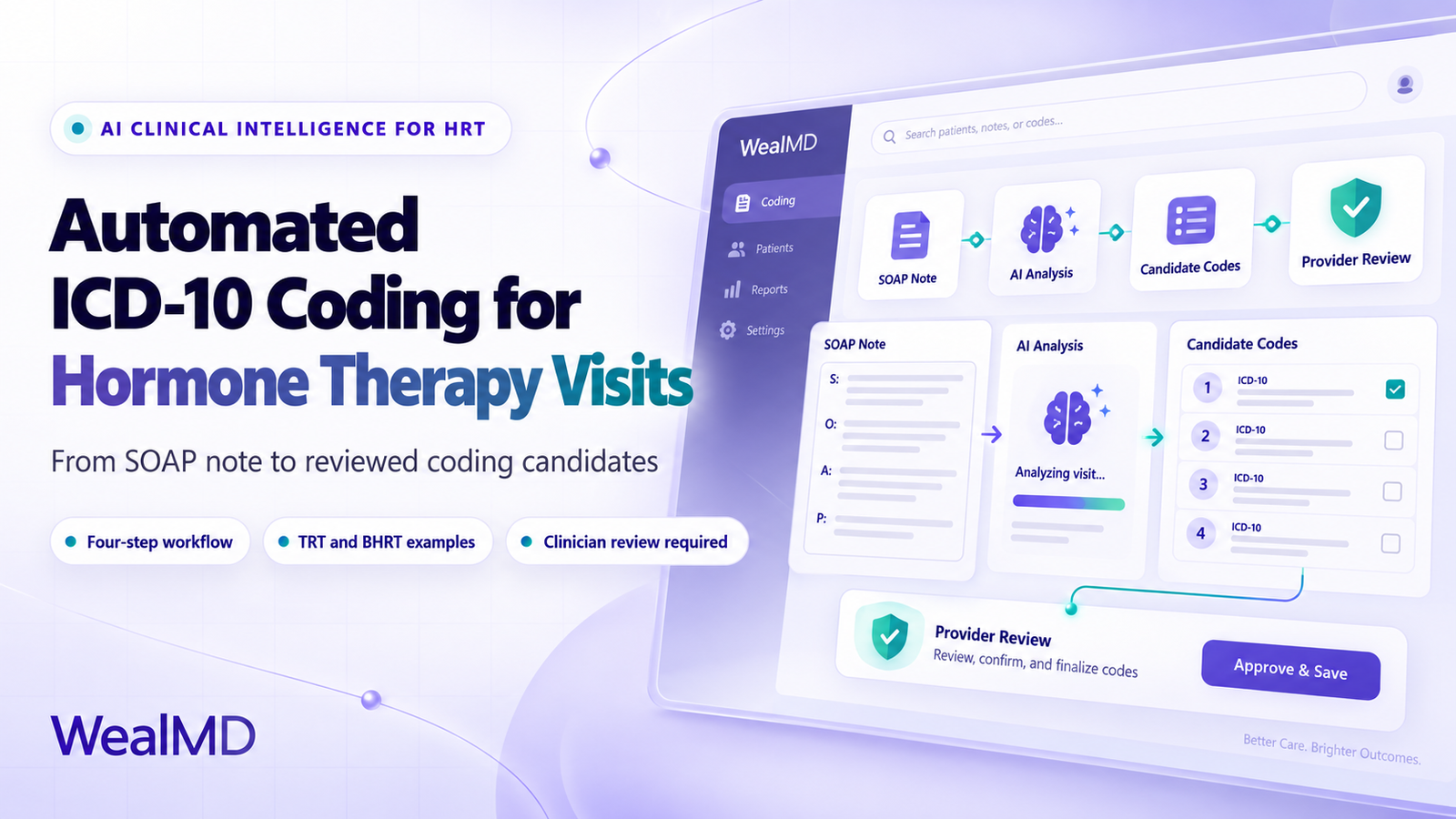
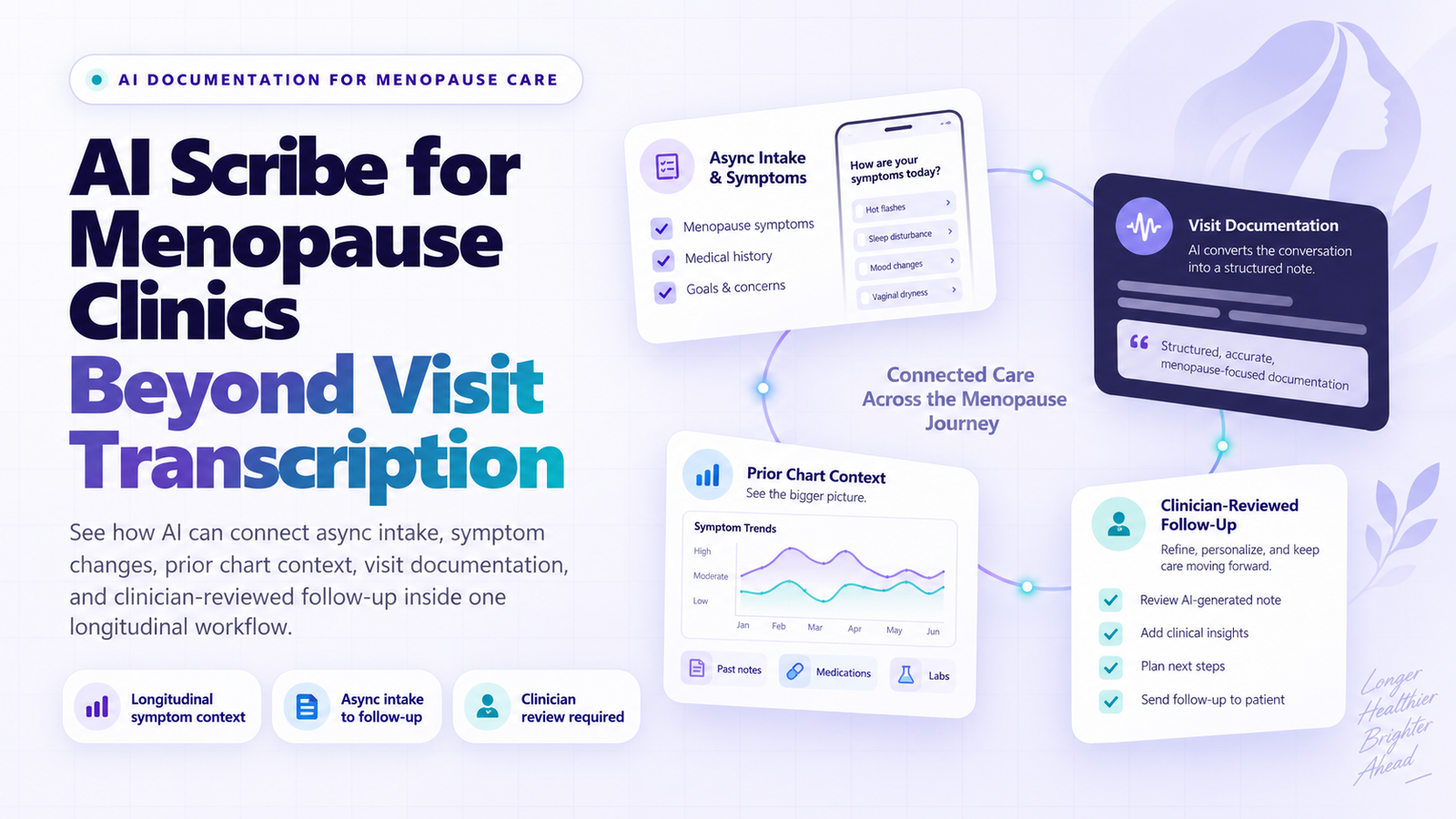
However, WealMD treats async intake as a core workflow, not an added form. Teams can configure structured symptom tracking for MRS or Greene Scale fields. Its AI clinical intelligence drafts SOAP notes, suggests ICD-10 codes, and summarizes lab trends. A clinician reviews and signs every AI-drafted note before it becomes final.
Telehealth is native rather than a Zoom plug-in. Pricing requires a demo instead of a public rate card. That limitation makes early budgeting harder. Therefore, ask about pricing in your first conversation.
OptiMantra
24/30OptiMantra is a strong fit for integrative and functional medicine clinics running BHRT. It has served this segment longer than WealMD. The platform supports e-prescribing for compounded and controlled medications. It also integrates with labs such as Labcorp, Quest, and DUTCH. Practices can adapt its charting templates for menopause-specific intake.
Also, published pricing starts at $99 per month for a first practitioner. That level of transparency is unusual in this category. The honest gap is AI documentation. OptiMantra added AI-assisted charting through a DeepCura partnership. Therefore, evaluate the integration's cost, depth, and data handling during a demo.
The async intake experience is also a general patient portal rather than a purpose-built structured symptom-tracking flow. You can build menopause-specific forms, but you're building them, not flipping a switch.
Cerbo
24/30If pellet therapy drives your practice, Cerbo has the deepest purpose-built tooling on this list. Its tracker documents pellet insertions and due dates through Health Maintenance. Cerbo also supports compounded e-prescribing and integrations with more than 50 labs.
In addition, Cerbo is highly flexible. Teams can configure intake forms and treatment plans around functional-medicine workflows. Cerbo now publishes pricing, including provider rates and setup fees. The remaining tradeoffs are its limited native AI and lack of ready-made MRS or Greene Scale templates.
PatientNow
15/30PatientNow's core identity is aesthetic medicine and med spas. Its AestheticNow HRT module adds strong CRM and marketing tools. These include automated follow-up sequences, lead tracking, and patient retention workflows.
For a menopause clinic that's primarily an aesthetics practice adding hormone services as a revenue line, that's relevant. However, it is a weaker fit when BHRT and menopause management are the primary service. We found no evidence of pellet-specific tracking, no MRS/Greene Scale templates, and no published pricing anywhere we could find.
Praxis EMR
18/30Praxis has a distinct AI advantage on this list. Its “Concept Processing” engine learns each physician's documentation style and free-text habits over time. Physician reviews on Capterra and G2 often praise that flexibility.
However, Praxis is not built around hormone therapy. It lacks compounding, pellet, and BHRT-specific templates. Its telehealth offering uses a Zoom integration instead of a native video layer. Praxis is worth a demo if you value AI-assisted, template-free charting. It is weaker when pellet tracking or compounded e-prescribing matter every day.
Charm Health
19/30CharmHealth is one of the most price-transparent platforms on this list. It offers a free tier for practices under 50 encounters per month. After that, encounter pricing starts at $0.50 per visit. EPCS and telehealth have clearly listed fees.
CharmHealth also offers Charm AI Scribe for ambient documentation. However, the platform is not menopause- or BHRT-specific. It is a general ambulatory EHR that can serve many specialties. Therefore, clinics must build hormone-specific templates and intake flows themselves.
Practice Better
18/30Practice Better excels where many EMRs are weakest: async client engagement. It combines journaling, habit tracking, program delivery, and client portal communication. It also publishes pricing in clear tiers.
The honest limitation is significant for a menopause/BHRT clinic. E-prescribing, including EPCS for controlled substances, is a paid add-on rather than a native included feature. Its lab-ordering and results capability also doesn't run as deep as Cerbo's or OptiMantra's dedicated functional-lab integrations.
As a result, Practice Better still leans toward wellness and coaching workflows. It has less depth for hormone dosing, lab-driven titration, and compounded prescribing. If your practice writes prescriptions and adjusts doses from labs, test those workflows closely during a demo.
A Note on Menopause Society Alignment
Worth saying plainly: none of the seven platforms advertises a ready-made “Menopause Society” template. The 2022 position statement emphasizes age, timing, VTE history, breast cancer history, and cardiovascular risk. Yet vendors do not market that framework as a single checkbox feature.
So what are you actually evaluating? Template and field flexibility. Your team should structure those variables once and save them as a reusable template. OptiMantra, Cerbo, and WealMD support custom template building.
Praxis approaches risk documentation through free-text learning. Ask about that workflow directly if alignment is a compliance priority. If a vendor claims to have a ready-made template, ask to see it live during the demo.
Menopause Clinic EMR Demo Checklist
A polished demo can hide the work your team will do after implementation. Use the questions below to test each platform against a real menopause workflow. Ask the salesperson to demonstrate every answer in the product. A slide deck or verbal promise is not enough.
- First, open the current intake form. Does it capture vasomotor symptoms, sleep, mood, cognition, and treatment goals as structured fields?
- Next, repeat the symptom assessment. Can patients complete the same questionnaire before follow-ups? Can clinicians compare scores across visits?
- Then, build a compounded prescription. Test dose, delivery method, pharmacy, refills, and instructions. Note any step that requires free text.
- For pellet therapy, run a complete workflow. Show insertion history, lot data, dose, site, and the next due date.
- After that, open longitudinal labs. Trend results from major and specialty labs. Confirm that staff do not need separate PDFs.
- Also, start a virtual visit. Follow intake, consent, documentation, prescribing, and follow-up. Count the third-party logins the workflow requires.
- Then, test AI documentation. Draft a note from a realistic menopause encounter. Ask which fields require review and where edits appear.
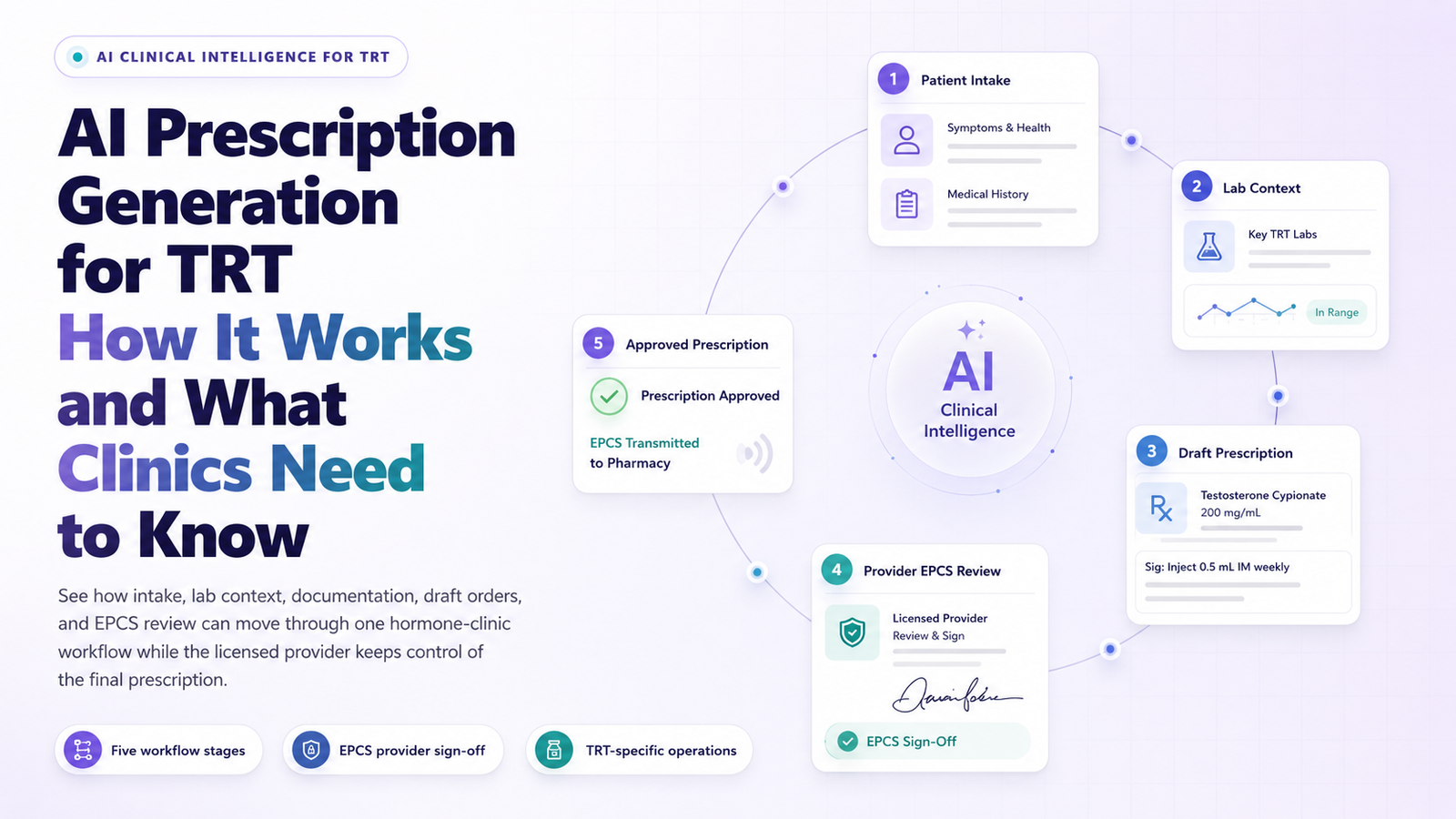
- If relevant, run a testosterone scenario. Verify EPCS, PDMP access, identity proofing, and the audit trail.
- Next, build a risk template. Save timing, VTE history, breast cancer history, and cardiovascular risk as reusable structured fields.
- Finally, request the complete price. Include migration, training, integrations, eRx, EPCS, telehealth, AI, support, and contract termination costs.
- Before signing, review a sample migration. Which records remain structured after import? Which arrive as flat PDFs or document attachments?
- Finally, test the mobile experience. Complete intake, upload a document, join video, and send a portal message from a phone.
Bring one de-identified intake form, one sample lab panel, and one representative follow-up note to every demo. Use the same materials with all seven vendors. That approach creates a fair comparison and exposes configuration work before you sign a contract.
Finally, record each answer while the demo is fresh. Note whether the feature exists today, requires paid configuration, or sits on a roadmap. Also separate one-time setup work from recurring staff effort. A flexible form builder may look impressive. However, your team still pays for every template it must design, test, and maintain. Therefore, treat “configurable” as a cost until the vendor shows a finished workflow.
Decision Framework: Who Should Pick What
One buying tip applies across every platform: request a live menopause or BHRT intake form during the demo. Do not settle for a generic walkthrough of the form builder. “You can build that” and “here it is, built” are different answers. The gap between them often turns weeks of implementation into months.
Conclusion
There is no single best menopause clinic EMR for every practice. Instead, the best fit depends on what your clinic actually does. A pellet-heavy BHRT practice needs different tools from an aesthetics clinic adding hormone services. Both buyers may start with the same search, but their priorities differ.
Score your priorities against the six criteria above. Also, ask each vendor about Menopause Society-aligned template flexibility. Do not accept “we can build that” as an answer to “does this exist today?”
The best hormone replacement therapy software should match your real intake, prescribing, and follow-up workflows. To test WealMD's async intake and AI clinical intelligence, book a demo and bring your current form. We will show the workflow inside the platform, not a generic product tour. For a step-by-step process, see our EMR decision framework for HRT clinics.
Running a BHRT-only practice, a TRT practice, or both? See our companion guides:
Frequently Asked Questions
Do menopause clinics need EPCS the way TRT clinics do?
Less often. Most menopause BHRT uses estradiol, progesterone, combination patches, or creams that are not DEA-scheduled. Therefore, EPCS is not the same hard requirement as it is for testosterone clinics. However, a clinic that prescribes testosterone or another Schedule III compound still needs EPCS.
What is BHRT charting and why do generic EMRs struggle with it?
BHRT charting records the dosage, delivery method, and compounding pharmacy for each prescription. Those details support accurate refills and pharmacy fulfillment. Generic e-prescribing templates focus on standardized retail drugs rather than custom compounds. As a result, practices may fall back to slower free-text fax orders.
How does an EMR support Menopause Society-aligned documentation?
No platform we reviewed advertises fields mapped directly to the Menopause Society's 2022 position statement. Instead, teams can build a reusable intake and visit template. It should capture age, years since menopause onset, VTE history, breast cancer history, and cardiovascular risk. That structure helps each chart document the assessment, not only the prescription.
What should a menopause clinic's async intake actually capture?
At minimum, capture vasomotor symptom frequency, sleep disruption, mood, and cognitive symptoms. Ideally, add a structured Menopause Rating Scale or Greene Climacteric Scale score. Async intake collects this information before the visit. Therefore, clinicians can spend more appointment time on treatment planning.
How much does a menopause clinic EMR typically cost?
Published entry prices vary widely. CharmHealth has a limited free tier and then charges from $0.50 per encounter. OptiMantra starts at $99 per month for the first practitioner. Cerbo lists $281 per month for a full-time prescribing provider, plus a setup fee. PatientNow and WealMD use quote-based pricing. Always request a complete quote because add-ons can materially change the total.
How long does it take to migrate a menopause clinic to a new EMR?
Plan on four to eight weeks for a clinic with one to three providers. Migration may take longer when years of pellet records need manual entry. Run both systems in parallel for two or three weeks of live visits. Also, confirm how the vendor imports historical lab trends. Those records often become flat PDFs instead of usable data.
Need a menopause clinic EMR built around async intake and hormone workflows?
Bring your current menopause or BHRT intake form to a WealMD demo. See how the platform connects intake, documentation, lab review, and AI assistance in one structured workflow.