BHRT EMR Software Built for Bioidentical Hormone Practices
WealMD is the only AI-native EMR designed for BHRT workflows, pellet therapy charting, compounding pharmacy integration, and bioidentical hormone tracking built in from day one.
Pellet Therapy Charting
Document pellet insertion procedures with pre-built templates for dosing, placement, and follow-up.
Compounding Pharmacy Integration
Send BHRT prescriptions directly to compounding pharmacies with accurate compound formulations.
BHRT Protocol Templates
Pre-built visit templates for initial consult, pellet insertion, and hormone adjustment visits.
AI Lab Synthesis
Auto-summarize hormone panels including estradiol, progesterone, testosterone, DHEA, and thyroid markers.
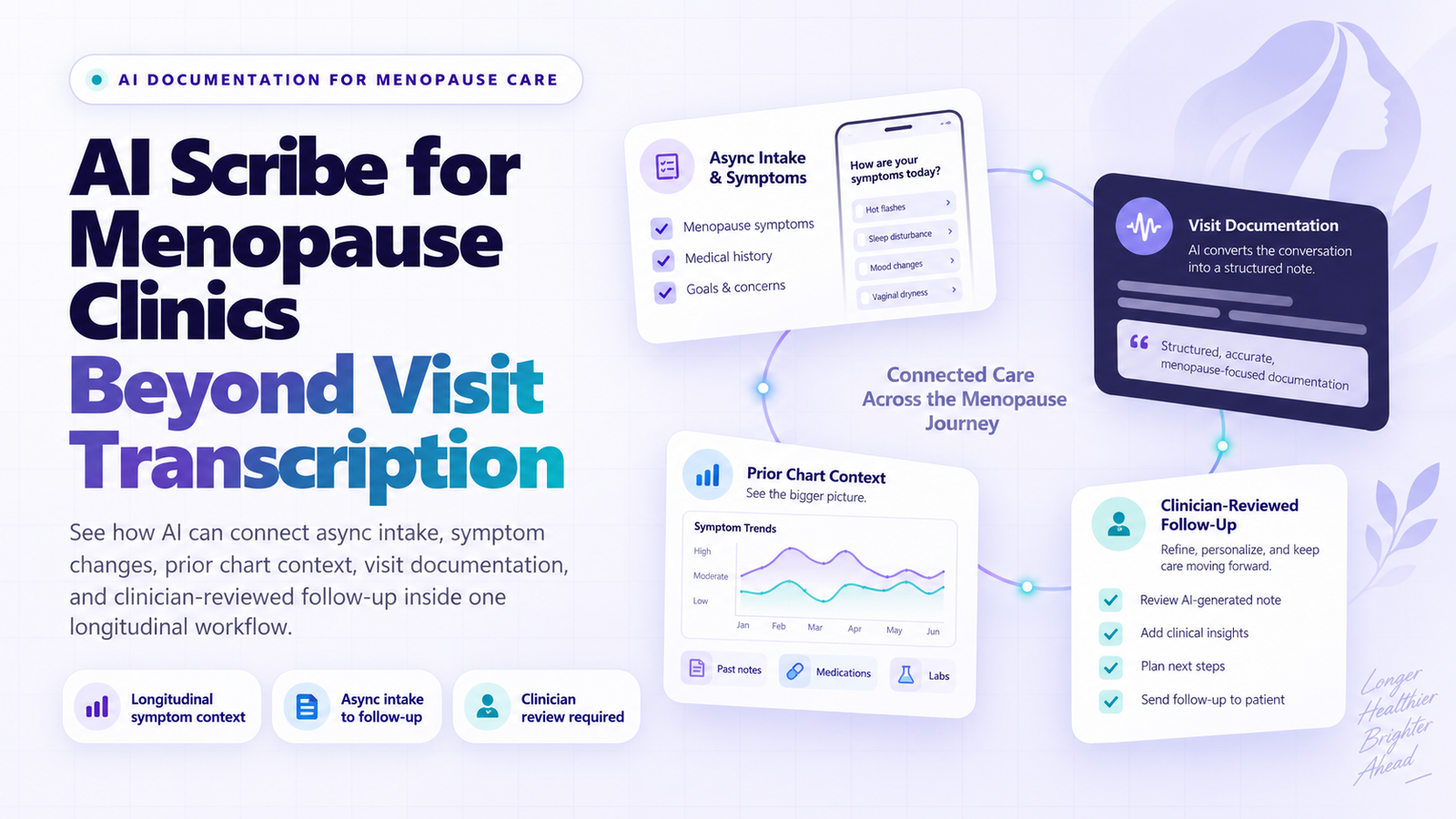
Async Patient Intake
Collect symptom questionnaires, consent forms, and prior labs before the visit — no back-and-forth needed.
EPCS Compliance
E-prescribe testosterone and other controlled substances with a full DEA audit trail built in.
You're running a BHRT clinic — or evaluating whether to launch one — on an EMR that wasn't built for bioidentical hormone replacement therapy. The scheduling works. The notes save. But compounding pharmacy orders live in a separate system, pellet insertion charting is a workaround, and every testosterone follow-up takes twice as long as it should because your templates were designed for a primary care visit.
This guide gives you a working framework for evaluating EMRs against the specific operational realities of a BHRT practice: compounding pharmacy integration, pellet therapy charting, bioidentical hormone tracking, EPCS for controlled substances, and the async-heavy patient flows that define modern hormone optimization clinics.
We've scored seven platforms honestly across six criteria. WealMD is one of them. Our limitations are listed explicitly.
- Why generic EMRs create friction in BHRT workflows — and which specific failure modes matter most
- 6 evaluation criteria for BHRT-specific EMRs
- Honest head-to-head comparison of 7 platforms (with scores)
- Pricing and total cost of ownership reality
- Migration guidance and 12 questions to ask in every EMR demo
Why Generic EMRs Fail BHRT Clinics
BHRT practices operate on a fundamentally different clinical model than the acute-care and primary-care workflows that most EMRs were designed around. The gaps aren't subtle.
No Compounding Pharmacy Integration
Bioidentical hormone therapy relies heavily on compounding pharmacies. Most generic EMRs treat compounding as an afterthought — the prescriber writes a note, someone copy-pastes the prescription into a separate portal, and the order is tracked in a spreadsheet.
Pellet Insertion Charting Is a Workaround
Pellet therapy requires procedure documentation that generic templates handle poorly. In most general-purpose EMRs, pellet insertion is documented as a free-text note — no structured recall, no lot-number tracking, and no clean audit trail.
EPCS Is Often Weak
Testosterone is DEA Schedule III — EPCS isn't optional. Many general-purpose EMRs treat EPCS as a bolt-on feature that's technically available but clunky in practice for high-volume BHRT or TRT workflows.
Lab Integration Too Shallow
A BHRT follow-up requires reviewing a full hormone panel — testosterone, estradiol, progesterone, SHBG, LH/FSH, thyroid, CBC, and metabolic panel. Generic EMRs rarely surface these values in the right format at the right time.
Async Intake Is an Afterthought
Telehealth-first BHRT practices rely heavily on asynchronous patient intake — comprehensive symptom assessments and health history questionnaires collected before the visit. Generic EMRs don't support structured async intake workflows.
6 Evaluation Criteria for BHRT EMR Software
Use these six criteria to evaluate any EMR against BHRT-specific requirements. For each criterion, we've noted what "good" looks like and the questions to ask in a vendor demo.
EPCS Depth
Look for EPCS fully embedded in the prescribing workflow — not a separate module or third-party redirect. Should support DEA two-factor authentication (biometric or hard token), comprehensive audit logs, and PDMP integration.
Async Patient Intake
Structured pre-visit questionnaires configurable for hormone therapy assessments — symptom burden, menstrual history, sexual health, sleep, energy, libido, mood. Intake data should flow directly into the chart note without manual transcription.
Lab Integration Breadth
Bidirectional integration with Labcorp and Quest at minimum. Trend view for hormone panels across visits. DUTCH test support is a significant differentiator. Ability to set hormone-specific reference ranges rather than relying on standard lab intervals.
AI Clinical Intelligence
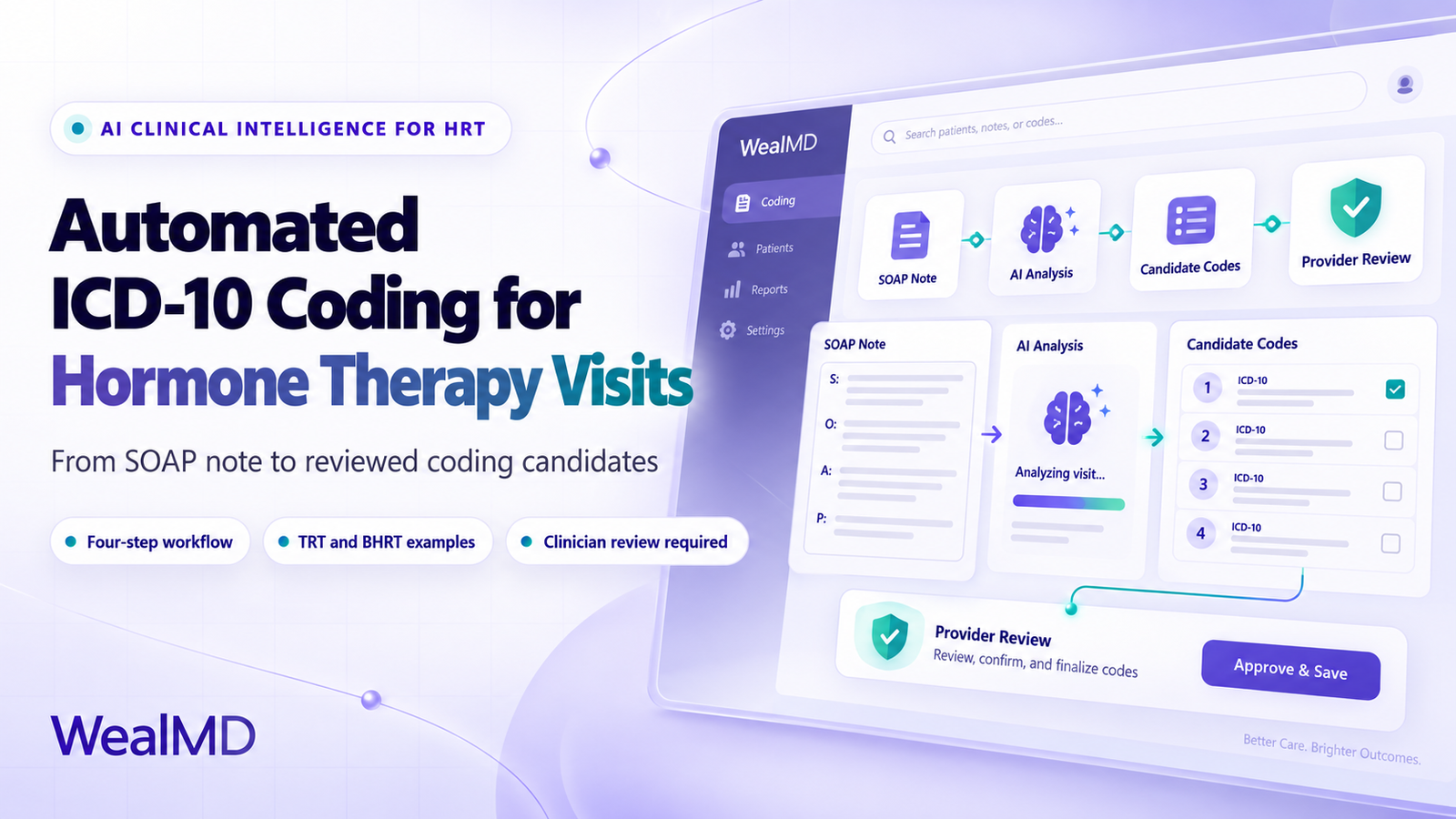
The key distinction: an AI scribe transcribes the visit; AI clinical intelligence generates the SOAP note, auto-codes ICD-10, drafts the prescription, and synthesizes labs into the assessment. For BHRT practices, AI that understands hormone therapy visit patterns is meaningfully more useful than generic ambient transcription.
Telehealth Architecture
Telehealth built into the platform, not a Zoom or third-party embed. Async-first workflows — so clinicians can manage patient follow-ups, review labs, and send prescriptions without a synchronous video visit for every interaction. Multi-state licensure support for DTC telehealth BHRT practices.
Compounding & Pellet Therapy Support
Direct integration with compounding pharmacies (or at minimum structured compounding prescription templates with lot tracking). Pellet insertion procedure templates that capture dosage, lot number, insertion site, and depth in structured fields — not free text.
7-Platform Comparison: Honest Scores Across 6 BHRT Criteria
Scored on a 1–5 scale (5 = purpose-built; 1 = not supported or significant workaround required). Research: G2 and Capterra reviews, vendor documentation, direct demos, and customer interviews as of Q2 2026.
| Feature | WealMD | OptiMantra | Cerbo | PatientNow | Charm Health | Practice Better | Praxis EMR |
|---|---|---|---|---|---|---|---|
| EPCS / Controlled Rx | ✔ Full | Limited | Basic | Limited | ✗ | ✗ | Limited |
| Async Intake | ✔ Native | Add-on | Partial | Add-on | Basic | ✔ Strong | ✗ |
| Lab Integration | ✔ Labcorp + Quest | ✔ | ✔ | Limited | ✔ | Limited | ✔ |
| AI Clinical Intelligence | ✔ End-to-end | ✗ | ✗ | ✗ | ✗ | ✗ | "Concept" only |
| Telehealth Native | ✔ | Add-on | Basic | Add-on | Basic | ✔ | ✗ |
| Pellet / BHRT Charting | ✔ Specialty | Partial | Partial | Limited | Generic | Generic | Manual |
| Compounding Pharmacy | ✔ Integrated | Manual | Manual | Manual | ✗ | ✗ | Manual |
| Price / Provider / Mo | $250–$450 | $149–$299 | $150–$300 | $299–$599 | $79–$199 | $59–$199 | $99–$249 |
| Score (out of 6) | 5.5 / 6 | 3 / 6 | 3 / 6 | 2.5 / 6 | 2 / 6 | 2.5 / 6 | 2 / 6 |
Vendor-by-Vendor Breakdown
An honest look at each platform — strengths, weaknesses, and who it's actually built for.
WealMD
Best for BHRTBuilt specifically for hormone therapy and wellness clinics. The platform combines end-to-end AI clinical intelligence — SOAP generation, automated ICD-10 coding, and prescription drafting — with native EPCS, compounding pharmacy integration, and telehealth-first async workflows. Pellet insertion charting uses structured templates, not free text.
OptiMantra
Integrative ClinicsThe most established platform in the integrative and wellness EMR space, with a substantial installed base and a broad feature set. Handles scheduling, billing, telehealth, and patient communication competently.
Cerbo
Functional MedicineHas a loyal following in the functional and integrative medicine community. Customizable, supports direct-pay practices, and has decent lab integration.
PatientNow
Aesthetics + HRTBuilt its reputation in aesthetic medicine — med spas, plastic surgery, and cosmetic dermatology — and has since expanded to include hormone therapy services. The CRM and patient communication tools are genuinely strong.
Charm Health
Budget OptionAn affordable, broadly functional EMR with decent feature breadth for the price point. Handles basic scheduling, billing, labs, and patient communication.
Practice Better
Coaching / WellnessWell-regarded in the health coaching and functional nutrition space. Clean UX, strong client communication tools, and solid scheduling.
Praxis EMR
Highly CustomizableTakes a distinctive approach — instead of templates, it uses "concept processing" where the EMR learns from how each clinician documents over time. Has a loyal user base that values its flexibility.
At-a-Glance: Who Should Pick What
A quick-scan summary of each platform's fit, strength, gap, and our honest read.
Pricing & Total Cost of Ownership Reality
EMR pricing is rarely what it appears on the pricing page. The monthly per-provider subscription is the most visible number — but implementation costs, training fees, and the cost of disconnected systems matter more over a 3-year horizon.
Typical Price Ranges (per provider, per month)
- Practice Better$59–$199Not a prescribing EMR — exclude if EPCS is required
- Charm Health$79–$199Lowest cost, lowest HRT-specific capability
- Praxis EMR$99–$249
- OptiMantra$149–$299
- Cerbo$150–$300
- WealMD$250–$450AI-native, specialty-focused
- PatientNow$299–$599Highest cost, aesthetic-first positioning
Hidden Costs to Ask About
ROI Framework for BHRT Practices
For a 2-provider BHRT practice seeing 80 hormone patients per month, documentation time savings alone can justify a higher-cost EMR.
If AI clinical intelligence reduces per-visit documentation from 8 min → 2 min — a conservative estimate based on published AI scribe benchmarks — that's:
6 min × 80 visits × 2 providers = 16 hours/month recovered. At $150/hr clinical time, that's $2,400/mo in recaptured clinician time versus a monthly EMR cost delta of $200–$300.
The Migration Question: What to Expect
Migrating EMRs is disruptive. Here's what most clinics underestimate.
12 Questions to Ask in Every BHRT EMR Demo
These questions will surface meaningful differences between platforms faster than any feature checklist.
- 01Walk me through a testosterone cypionate EPCS prescription from chart note to pharmacy confirmation. How many clicks?
- 02How does your platform handle DEA two-factor authentication — hard token, biometric, or both? What does PDMP integration look like in this workflow?
- 03Show me how a compounding prescription is generated and sent from the chart. What data fields are captured?
- 04Where is pellet insertion documented? Show me the template and how dosage, lot number, and site are captured.
- 05Show me a patient's testosterone and estradiol trend across three visits. What does that view look like?
- 06Do you support DUTCH test result import? What lab partners are you integrated with?
- 07After a 15-minute BHRT follow-up visit, what does the AI generate automatically? What does the clinician still need to do?
- 08How does the AI handle ICD-10 coding for hormone therapy visits? What's the accuracy rate on your platform?
- 09Can a clinician complete a hormone follow-up — review labs, adjust a prescription, and bill the encounter — asynchronously without a video visit?
- 10What does a patient's pre-visit hormone intake assessment look like, and how does that data flow into the clinical chart?
- 11What's the typical data migration timeline from [current EMR]? What data can and can't be migrated?
- 12What support is included post-launch? What's the average response time for an urgent support issue?
Conclusion
The right BHRT EMR isn't the one with the longest feature list — it's the one that handles compounding prescriptions, pellet charting, controlled substance prescribing, and hormone lab review without workarounds.
Generic EMRs can technically support a BHRT practice. But the friction — manual compounding orders, free-text pellet notes, clunky EPCS flows, shallow lab trending — compounds across every patient encounter. At 30 patients a month that friction is manageable. At 150 patients a month it's a growth ceiling.
If you're in early-stage evaluation, use the 12 demo questions above to pressure-test vendor claims against your actual workflow. The answers will tell you more than any pricing sheet.
A BHRT-Specific Demo Is Available
WealMD offers a guided demo specifically for BHRT clinic workflows — including live walkthroughs of pellet insertion charting, compounding pharmacy integration, and EPCS for testosterone.
Frequently Asked Questions
Explore WealMD
Book a demo or discovery call to see how our multi-location EMR solution can support your practice—no commitment required
WealMD Software Updates
Automated ICD-10 Coding for Hormone Therapy Visits